It is a Tuesday evening, and you have been turning a small thing around all afternoon. A colleague said something at lunch that landed harder than it should have, and you have been holding it for three hours. Then the door opens and your partner walks in mid-thought about a podcast, an article he half-read on the train, what he might do at the weekend, three subjects in the first thirty seconds. He glances at you, asks if you are alright, and you say "yeah, fine" before you have thought about the question. He takes it at face value and carries on with the podcast theory. Twenty minutes later, in the bath, you half-wish he had asked again. He didn't. He is not a mind-reader. You did not, strictly, lie.
Next morning you open a tab. The first site tells you Cancer and Gemini are a hard match. The second calls it emotional versus intellectual. The third concludes that "communication is key", which is what people say about every pair when they have nothing else to say. None of the three names what just happened in the kitchen.
Here's the honest version. Cancer and Gemini sit roughly thirty degrees apart on the zodiac, what astrologers call a semisextile, the adjacent-signs aspect. That thirty-degree gap is the structural reason for the small recurrent missed beat, and it isn't either sign's fault. Cancer is ruled by the Moon, which feels first; Gemini is ruled by Mercury, which talks first. Both responses are legitimate. The work the pair has to do is translation.
In short. Cancer and Gemini sit about thirty degrees apart on the zodiac, a semisextile, the adjacent-signs aspect. Underneath the friction is a Moon-versus-Mercury rulership pair: feeling-first meeting talking-first, neither defective. Whether the dynamic settles or stays awkward is decided lower in the chart, by the Moons, the Mercury contacts, where Venus and Mars sit between you. One structural footnote nobody says aloud: Cancer-Gemini pairs often work much better in a shared-activity context (a book club, a cooking class, a project) than in unstructured face-to-face, because a third thing between you absorbs the asymmetry.
 "Fine" — and the small missed beat that follows.
What the compatibility sites get right (and what they leave out)
The hard-match framing is half-true. Cancer and Gemini really do sit at an angle that creates friction. What it leaves out is the angle's name, the reason for it, and what the pairing brings back.
Your Sun sign is roughly one tenth of your chart. The Sun describes your basic sense of self, but the rest of the chart describes the rest of you: how you handle a long silence, what makes you feel safe, who you become when you stop performing for anyone. Two people can have an awkward Sun-sign click on paper and an easy underlying climate in practice. The opposite happens too. Synastry, the proper word for compatibility used by working astrologers, takes both whole birth charts, ten planets each, and reads the dynamic between them. It tells a far more useful story than any Sun-sign table.
If you want to know what each sign means as an individual, the twelve zodiac signs explained covers the personal traits side. This piece is about what happens between the two of them.
The semisextile, named
Cancer and Gemini sit roughly thirty degrees apart on the zodiac. In astrology, the angular distance between two points is called an aspect, and an aspect of thirty degrees is called a semisextile, the adjacent-signs aspect.
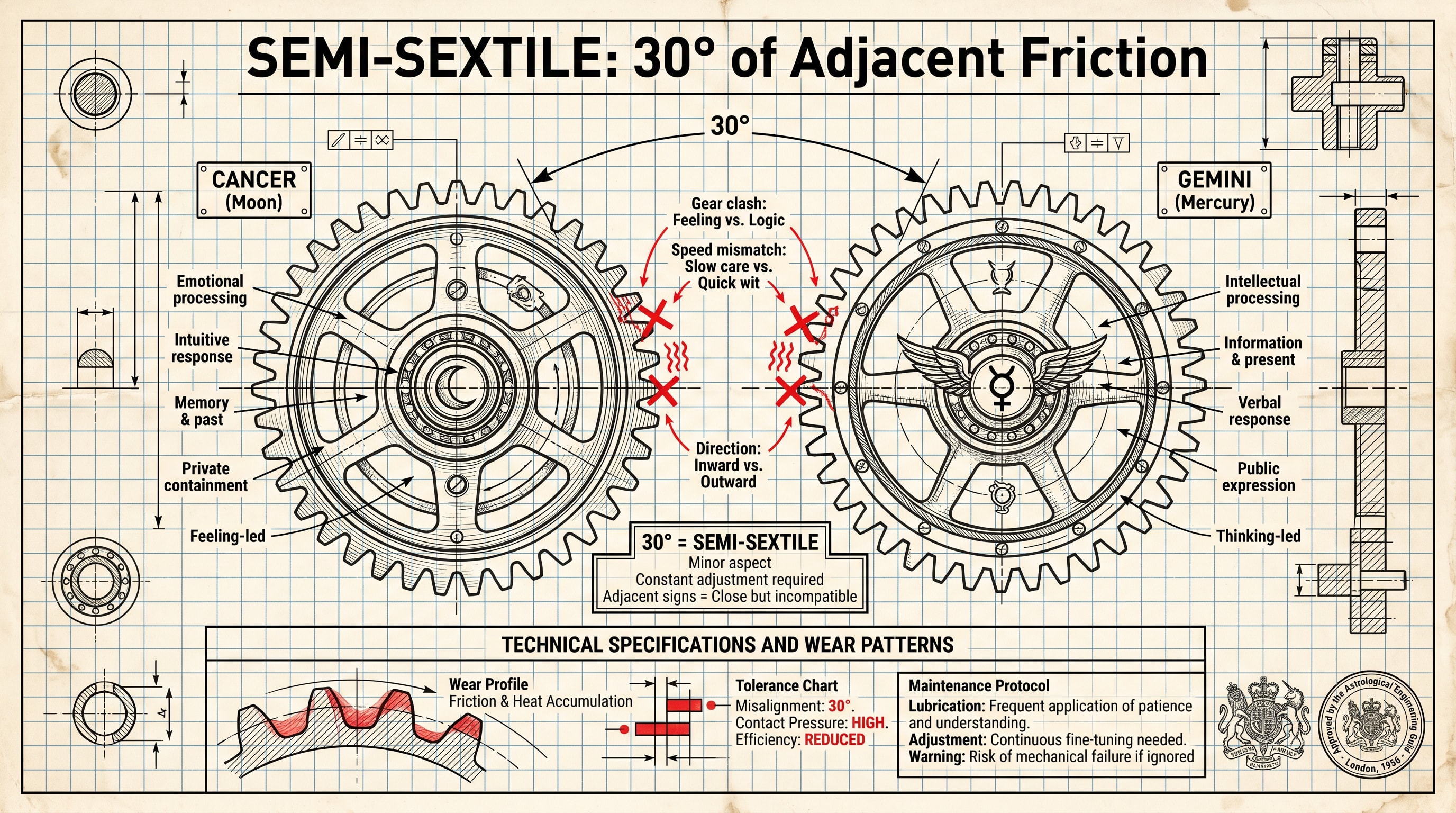
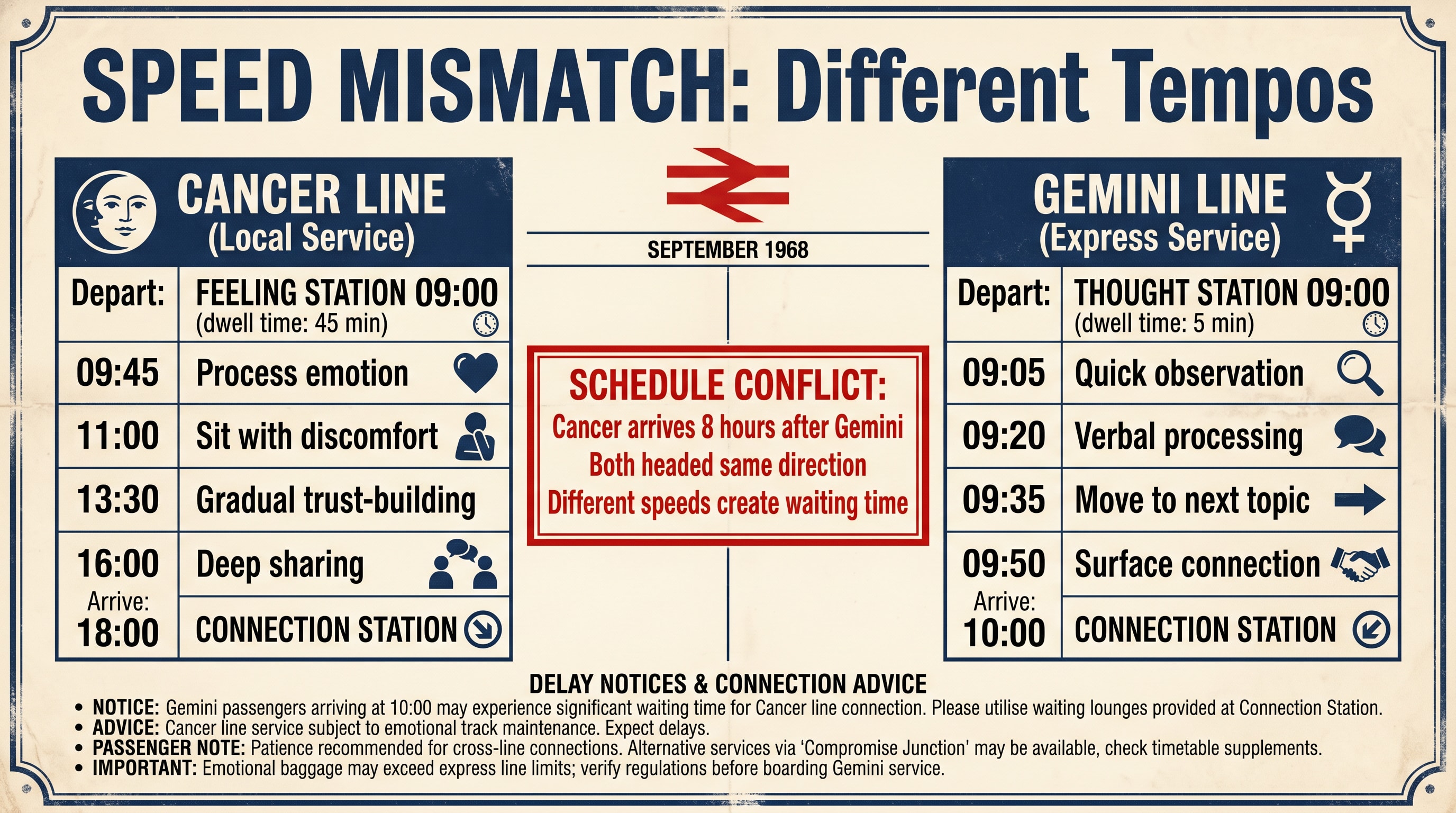
A semisextile is not an opposition (two signs facing each other across the wheel) and it is not a trine (two same-element signs relaxing into each other from a hundred and twenty degrees away). It sits in a much smaller and more uncomfortable space. The two signs are next-door neighbours on the wheel but share neither element nor modality. Cancer is cardinal water; Gemini is mutable air. The semisextile is the geometry of awkward closeness, close enough to feel each other constantly, different enough that neither quite speaks the other's first language.
Astrologers describe semisextiles as the aspect of borders. Two adjacent signs share a literal line on the wheel, and each carries the thing the other doesn't. Gemini has the words Cancer is sometimes still finding. Cancer has the emotional patience Gemini's quick mind sometimes skips. The friction is not a verdict; it is a description of being neighbours in this particular way.
Moon meets Mercury — feeling first, then talking first
Cancer is ruled by the Moon, the part of you that feels first. Gemini is ruled by Mercury, the part of you that talks first. Same situation, two different first responses.
A Moon-ruled person reads the room before naming it. The honest answer happens at the speed of feeling, which is slower than the speed of speech. Asked "are you alright?" by someone walking through the door, the Moon-ruled answer is the literal social check-in. The bigger answer is still coming; it will arrive in an hour, in a different room, possibly without being asked for again.
A Mercury-ruled person talks the room into existence. Words are not the report of a thought; they are the thought happening. Mid-sentence revisions are normal, not vague. The Mercury-ruled person takes the literal answer at face value and moves on, because that is how they would themselves answer a quick social check-in. If there were a real thing to say, they would have said it.
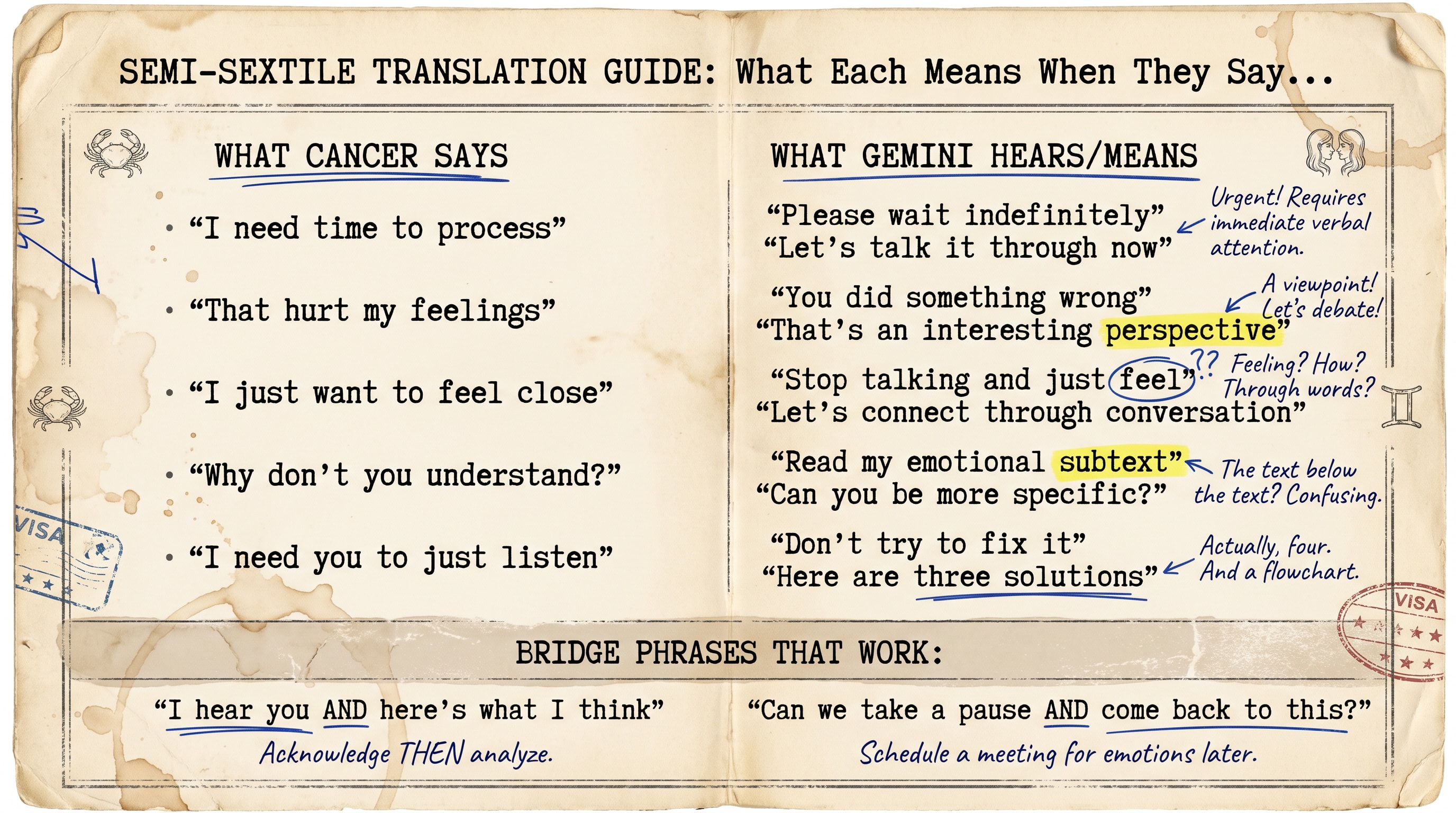
The classic moment in a Cancer-Gemini pairing is the one in the kitchen: "I asked how you were and you said fine but you weren't". Neither person failed. Cancer answered the question that was actually asked. Gemini took the answer at face value. Two operating systems doing what each does well, missing each other by about thirty degrees.
The semisextile asks of this pair a deliberate second pass. Gemini learns to ask the question twice when the first answer was suspiciously quick. Cancer learns to volunteer the second-pass answer without waiting to be asked again. Couples who learn the move tend to stop noticing the gap at all.
The "shared activity" pattern nobody surfaces
Cancer-Gemini pairs often discover, by accident, that they work much better in a shared-activity context — a book club, a cooking class, a creative project, a piece of admin to do together — than in unstructured face-to-face.
This is the thing the SERP never names. The semisextile asymmetry is loudest when two people sit opposite each other with nothing to do but talk. Drop a third thing into the middle (a book, a recipe, a small problem to solve together) and the asymmetry inverts. For the Cancer half, the shared activity provides emotional containment without the pressure of being looked at directly. For the Gemini half, it gives the mind something to do with itself, so the talking becomes considered rather than rapid-fire. Both do their best work next to each other rather than at each other.
A typical Cancer-Gemini failure mode is the long sit-down date night designed to "sort the relationship out", where the pair tries to negotiate the asymmetry head-on and finds it gets louder the more they pull on it. A typical working pattern is parallel play: the two of them in the same room with separate books, occasionally reading a sentence aloud, occasionally going quiet. The shared activity is the engine; the semisextile is the friction the engine pushes against to keep moving.
What synastry actually checks for Cancer and Gemini
Whether a particular Cancer-Gemini pairing settles or stays awkward is decided lower in the chart than the Sun. Five things do the work.
The Moons are the foundation, what each of you needs in order to feel safe. The cross-rulership exchange is the one to watch for in this specific pair: a Cancer with a Mercury-flavoured Moon in Gemini, Libra or Aquarius brings words to feeling and softens the asymmetry from one side; a Gemini with a Moon-flavoured Moon in Cancer, Scorpio or Pisces brings feeling to thought and softens it from the other. Either mirror does more than any compatibility article admits.
Mercury and Moon contacts carry extra weight in this specific pair because they are the ruling planets of the two signs. Anything between one person's Mercury and the other's Moon is what the semisextile is really about, played out at the planetary layer.
Venus and Mars are the chemistry layer, what pulls two people across an awkward angle and into morning coffee. Saturn, if it touches either chart's personal planets, gives the relationship the structure to survive its own friction. The Ascendants, what each of you looks like at hello, often sit somewhere different from the underlying dynamic, which is why first impressions in this pair sometimes mislead in both directions. The full synastry guide walks through all five layers in detail.
One real-feeling worked example
Two people, illustrative, not a real couple. Let's call them Maya and Sam. They met at a Wednesday-evening book club at the local library, which is a detail the rest of this section is going to come to matter for.
Maya — Sun in Cancer, Moon in Gemini, Mercury in Cancer, Venus in Leo, Mars in Taurus, Rising in Pisces. Sam — Sun in Gemini, Moon in Cancer, Mercury in Gemini, Venus in Taurus, Mars in Cancer, Rising in Libra.
Start with the Suns, where the article started. Maya's Cancer Sun and Sam's Gemini Sun sit thirty degrees apart, the semisextile already described. That's the geometry. Now read what's under it.
The Moons next. Maya's Moon is in Gemini. Sam's Moon is in Cancer. Each one's Moon sits in the other's Sun sign. Astrologers call this a Moon-sign exchange, and it is one of the strongest softening moves a semisextile pair can have. Her feelings have words in them; his thinking has feeling in it. The asymmetry the Suns set up is half-resolved at the Moon layer before the conversation has even started.
The Mercurys repeat the Sun pattern. Maya's Mercury sits in Cancer, Sam's in Gemini, the same thirty degrees apart, and the semisextile shows up again at the language layer. So when they are trying to talk through something on a Sunday evening, the same thirty-degree gap reappears as the gap between how he says a thing and how she hears it. This is where the Moon exchange earns its keep. Because each carries the other's first language as their Moon, the translation happens half-automatically.
Venus and Mars give them their chemistry. Sam's Venus in Taurus and Maya's Mars in Taurus sit in the same sign, a conjunction, the strongest planetary contact there is, and a tactile one in earthy Taurus. Maya's Venus in Leo sits thirty degrees from Sam's Mars in Cancer, a softer echo of the Sun gap at the chemistry layer; their Marses are sixty degrees apart, a sextile, both protective and quietly grounded.
 Side-by-side, with something between them to read.
Then the overlays. Sam's Gemini Sun, dropped into Maya's chart, lands in her fourth house, the house of home and emotional foundation. Given how loquacious he is, this is a small inversion: she experiences him as something foundational, not decorative. Maya's Cancer Sun, dropped into Sam's chart, lands in his tenth house, the house of career and public face. He reads her as part of how he sits in the world. A house overlay like this often shows up in long-running Cancer-Gemini couples, where the unexpected weighting is part of what holds them.
The Ascendants, Maya's Pisces and Sam's Libra, sit a hundred and fifty degrees apart, an aspect called a quincunx, technically awkward. In practice both Risings are gentle social-surface signs (Pisces soft, Libra polite), so the first impression reads easier than the quincunx alone would suggest. The polite surface holds while the rest of the chart does the work.
What you end up with is a pair the SERP would lazily call a hard match and synastry would call a workable pair with a built-in cross-rulership safety net. The thirty-degree friction stays at the language layer, the Moon-sign exchange holds the bottom of the relationship steady, and the Venus-Mars Taurus pull keeps both of them turning up to whatever the next shared activity is.
What to actually check if you're in this pairing
Three things worth knowing, beyond your Sun signs.
First, find your Moon signs. The Moon takes a little more than two days to move through each sign, so depending on the time of day either of you was born, your Moon could be one of two signs. A free chart at astro.com gives the answer in a minute or two. Look especially for the cross-rulership exchange: a Cancer with a Gemini, Libra or Aquarius Moon, or a Gemini with a Cancer, Scorpio or Pisces Moon. Either mirror does most of the heavy lifting the rest of the chart would otherwise have to do.
Second, look at both your Mercury signs as well as your Moons. The planet-on-planet conversation between the two rulers, Mercury and the Moon, is where the whole semisextile argument lives. Any softening at that layer is a real result.
Third, have a look at where Venus and Mars sit. A Venus-Mars contact, even across an awkward Sun angle, is what tends to keep two people in the room long enough to learn the translation.
If you'd rather see the whole synastry for both of you on real charts, WowAstro will run it using the Swiss Ephemeris, the same astronomical data working astrologers use. The full synastry guide goes through the method end to end if you want the longer read. If you've been reading about Gemini with another sign, the Gemini and Pisces compatibility piece sits next door to this one and uses a different mechanism, a ninety-degree square rather than this thirty-degree semisextile.
 Different processing speeds, walking home together.
Questions readers ask
Are Cancer and Gemini compatible?
The popular answer is "not really", or "only with effort", usually framing the gap as emotional-versus-intellectual. The honest answer is that the pairing sits at a semisextile aspect, the thirty-degree adjacent-signs angle, which is structurally awkward but not at all fatal. Underneath the friction, the two ruling planets, the Moon (Cancer) and Mercury (Gemini), are two legitimate processing styles, not one good and one bad. Whether a particular Cancer-Gemini pairing settles depends on what sits below the Sun signs: the Moons (look especially for cross-rulership exchanges), the Mercury contacts, the Venus-Mars chemistry, and where Saturn falls between you.
Why does my Cancer partner say "fine" when they aren't?
Because the question, asked at the speed of speech, is a literal social check-in, and the Moon-ruled answer to a literal social check-in is the literal social answer. The bigger answer is on a slower timer; it tends to arrive later, in a different room, sometimes hours after. This is not stonewalling and it is not deception. It is what feeling-first processing looks like in real time. The translation, if you'd like the bigger answer to arrive sooner, is to ask the question twice, once on the way in and gently again half an hour later when there is space for it.
Why do Cancer and Gemini often work better at book club than on date night?
Because the semisextile asymmetry is loudest when the two of you sit opposite each other with nothing in the middle. A book club, a cooking project, a small piece of admin (anything that puts a third thing between you) gives the Cancer half emotional containment without the pressure of being looked at, and gives the Gemini half something for the quick mind to chew on so the talking becomes considered rather than fill. The asymmetry inverts. If your best moments together happen side-by-side rather than face-to-face, that's the structure doing what the structure does.
Can Cancer and Gemini last long-term?
Yes, often, especially when the Moons cross-flavour each other and the Venus-Mars contacts hold warmth across the awkward Sun angle. Long Cancer-Gemini pairs tend to develop a recognisable rhythm: shared activity for the climate, deliberate second-pass conversations for the bigger answers, and a quiet acceptance that one of you will start talking first and one of you will finish feeling first, and that both are how the pair stays in the room together.
A note on what this is. Astrology, as we use it at WowAstro, is a tool for self-reflection and self-understanding, not a method for predicting events, health, financial outcomes or whether a relationship will last. Read a synastry chart as a description of a dynamic, take what's useful, leave the rest.
Written by Oksana Miatova, astrologer and writer at WowAstro. Charts calculated using the Swiss Ephemeris, the same astronomical data working astrologers use.
See what your charts say about each other
A personal AI synastry reading — not a sun-sign table, but an analysis of both natal charts across 8 areas of the relationship
Comments
New here? Get −30% off your natal chart
Leave your email and we will send you the promo code WELCOME30. Straight after that you can comment — no passwords, all automatic.
Quick sign-in
Sign in with Telegram — one click.
Or by email (with a gift)
Already have an account? Enter the same email — we'll email you a sign-in link.