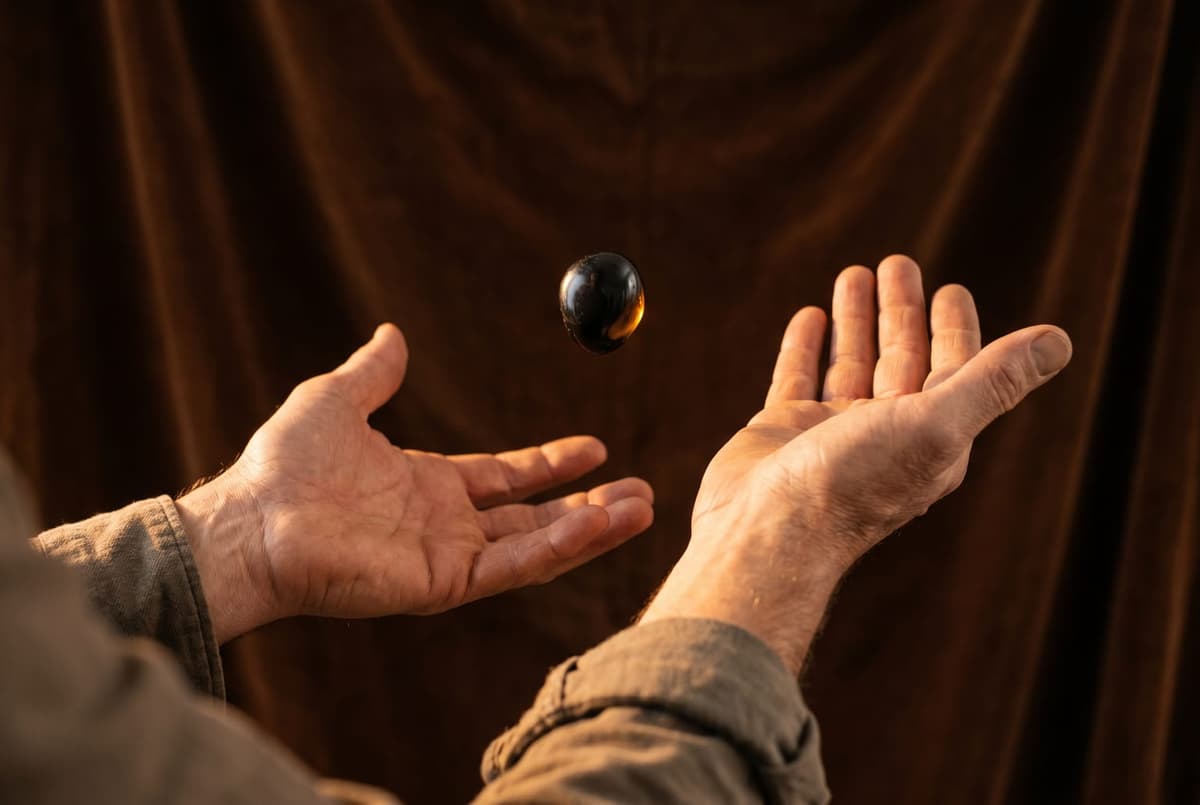
If this aspect sits in your natal chart, picture a radio quietly switched on somewhere inside you. It doesn't blare, it doesn't demand attention, it doesn't insist on its own way. There's simply a second frequency running in the background, another band on which the world can be heard — the band of images, sensations and faint signals that the rational mind usually filters out as static. Sun sextile Neptune works in exactly that fashion. Your will is your own: clear, personal, definite. But beside it runs a second channel that adds the shading. And life often arranges itself so that some people use that channel the whole way through, while others never once suspect they have it.
I frequently meet Sun sextile Neptune in the charts of people who weren't especially noticeable at school. They weren't the stars of the writing club, didn't win competitions, didn't strike anyone as 'the creative type'. Then somewhere around twenty-five or thirty they discover, to their own surprise, that they're rather good at writing, or photography, or running therapeutic groups. And every time they wonder where it came from, since there had never been a hint of it before. The truth is it was always there. The sextile just stays silent until you address it.
The fineness of the aspect shows in everyday things too. You can feel the mood of a room the moment you walk in. In conversation you can sense that someone isn't saying everything and gently shape the right question. You can notice a friend is tired before they've noticed it themselves. This isn't magic and it isn't clairvoyance — it's Neptune working in harmony with the Sun. Perception sits open a little wider than the average person's, and that gives you a practical instrument. The main thing is not to dismiss it as 'everyone's like that'. Not everyone is.
The shadow of the sextile is omission. The aspect is gentle, and it's easy to take for 'nothing special'. A person lives an ordinary life, does ordinary things, and somewhere in the background feels a vague 'there could have been more'. They can't quite work out more of what. Money? A career? Love? What's actually missing is the use of that channel the aspect left ajar. Without regular practice, fine attention grows over with the clutter of daily life the way a woodland path grows over with grass. Walking it becomes harder and harder, and bit by bit the person stops believing it was ever there.
So what helps. Any practice that returns you to the mode of watching yourself. A journal in which you record not the day's events but its sensations and images. A walk without headphones, on which you notice sounds, smells, colours. An hour a week on any creative thing — drawing, modelling, video editing, writing — with no aim of showing the result to a soul. It matters that you do it steadily rather than in fits and starts. The sextile's channel develops slowly, like a muscle that's gone years without load. Don't expect a revelation in week one; expect a quiet thickening of texture over months.
There's one more thing I notice in people who carry this aspect. They are often shy of their own sensitivity. It seems to them that the modern world wants you harder, more efficient, more rational, and that a tendency to dream and to feel with others is a weakness. In fact it's the reverse. In a world where everyone talks and few listen, the ability to feel another person finely is a competitive advantage. Psychologists, marketers, teachers, doctors, directors, negotiators — all of these trades stand on a Neptunian sensitivity buckled to a solar will. That is the working application of the sextile, and worth saying plainly so you stop apologising for it.
To understand exactly how this aspect is woven into your chart as a whole — which signs the Sun and Neptune sit in, which houses, what other aspects touch them — you'd need to look at the chart in full. Subtle configurations only read in context, and a single aspect, taken alone, is a thread rather than the whole cloth.