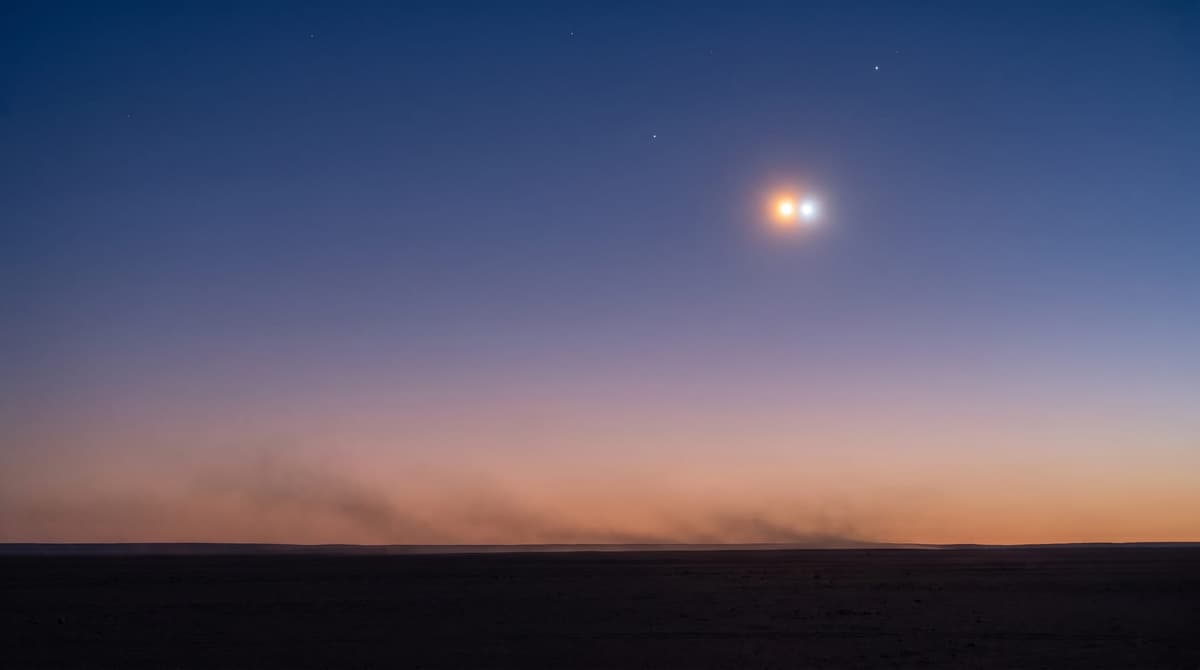
If Sun conjunct Neptune sits in your natal chart, you were born in one of those 14-year windows when Neptune was moving through the sign of your Sun. This is not a mass aspect: Neptune changes sign only once every decade and a half, and lining up with the Sun by sign and degree falls to particular years. Inside the chart it means the solar archetype (will, identity, the conscious 'I') has merged with the Neptunian one, which carries sensitivity, porous boundaries, the dream, and the link to a collective current. They cannot be pulled apart. And that is, at once, your strength and your long inner confusion.
The difficult side shows from early childhood. A child like this often seems a little otherworldly: quiet, dreamy, slow to react, watching the room from somewhere just out of reach. Old family photographs of people with this aspect frequently come out faintly soft, as though the film were trying to catch something that doesn't hold well to optics. Early memories arrive wrapped in the same haze: the details rub away and only the atmosphere stays. In adulthood the effect carries on. The simple questions defeat you for years. What do you want to be, what do you want from a partner, what kind of work would suit you. Not from dullness or laziness, but because there is no firm inner point against which a choice can be measured.
The gift, though, shows up just as early. It is an artistic ear in the widest sense of the phrase. Music, painting, poetry, photography, film, psychotherapy, contemplative practice: anything that asks you to catch fine signals and translate them into form tends to come naturally. In my practice I watch this pattern repeat: children with Sun conjunct Neptune are almost always gifted in one of the subtle crafts, even when their parents have no idea. The talent arrives not as ambition but as a background ability, one the person themselves rarely values as something rare.
The central drama of this aspect is the relationship with the father figure. Because the Sun is classically tied to the paternal archetype, its merger with Neptune almost always produces a particular kind of father story. Most often that is an absent father, physically (gone early, died early, lived apart) or emotionally (present in the house, yet somehow behind glass). Or it is a worshipped father, idealised to an impossible height, whose image then collapses in adolescence and whose fall is lived as a personal catastrophe. A third version is the artist-father, the mystic, the wanderer, whose own Neptunian nature becomes the background of childhood. Any of these leaves an unfinished theme in the chart: what does it mean to be myself, if I never had a steady father figure to mirror me.
In adult life that theme unfolds through work and through boundaries. Work is usually the harder of the two. People with this aspect tend to find their vocation late, after thirty, after forty, or to drift between several creative pursuits without settling on one, or to bury themselves in dutiful work that doesn't resemble them and quietly suffer for it. Boundaries are harder still: it is unclear where the 'I' ends and the current begins, which feelings are yours and which were absorbed from the people around you, which wishes are genuinely your own and which are a borrowed collective picture. That is precisely how someone can live another person's life for years before noticing.
The sign the conjunction sits in colours all of it. In Pisces it deepens into mysticism and a fluid, near-oceanic empathy. In Scorpio it sharpens into psychological perceptiveness and an interest in what lies under the surface. In Sagittarius it turns towards a religious or philosophical search, a hunger for meaning on a wide scale. In Capricorn, an unusual placement for Neptune, it grounds into a more structured kind of spiritual or creative discipline. The house it falls in decides the arena: the seventh, and the theme plays out through partners; the tenth, and it plays out through vocation and public image.
The way I work with this aspect is patient. First, a return to the body: regular physical practice, ideally one with a concrete physical result, such as running, swimming, lifting. The body gives the foothold the chart is short of. Second, rhythm: sleeping at the same hour, eating at the same hour, staying off substances. Neptune behaves more gently where there is structure. Third, therapy that keeps its attention on sensation rather than on interpretation alone. Fourth, a creative channel, not as a profession but as a daily practice, somewhere you can merge with the current deliberately and then climb back out. To see exactly how it plays for you, the sign, the house and the aspects to other planets (especially Saturn, Pluto and the Moon) all have to be read together. By their forties and fifties, people with this aspect often arrive at a strikingly mature and gentle version of themselves: one that knows its own edges, yet keeps its capacity for deep compassion.