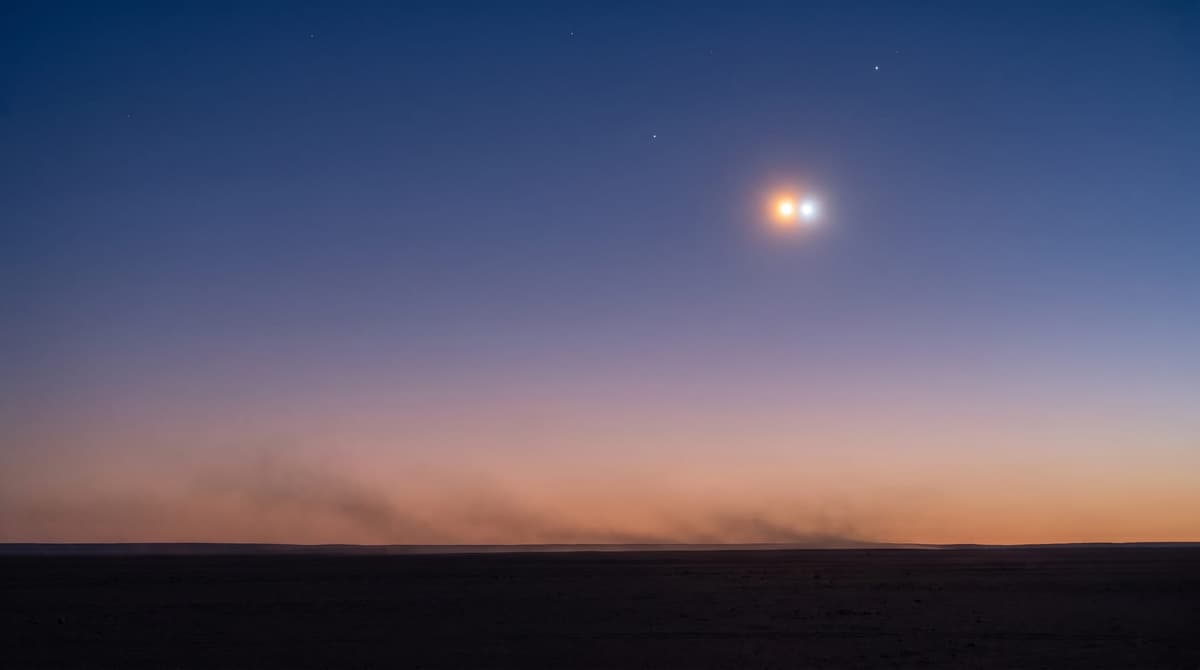
If Moon conjunct Neptune sits in your natal chart, you were born in one of those narrow windows when the transiting Moon was passing through the exact degree Neptune held at the moment you arrived. It isn't a common aspect. Neptune lingers in a single sign for around fourteen years, while the Moon turns hundreds of times over that stretch, yet the precise same-degree conjunction lands on only the relatively rare two days a month. Inside the chart it means the lunar archetype — emotional memory, the mother theme, the way you soothe yourself, the background sense of safety — has fused with the Neptunian one, which carries sensitivity, porous boundaries, dream and a tie to the collective current. They cannot be pulled apart. And that is, at once, your rare strength and your long inner confusion.
The vulnerable side reads from earliest childhood. A child like this absorbs the mood of the whole family like a sponge. When the mother has a heavy day, the child feels low before anyone has said a word. When the parents quarrel in the next room, the child cries quietly without understanding why. When a new teacher arrives at nursery, the child's stomach aches all that first week — they read the teacher's anxiety as their own. By school age this thread becomes a peculiar sensitivity to the atmosphere of a classroom: the others might miss a tension between two teachers, while this child lies awake for a week after the first lesson where something rang in the air. I watch this in children with Moon conjunct Neptune again and again, and almost always the parents don't grasp what is happening and put it down to fussing.
The main and most tender theme of this aspect is the maternal one. The Moon is classically tied to the mother and to the emotional experience of early childhood, and Neptune blurs the form of everything it touches. Their fusion nearly always produces a particular maternal script. Most often the mother was emotionally blurred — physically present, yet somehow behind thin glass. That might have been bound up with her own low spell, her own lostness, a post-natal difficulty, a dependency, a hard situation in the first years of your life. Sometimes the opposite holds: the mother was too close, allowing no separateness, and the emotional boundaries between you and her wore so thin that, as an adult, you go on feeling her mood as your own across hundreds of miles. In either case there grows a person who longs for an ideal maternal figure and then spends a life looking for it — in partners, in spiritual teachers, in therapists, in friends, in mentors.
The strength shows early too. It is intuition, in the most precise sense of the word. Not a guess and not a foreboding, but a capacity to read the subtle: the mood of a room, a person's hidden state, the buried conflict beneath formal politeness. From such children come good psychotherapists, painters, musicians, hospice nurses, vets, teachers of the very young. The professions where you have to understand without words come naturally. The talent shows up not as ambition but as a background ability the person often doesn't even register as valuable — until someone from outside points out that it is rare.
In adult life the central task with this aspect is to learn to tell your own feeling from an absorbed one. That isn't done in a single session with an astrologer and doesn't simply arrive with age. It is years of practice. I tend to work with it like this. First, the practice of naming. Once a day, at least, stop and ask yourself: what am I feeling right now, and whose feeling is it — mine, or absorbed from the person I've just been talking to? Second, the body. Regular physical exercise, ideally with a concrete result: running, swimming, strength work. The body becomes the boundary the chart is missing. Third, a sleep routine — without it Neptune blurs not only the emotions but the health. Fourth, therapy with a focus on sensation and on the childhood story.
The sign and house the conjunction sits in colour all of it. In water signs the blurring deepens into mysticism and a healing instinct; in air signs it can read more as an imaginative, almost telepathic sociability; in earth signs it grounds into a quiet, practical care for others; in fire signs it lends a dreamer's warmth to an otherwise direct temperament. The house tells you where the porousness is felt most — the home, the workplace, the partner, the wider public. To see how your own version plays out, the sign, the house and the contacts to other planets, especially Saturn, the Sun and Jupiter, all have to be read together rather than the aspect alone.
By forty or fifty, a person with this aspect often arrives at a surprisingly mature emotional life, one where the empathy has stayed but the blurring has eased considerably. Read that way, the natal chart becomes a map of a road you have already walked, rather than a sentence handed down. It describes a tendency to notice and to work with — not a fixed fate, and certainly not anything to predict.