Hannah opens a third browser tab. The first article said the Pisces birthstone is aquamarine. The second listed nine stones — aquamarine, amethyst, moonstone, fluorite, bloodstone, jade, turquoise, lapis lazuli, opal — all apparently «the Pisces stone». The third was firm: «Amethyst, the spiritual stone, especially if you were born in late February.» Her birthday is the 7th of March. She closes all three tabs and stops looking.
Here's the honest answer those three articles skipped. There isn't one Pisces birthstone, because there isn't one question. «What's the Pisces stone» gets answered three different ways by three different traditions, with a fourth answer (your own birth chart) waiting quietly behind all of them. Pisces is also a sign with two rulers, traditional Jupiter and modern Neptune, which means the correspondence-pool is richer and more layered than for signs with a single ruling planet. Once you can see which question goes with which answer, the contradictions stop mattering.
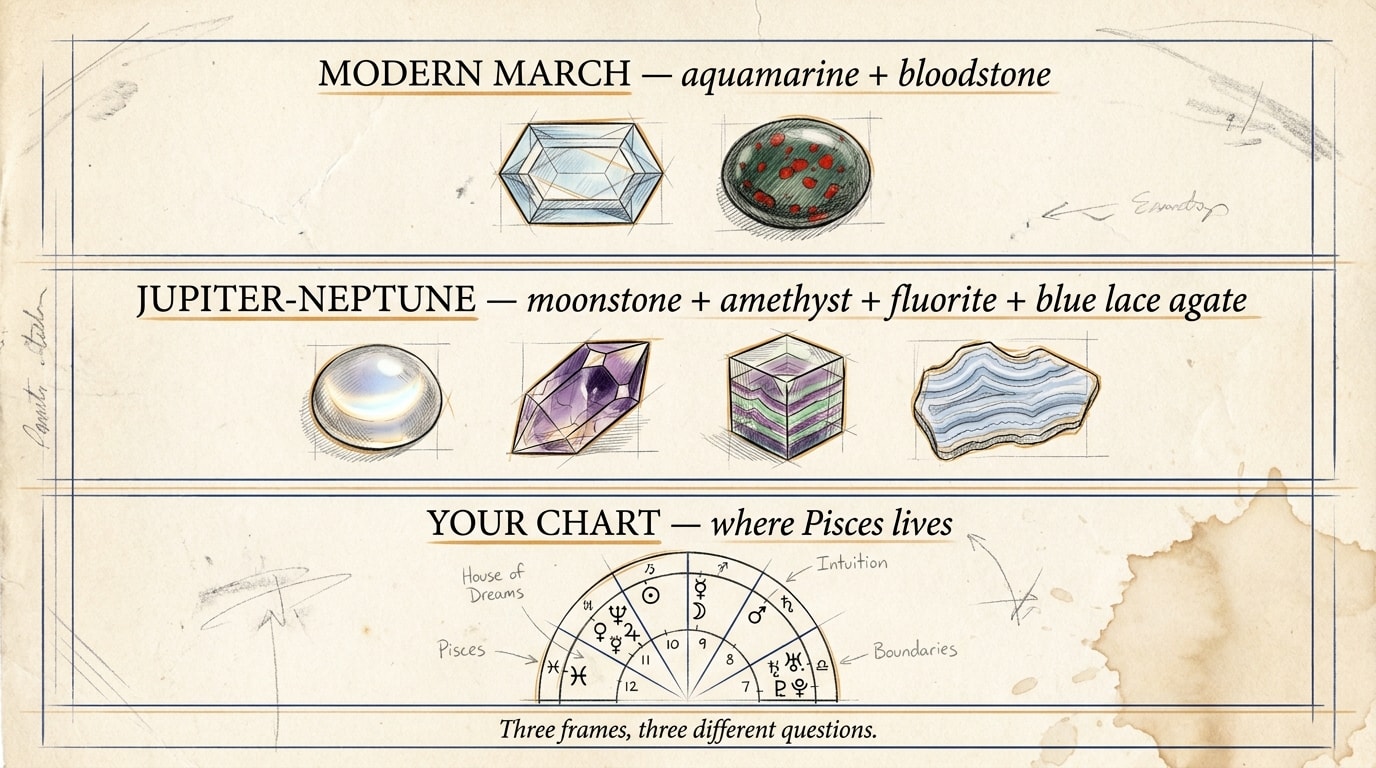
In short. «The Pisces birthstone» is three lists answering three different questions. The modern commercial March birthstones are aquamarine and bloodstone, per GIA's standardised list, with amethyst as February's stone if your birthday landed before the equinox. The Jupiter-Neptune correspondence stones (moonstone, amethyst, fluorite, blue lace agate, aquamarine) come from a much older tradition (Jupiter has ruled Pisces in Western astrology since the Hellenistic period) layered with a modern one (Neptune was added as Pisces's co-ruler after its discovery in 1846), and they share a quality of holding form lightly. And your own chart may have Pisces placed somewhere other than your Sun, which changes the question entirely.
 The honest answer rarely sits at the top of the search results.
Why there isn't one Pisces birthstone
«Pisces birthstone» is really three questions wearing one coat, and that is why search results seem to argue with each other while every page sounds confident. Type the phrase in and you land on three separate lineages of stone-lore stacked together, none of them flagged, each running on its own quiet logic. The first is the shopfront calendar your local jeweller stocks by, which sorts stones under birth months. The second is the old European lapidary line, which sorts stones under planets, and Pisces is the awkward case here, because it answers to two: Jupiter in the classical scheme, and Neptune, drafted in as a modern co-ruler once the planet was found in 1846. The third frame, kept for last, ignores your birth month entirely and asks where Pisces actually falls in your chart rather than assuming it sits on your Sun. Read on its own terms, each lineage is perfectly coherent; the apparent contradiction only shows up when a writer tips all three into one bowl and serves it as a single answer.
Pisces also has a particular twist that single-ruler signs don't share. Where Capricorn answers to Saturn alone and Libra answers to Venus alone, Pisces draws stones from two planetary palettes at once: Jupiter's traditional purples and blues (amethyst, sapphire, turquoise) layered with the modern Neptune-pool of sea-greens and drifting iridescent stones (moonstone, fluorite, blue lace agate, aquamarine). That's why Pisces lists tend to run longer than other signs', and why they hold together as a family despite covering a wider colour range. The three sections that follow take Pisces's three frames in turn: calendar month, then the doubled planetary correspondence, then your own chart.
Aquamarine: what the March calendar gives a Pisces
In the modern commercial system that GIA and the British Gemmological Association run on, March answers to aquamarine and bloodstone, while February answers to amethyst. This is the list your high-street jeweller stocks by, the one that decides which gem fills the «March» tray at Hatton Garden, and the default reference for every birthstone-ring site online. Its modern shape was fixed in 1912, when the American National Association of Jewelers pinned the months to their stones; Jewelers of America later adopted it formally, and GIA keeps it current. Aquamarine took the primary March slot, with bloodstone standing as the long-running alternative for anyone who prefers a deep green to a pale sea-blue.
Aquamarine carries a long history sitting at the back of every March ring. The name itself is Roman: aqua marina, «sea water», first attested in Pliny the Elder's Natural History around 77 CE. Roman sailors carried aquamarine intaglios carved with the image of Poseidon as talismans for safe sea-passage, a use that links the stone to its modern Neptune-association by almost two thousand years of unbroken metaphor. Today, Brazil's Minas Gerais state supplies most of the world's commercial aquamarine, with significant production also coming from Mozambique, Nigeria and Madagascar. The pale sea-green-blue you see in shops is almost universally enhanced by heat-treatment, a normal and disclosed trade practice that removes residual green tones and deepens the blue. Untreated aquamarine exists in the high end of the market and commands a premium for collectors, but heat-treated stones are the rule, not the exception, and that doesn't make them less real.
A note for cusp-dwellers. If your birthday falls between 19 and 28 February, the calendar names amethyst as your birth-month stone, but you're astrologically a Pisces. If your birthday is 1 to 19 March, both frames agree on March-month logic. If you're a 19 or 20 March birthday, you're on the Pisces-Aries cusp, and the exact moment of the Sun's ingress shifts by a day between years. The calendar gives you whatever it gives you; your astrological sign depends on the exact sign-change for your birth year.
The Jupiter-Neptune correspondence stones
In the traditional astrological lapidary tradition, the stones of Pisces are the stones of Jupiter. And since Neptune was assigned to Pisces as a modern co-ruler after its 1846 discovery, the pool expanded to include sea, drifting and dissolving stones that Jupiter's pre-modern catalogue didn't cover. Jupiter ruled Pisces and Sagittarius in the classical dual-rulership scheme that runs from Hellenistic astrology through William Lilly's Christian Astrology of 1647 into modern textbooks. Neptune was first observed on 23 September 1846 by Johann Galle at the Berlin Observatory, working from calculations made by the French mathematician Urbain Le Verrier. Within a generation, early-twentieth-century astrologers (Alan Leo and later Charles Carter among them) had assigned Neptune as the modern co-ruler of Pisces on the symbolic basis of Neptune's association with the sea, with dreams, and with the dissolving of boundaries. Sagittarius kept solo Jupiter; Pisces drew the long straw with two rulers and a layered stone pool.
 A correspondence is a name in a tradition, not a verdict.
The two great primary sources for the Jupiter-pool are Nicholas Culpeper's Complete Herbal and English Physician of 1652 and Heinrich Cornelius Agrippa's De Occulta Philosophia of 1533. Culpeper names tin as Jupiter's metal and groups amethyst, sapphire and turquoise among Jupiter's stones; the Jupiter palette runs to purples and Jupiter-blues, the colour of celebration and the deep sky. Agrippa, writing a century earlier, gives the longest Renaissance catalogue of Jupiter-correspondences (Book I of the De Occulta), drawing on Arabic and earlier Hellenistic sources. Marbode of Rennes' lapidary of around 1090 had already described amethyst in plainer terms a few centuries before. The Neptune-pool, by contrast, is genuinely modern: twentieth-century astrological writers added moonstone, fluorite and blue lace agate to the Pisces correspondence on the strength of their sea-associations and their visual quality of holding form lightly, rather than on any medieval source.
Moonstone is the Pisces-stone most often named in modern lists. It's a feldspar mineral whose drifting blue-white sheen (gemmologists call it adularescence) comes from light scattering between extremely thin internal layers of two slightly different feldspar phases. The stone literally seems to hold its form lightly: every angle of viewing reveals a different drifting glow. Sri Lanka (historically Ceylon) has produced the finest moonstone for centuries from the Meetiyagoda mines; Indian moonstone from Tamil Nadu is more affordable and widely commercial. Amethyst is Jupiter's traditional purple stone in the classical correspondence pool, named in both Culpeper and Agrippa. The Greek name a-methystos means «not drunken»; classical wine-cups were sometimes carved from amethyst on the supposition that the stone protected the drinker from intoxication. Fluorite is calcium fluoride, naturally grown in gradient layered bands of purple, green, blue, sometimes all three in a single specimen. Its name comes from the Latin fluere, «to flow», a sixteenth-century mining term for the stone's unusually low melting point, useful as a flux in smelting. Its layered structure echoes Pisces's mutable register exactly.
The aesthetic logic running through Pisces's pool is worth seeing once. Pisces is the only mutable-water sign in the zodiac. Mutable signs adjust rather than hold a line; water dissolves what was solid. Pisces's stones share this quality of holding form lightly: moonstone's adularescence is light playing on shifting internal layers, fluorite grows in gradient bands not single colours, blue lace agate's tide-stripes look like still water frozen mid-motion, aquamarine's pale transparency lets you see right through it. This isn't decorative reading. It's the structural pattern that distinguishes Pisces-stones from any other sign's pool. Saturn-stones are heavy and grounding; Venus-stones are soft and aesthetic; Pisces-stones are translucent and shifting.
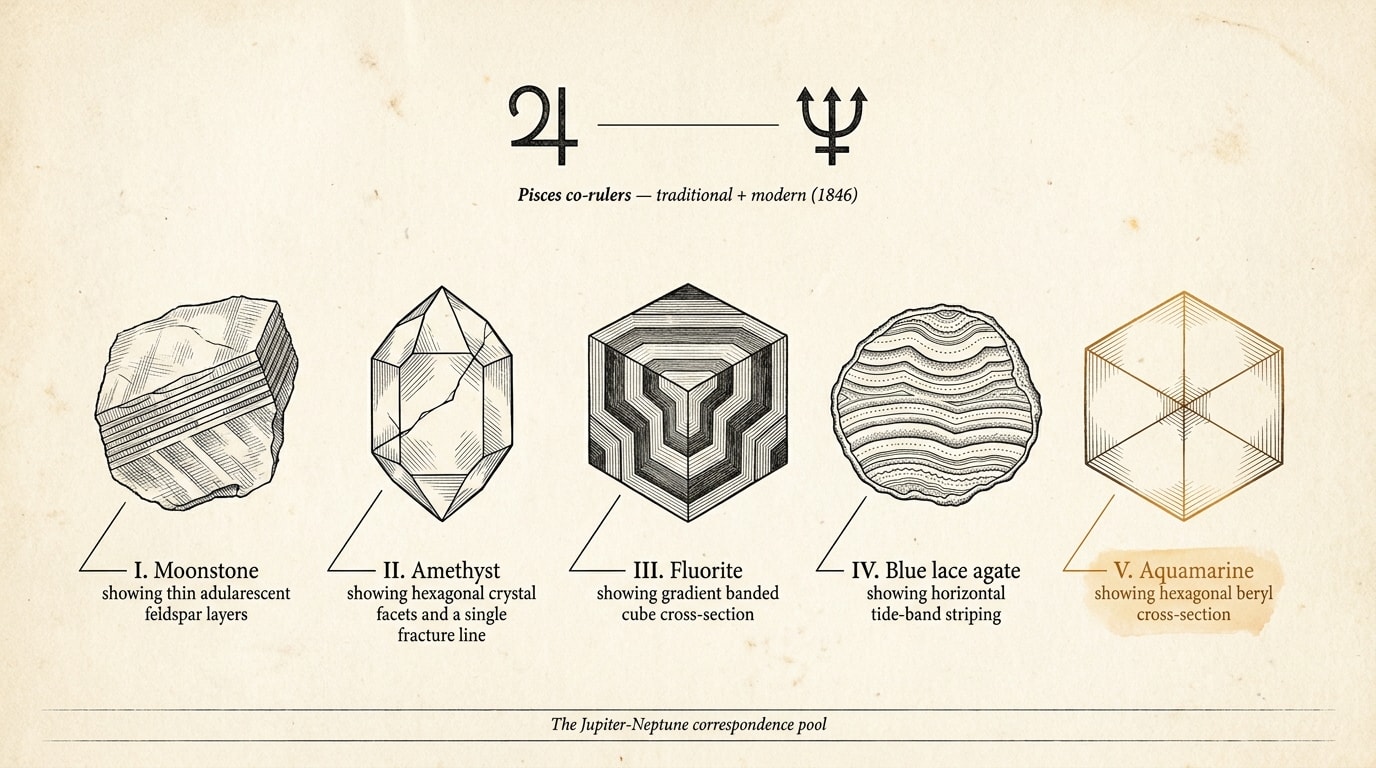
Blue lace agate, the fourth in the Neptune-pool, is banded chalcedony with pale blue tide-line striping, mined chiefly in Namibia's Ysterputz region. The horizontal banding looks like still water at dawn: pure Neptune-association by metaphor, with no medieval source needed. Aquamarine completes the list as a double-counted stone: it's already the modern March birthstone, and it's also at home in the Pisces correspondence-pool by colour and by Roman sea-water association. If you have one stone that does both jobs, aquamarine is it.
What a birthstone tradition can and can't claim. Planetary correspondence makes one modest statement: «this stone was linked to this planet, for these reasons». What it never says (and this matters most for Pisces, the sign most heavily marketed to on this front) is that a stone «will open your third eye, guard your empathic boundaries, tune you to the spirit realm, or wash your anxieties away». Those promises come from a separate twentieth-century crystal-healing genre with no footing in the astrological texts. Wear whatever you find beautiful; the symbolic link is the whole of the gift, and no «activation» is on offer.
Buying a real Pisces stone without overpaying
Say you've landed on aquamarine, moonstone or one of the other Pisces stones, and now you'd rather pay for the genuine article than a marked-up impostor. What follows is the plain, unsexy sort of guidance you get from someone with nothing in it for them: the kind of boring that keeps money in your pocket, and doubly worth reading for Pisces stones, where the two commonest fakes (treated aquamarine sold as untreated, glass sold as moonstone) trip up more buyers than for almost any other sign.
Where to look, in the UK. For the broadest choice, start at Hatton Garden, Britain's main jewellery quarter: roughly three hundred dealers packed into a few central-London blocks, most happy to let you browse off the street without booking ahead for ordinary stones. Liberty's gem counter, Astley Clarke, Selfridges and Boodles (a heritage jeweller founded in Liverpool in 1798) all carry reputable stock at department-store and fine-jeweller price points. Independent regional jewellers, often your county's old high-street name and family-run for several generations, are frequently better value than anything in London. For free education there's nothing to beat the William and Judith Bollinger Gallery at the V&A in South Kensington; you can study the difference between natural and treated stones, in good light, with nobody angling to close a sale.
Two warnings matter more than the others if you're shopping for Pisces stones in particular. The first is the aquamarine heat-treatment norm, already mentioned: virtually all commercial aquamarine has been heat-treated to enhance the blue. This is not a fault, not a scam, and is universally disclosed by reputable sellers. If a listing makes a song-and-dance about «untreated aquamarine», expect to pay several times the standard price; if it doesn't mention treatment at all, assume the stone is heat-treated and that's fine. The second warning matters more. «Opalite» is man-made glass, usually milky pale-blue-white, sold cheaply (often in the low two-figure pounds for a small pendant) under listing names that include the word «moonstone»: «moonstone opalite», «opalite moon», «moonstone-style glass bead». It is not the natural feldspar mineral. Genuine moonstone shows internal layers that produce a drifting, directional sheen as you rotate the stone; opalite is uniformly translucent and shows no internal structure. If the price seems suspiciously low and the listing won't tell you the mineral species, it's likely opalite. Ask for the species in writing.
What else to read on the tag. «Natural» and «lab-grown» are both real stones; they have the same crystal structure and chemical composition, just different origins. Lab-grown is significantly cheaper and ethically simpler; natural costs more for reasons of rarity and provenance rather than physical merit. «Heat-treated» appears on most aquamarine and on much amethyst sold today and is a normal, disclosed practice that improves colour stability, not a fault. «Synthetic» means lab-grown and disclosed; «simulant» means a different material made to look similar (cubic zirconia for diamond, opalite glass for moonstone) and should also be disclosed in writing.
What to ignore. Moonstone in particular attracts a thick layer of spiritual sales-talk: «opens the third eye», «attunes you to lunar energy», «dissolves emotional blockages». The moment a listing starts pricing a stone's «vibration», «energy frequency», «chakra alignment» or what it «will activate», you've stepped out of gemmology and into a sales script. Neither the March calendar nor the old Jupiter-Neptune lapidaries ever promised anything of the kind. A description that leans on healing language is usually a seller charging you for the story instead of the stone. The label worth your attention carries carat weight, country of origin, treatment status and clarity grade: the gemmologist's tag, and the one that tells you what you're actually paying for.
From «Pisces birthstone» to your Pisces placements
A Pisces birthstone search assumes Pisces is your Sun, but Pisces might be living somewhere else in your chart entirely, and for Pisces one extra piece of chart geometry pulls double weight. A chart is never a single sign: it's ten bodies (Sun, Moon, Mercury, Venus, Mars, Jupiter, Saturn, Uranus, Neptune and Pluto) each parked in one of the twelve signs, with a Rising sign pinned down by the exact minute of your birth and the horizon overhead at the time. The wheel is also sliced into twelve houses, each one an area of life, and every sign keeps a house astrologers treat as its «natural» home. For Pisces that home is the twelfth, the house traditionally associated with solitude, dreams, the hidden inner life, and what dissolves the small everyday self into something larger. If you have planets in your twelfth house, even without a Pisces Sun, that twelfth-house cluster carries a Pisces-coloured register, and Pisces correspondence-stones become doubly relevant for you.
 One stone, one symbol, twelve houses in a chart.
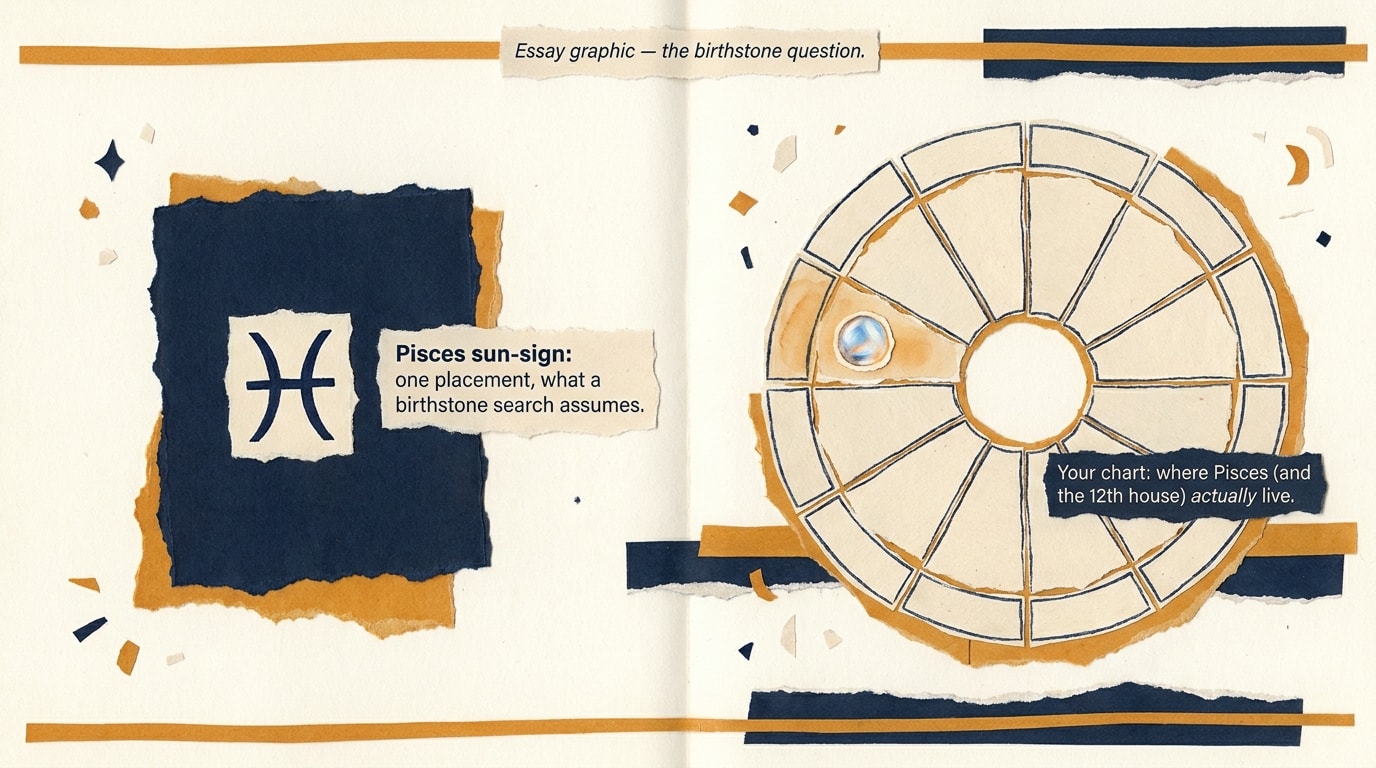
If your Moon is in Pisces, the way you settle and process emotion drifts and shifts; what calms you isn't a fixed ritual, it's something more like floating. If your Venus is in Pisces, your aesthetic and the way you give and receive affection lean dreamy and a little self-effacing. If your Mars is in Pisces, the way you push for what you want moves indirectly, more by erosion than confrontation. Your Sun in Pisces, by contrast, is your sense of self, your will, the part of you that asks to be seen: the placement a sun-sign birthstone search assumes you have but never checks. And if you have a 12th-house cluster of any planets in any sign, that whole region of your chart speaks the Pisces dialect even when the Sun is elsewhere.
If you'd like to see where Pisces actually lives in your chart (Sun, Moon, Venus, Rising, or as a 12th-house cluster), WowAstro will calculate a free birth chart for you. Give it your birth date, your birth time and your birthplace, and a minute or two later it's done. The stone is a small symbol; the chart is the fuller description, and for Pisces the 12th-house reading is the doubly-Pisces answer.
Questions readers ask
What is the actual birthstone of Pisces?
There isn't one — there are three honest answers, depending on which question you're asking. If you mean «what stone does the modern commercial calendar give people born in March», that's aquamarine, with bloodstone as the long-standing alternative, per GIA's standardised birthstone list, the industry reference since 1912. Late-February Pisces inherit amethyst by the same calendar logic. If you mean «what stones did the astrological tradition associate with Pisces», there are two overlapping pools to consider: Jupiter's traditional stones (amethyst, sapphire, turquoise — Culpeper's 1652 Complete Herbal and Agrippa's 1533 De Occulta Philosophia) and the modern Neptune-pool added after Neptune's 1846 discovery (moonstone, fluorite, blue lace agate). If you mean «what stone actually means something for me», the question changes again: it depends on where Pisces lives in your chart, which depends on your full birth data. Pick the question you're actually asking, and the answer follows.
Am I amethyst or aquamarine if I was born in late February?
By the modern calendar list, you're an amethyst Pisces. February's birth-month stone is amethyst, regardless of which zodiac sign you happen to be — and roughly the first month-third of Pisces have February birthdays. By the astrological-rulership frame, calendar month doesn't enter into it: Pisces is ruled by Jupiter (traditionally) and Neptune (modern co-ruler), and Pisces's correspondence stones are the Jupiter-Neptune pool (moonstone, amethyst, fluorite, blue lace agate, aquamarine) for everyone born under Pisces, whether February or March. Neither answer is the «real» one; they're answering different questions. If you want a calendar-month stone, amethyst. If you want a Pisces-as-Pisces stone, the Jupiter-Neptune pool. There's nothing stopping you from owning both, and amethyst happens to sit in both lists — it's the one stone that ties the two frames together for late-February Pisces.
What is the lucky stone for Pisces?
«Lucky» is a word that belongs to a different conversation than the one tradition is having. Astrological correspondence-tradition says «this stone was associated with this planet, for these reasons» — it doesn't promise the stone will bring you luck, intuition, spiritual gifts or any particular outcome. The stones most commonly named in connection with Pisces, in answer to the «lucky stone» framing, are aquamarine (the calendar's March stone, with the longest Roman maritime-talisman lineage) and moonstone (the most prominent modern Pisces stone, tied to Neptune by metaphor). If you'd like a stone for symbolic association rather than for a promised outcome, either is a reasonable choice. If you'd like a stone because you find it beautiful, that's a perfectly good reason on its own.
Why is moonstone considered a Pisces stone?
Because Pisces gained Neptune as its modern co-ruler after Neptune's 1846 discovery, and moonstone — with its drifting blue-white sheen and feldspar internal layering that catches and scatters light differently from every angle — became the most natural Neptune-stone by metaphor. Neptune is the planet of dreams, the sea and the dissolution of boundaries in modern astrological grammar; moonstone is the gem that most visibly seems to hold its form lightly, exactly the quality Pisces-as-mutable-water carries. Twentieth-century astrological writers (Alan Leo, Charles Carter, and the mid-century compilers who followed them) named moonstone in Pisces correspondence on the strength of this metaphor — no medieval source required. Moonstone shares the Pisces stone-family resemblance with fluorite, blue lace agate and aquamarine: all stones that seem more transparent than solid, more drifting than fixed. Whether you take the symbolic association seriously or not is up to you; the connection itself is real, post-1846 and traceable.
Astrology, as we use it at WowAstro, is a tool for self-reflection and self-observation, not a method for predicting events, health, or financial outcomes. Traditional correspondence-stones are symbolic associations, not medical recommendations or guaranteed luck-bringers. Take what's useful from any tradition, leave the rest.
Written by Oksana Miatova, astrologer and writer at WowAstro. Charts calculated using the Swiss Ephemeris, the same astronomical data working astrologers use. Historical correspondences drawn from Nicholas Culpeper's «Complete Herbal and English Physician» (1652), Heinrich Cornelius Agrippa's «De Occulta Philosophia» (1533) and Marbode of Rennes' «Liber Lapidum» (~1090); modern birthstone list per the Gemological Institute of America; Neptune-discovery historical record per the Berlin Observatory and Le Verrier's published calculations of 1846.
Read your own natal chart
A personal AI reading, from £1
⭐ +50 Wow Stars cashback · sign up and get 100 ⭐
Build my chart →Comments
New here? Get −30% off your natal chart
Leave your email and we will send you the promo code WELCOME30. Straight after that you can comment — no passwords, all automatic.
Quick sign-in
Sign in with Telegram — one click.
Or by email (with a gift)
Already have an account? Enter the same email — we'll email you a sign-in link.