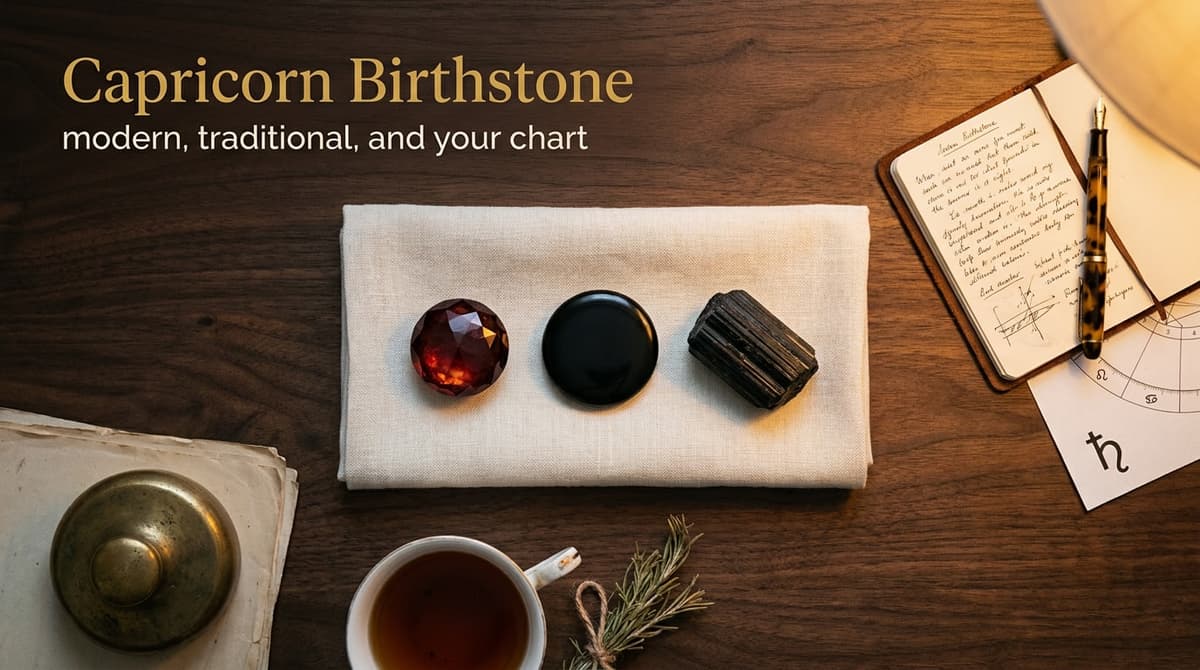
Hannah opens a third browser tab. The first article said the Taurus birthstone is emerald. The second listed ten stones — emerald, rose quartz, jade, lapis lazuli, sapphire, peridot, garnet, citrine, malachite, tiger's eye, all apparently «the Taurus stone». The third was quieter and stranger: «Emerald is the May birthstone, but emerald is also the Venus stone, and Venus rules Taurus, so emerald lands twice — for two different reasons.» Her birthday is the 12th of May. She closes all three tabs and stops scrolling.
Here's the honest answer those three articles skipped. There isn't one Taurus birthstone, because there isn't one question. Three different traditions answer «what's the Taurus stone» in three different ways, a fourth (your own birth chart) sits quietly behind all of them, and Taurus is the rare sign where the modern calendar and the ancient rulership tradition happen to land on the same gem for entirely different reasons. Once you can see which question goes with which answer, the contradictions stop mattering — and the coincidence starts to feel less like a contradiction and more like a small piece of good luck.
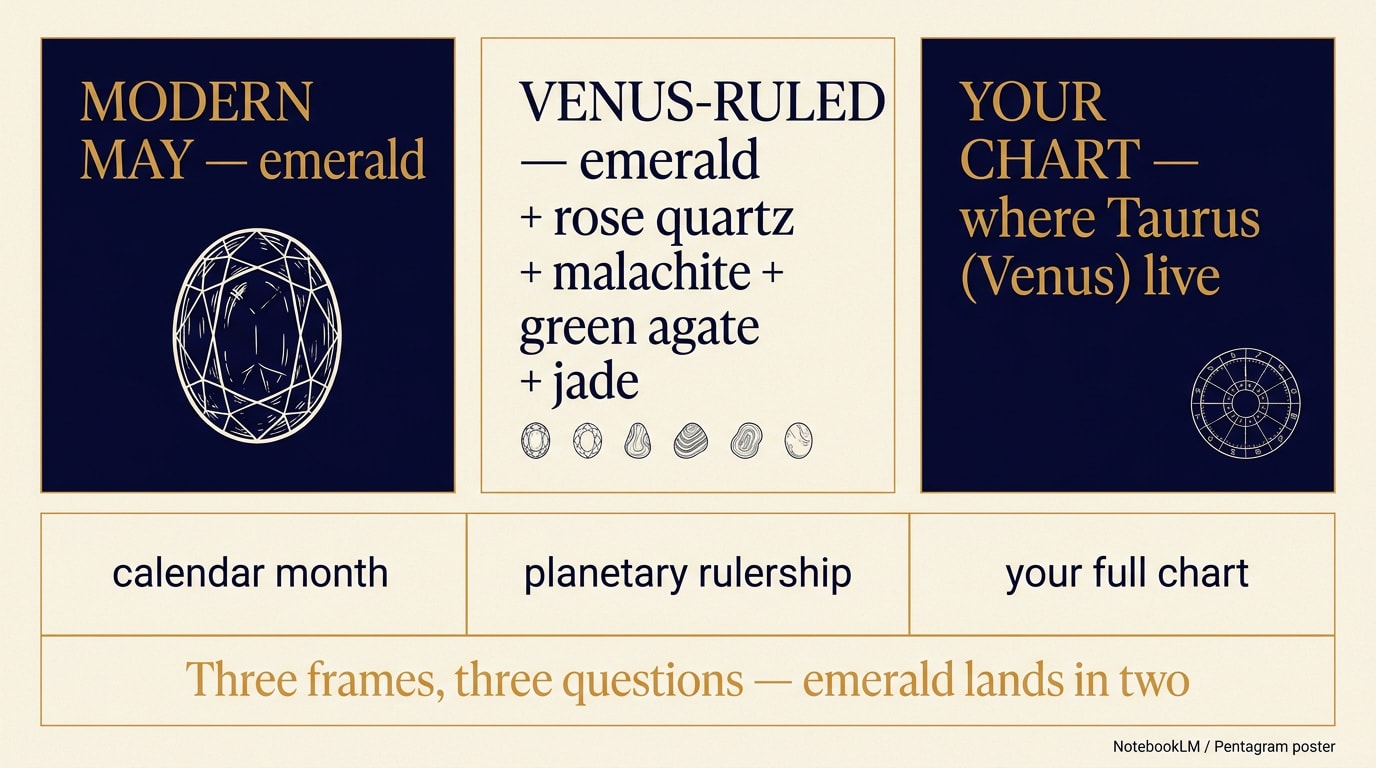
In short. «The Taurus birthstone» is three lists answering three different questions. The modern commercial May birthstone is emerald, per GIA's standardised list (with agate and chrysoprase as historical alternatives, since dropped from the primary list). The Venus-ruled correspondence stones — emerald (yes, the same emerald), rose quartz, green agate, malachite and jade — come from a much older tradition that ties Taurus's stones to Venus, the planet that rules the sign, and to Venus's earth-domicile palette of deep growing-greens and soft sensory pinks. And your own chart may have Taurus placed somewhere other than your Sun, with your Venus somewhere worth a second look, which changes the question entirely. Emerald lands twice for Taurus, for two unrelated reasons. That's the small coincidence the other articles skip.
 The honest answer rarely sits at the top of the search results.
Why there isn't one Taurus birthstone
Ask «what's the Taurus birthstone» and you've actually asked three questions wearing one coat, which is why the results squabble with each other. Behind the contradictory lists sit three separate traditions, each built to answer its own question, and almost nobody writing them stops to say which one is doing the talking. The first is the shop-counter calendar your local jeweller stocks by, which sorts stones under the month you were born. The second is the old European lapidary line, which sorts stones under planets; since Venus owns Taurus, the Taurus entry is simply Venus's stones. The third, kept for the end here, ignores the Sun-sign assumption entirely and asks where Taurus actually lands in your own chart. Take any one on its own terms and it holds together cleanly; the apparent quarrel only starts when a writer pours all three into the same bowl and calls it one answer.
Taurus also straddles two birth months in a way that turns out to matter. Taurus season runs roughly 20 April to 20 May, which means roughly a third of Tauruses have late-April birthdays and a calendar claim on diamond, while the rest have May birthdays and a calendar claim on emerald. The astrological frame, helpfully, gives one consistent answer for both: Taurus is Taurus, Venus is Venus, the Venus-pool is the Venus-pool. And then, for reasons with no connection to one another, the modern May calendar and the Venus-rulership tradition both come to rest on the same gem — emerald — about as close as the birthstone tradition ever gets to a happy accident. We'll walk through the three frames below, one at a time, in the order they're worth understanding.
Emerald: what the May calendar hands a Taurus
In the modern commercial system used by GIA and the British Gemmological Association, the May birthstone is emerald. This is the list every high-street jeweller is working from, the list that decides which gem sits in the «May» tray at Hatton Garden, and the list every birthstone-ring website cites by default. It was standardised in 1912 by the American National Association of Jewelers, formally adopted by Jewelers of America, and is maintained by GIA. The original 1912 list named emerald as May's primary stone, with agate and chrysoprase as historical alternatives — both since dropped from the modern primary reference, leaving emerald to hold the month on its own. A note on the dropped alternatives: agate (a banded chalcedony with quiet earthy stripes) and chrysoprase (a soft apple-green chalcedony) both share emerald's green register and were grouped with it for that reason; they survive in some older birthstone tables but the modern industry consensus is emerald-only.
The history sits at the back of every emerald ring. Emerald is gem-quality beryl, the same mineral family as aquamarine and morganite, coloured deep green by trace amounts of chromium (sometimes vanadium). The oldest emerald mines we know of sit at Mons Smaragdus, also called Sikait, in Egypt's Eastern Desert; the workings date from around 330 BCE and were active through Roman times, which makes them the source of Cleopatra's famous emerald jewellery. The mines fell into disuse and were rediscovered by a French explorer in 1816. Colombia (Muzo and Chivor) overtook Egypt as the world's premier emerald source from the sixteenth century onward, after the Spanish conquest, and remains the dominant origin today. Pliny the Elder, in his Natural History of around 77 CE, called emerald the most refreshing of stones to look at, saying that gem-cutters rested their eyes on emerald to recover from close work. Whatever Pliny knew about eyestrain, he was right about the colour.
A note for cusp-dwellers — and Taurus has more of them than you might think. If your birthday falls between 20 and 30 April, the calendar names diamond as your birth-month stone (April is the diamond month), but you're astrologically a Taurus. The calendar gives you diamond; the astrological tradition gives you emerald. Both are correct answers to different questions. If you're a Taurus born 1 to 20 May, the two frames quietly agree: emerald by the calendar, emerald by the rulership tradition, for completely unrelated reasons. If you're a 19-20-21 April birthday or a 20-21 May birthday, you're on the sign boundary, and the exact moment of the Sun's ingress shifts by a day between years; your sign depends on the year you were born and the time of day.
Venus's stones, and so the bull's
In the traditional astrological lapidary tradition, the stones of Taurus are the stones of Venus, because Taurus is one of Venus's two ruling signs. And here's the lovely coincidence the SERP keeps missing: the primary Venus stone in that lapidary tradition is emerald — the same gem the modern May calendar names. Two unrelated traditions, separated by several centuries and entirely different logics, both put emerald in Taurus's hands. That doesn't happen for most signs. For Libra (Venus's other ruling sign), the calendar gives opal or sapphire and the Venus-tradition gives rose quartz and lapis lazuli; the two frames don't agree at all. For Taurus they do, and the accidental harmony is genuinely a small gift from the history of both jewellery and astrology.
 A correspondence is a name in a tradition, not a verdict.
Venus rules both Taurus (fixed earth — the sensory, fertile, material register) and Libra (cardinal air — the harmonising, aesthetic, social register), a dual-rulership that goes back to Hellenistic astrology and runs forward through William Lilly's Christian Astrology of 1647 into modern textbooks. The two Venus signs read the planet through different elements: Taurus tilts toward what Venus governs at ground level — deep growing greens, soft sensory pinks, things that feel and weigh well in the hand, the lush garden in late spring. Libra tilts toward sky-blue balance. Same planet, two different elemental keys. Taurus's stone-family looks the way late-May leaves look, and that isn't accidental.
The two great primary sources for the Venus-pool are Nicholas Culpeper's Complete Herbal and English Physician of 1652 and Heinrich Cornelius Agrippa's De Occulta Philosophia of 1533. Culpeper names copper as Venus's metal and emerald as Venus's stone, grouping the rest by colour around emerald's green. Agrippa, writing a century earlier, gives the longest Renaissance catalogue of Venus-correspondences in Book I of the De Occulta, fixing the fertile-green palette in the European tradition. Marbode of Rennes' lapidary of around 1090 had already described emerald in plainer terms a few centuries before, calling its green the most cheering of colours.
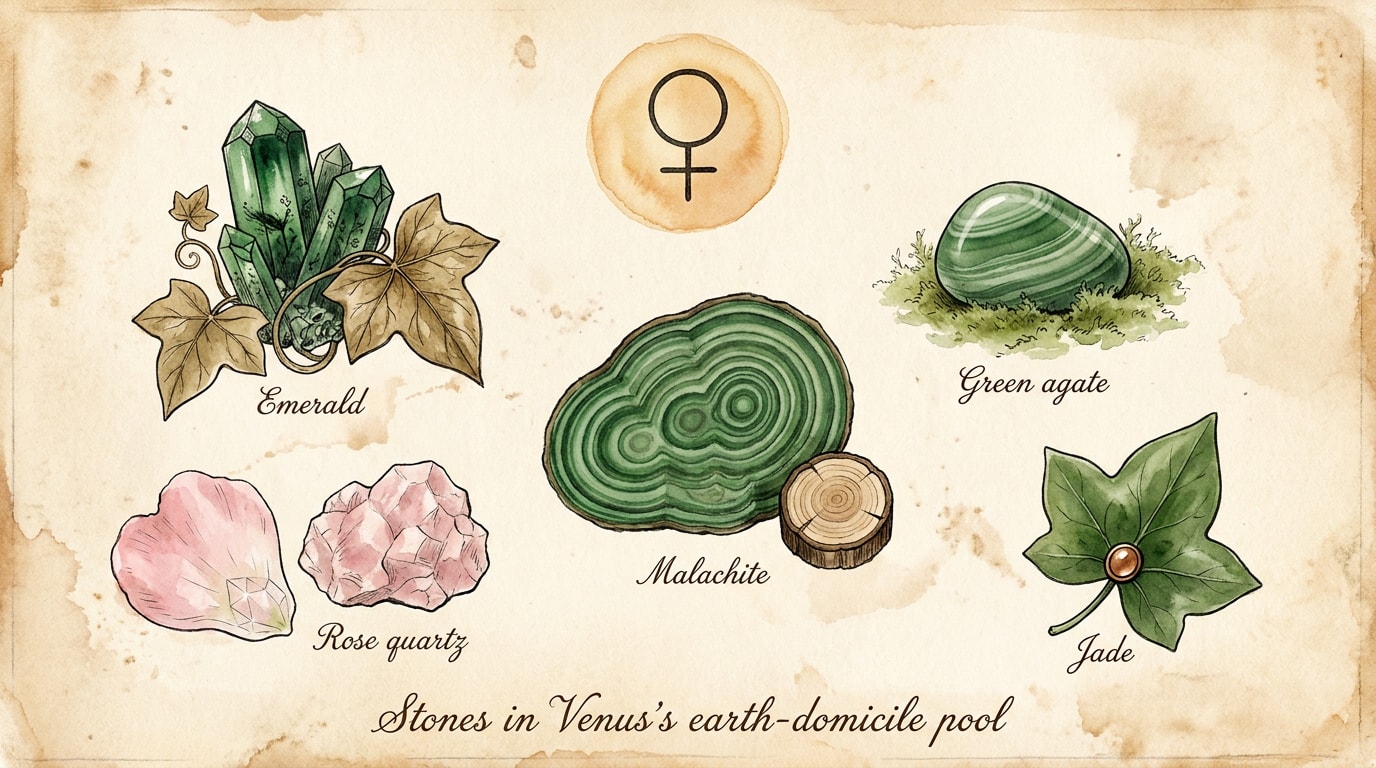
Emerald holds the centre of the Venus-pool in the lapidary tradition, named explicitly by both Culpeper and Agrippa, and named again two and a half centuries later by the 1912 American National Association of Jewelers as May's birthstone. For Taurus, this is the one stone that lands twice for two independent reasons. Rose quartz is pink quartz, named for its colour; its explicit Venus tag is largely a twentieth-century crystal-revival reinforcement of Agrippa's colour-palette logic, though rose-quartz beads have been excavated from Mediterranean sites two and a half thousand years old. Malachite is copper carbonate — which means it is, quite literally, Venus's metal crystallised into stone form. Its banded earth-green has been mined and prized since ancient Egypt, and the planetary-metal-becoming-stone makes it perhaps the most chemically Venusian of all the pool. Green agate is a quiet banded chalcedony, historically included in Venus-pool lists by colour and gentleness, and one of the dropped alternatives from the 1912 May list — a small claim from both traditions. Jade — the green family covering both nephrite and jadeite — carries Venus's nurturing-green register in the Western canon, with a deep aesthetic association in Chinese tradition that developed independently. Both lineages converge on jade as a stone of patience, growth and the durable beautiful, which is a description Taurus would happily live with.
The underlying logic is worth seeing once. In the lapidary tradition, planets are read through colour as a shorthand: red is Mars (heat, action), gold is the Sun (warmth, sovereignty), deep navy and dark earth are Saturn (gravity, time), and Venus splits by element — soft pink and sky blue for Venus-of-air (Libra's harmonising register), deep growing green and sensory pink for Venus-of-earth (Taurus's lush garden). This is why Taurus's stones look like a family rather than a random pick from the gem cabinet, and why they look distinctly different from Libra's family even though both are «Venus stones». The aesthetic isn't accidental.
What a birthstone tradition can and can't claim. Traditional planetary correspondence says: «this stone was associated with this planet, for these reasons». It does not say: «this stone will attract financial abundance, open your heart chakra, ground your root chakra, or unblock your Taurus stubbornness». Those claims belong to a separate modern crystal-healing genre that sits outside the astrological canon. Buy and wear what you find beautiful; the symbolic association is the gift, the productivity-fix isn't on offer.
Buying a real Taurus stone without overpaying
So you've landed on emerald, or one of the softer Venus-pool stones, and now you'd rather pay for the genuine article than a marked-up version of it. What follows is the plain, unglamorous kind of advice you get from someone with nothing to sell you — not exciting, but the sort of boring that keeps money in your pocket.
Where to look, in the UK. For the widest choice, head for Hatton Garden, Britain's main jewellery quarter: roughly three hundred dealers packed into a few central-London blocks, most happy to let you browse off the street with no appointment for ordinary stones. Liberty's gem counter, Astley Clarke, Selfridges and Boodles (a heritage jeweller founded in Liverpool in 1798) all carry reputable stock at department-store and fine-jeweller price points. Independent regional jewellers — your county's old high-street name, often family-run for several generations — are frequently better value than anywhere in London. For free education, the William and Judith Bollinger Gallery at the V&A in South Kensington is unbeatable; you can see the difference between natural and treated stones, in good light, without anyone trying to close a sale.
The emerald-specific honest note matters more than the others. Almost all natural emerald sold in the trade has been fracture-filled with cedar oil or a colourless resin to enhance clarity — emerald grows with small fractures (the gemmologist's word is jardin, French for «garden», because the inclusions look like tiny leaves and twigs trapped in the stone), and the filling makes the green read more cleanly. This is a centuries-old, disclosed trade norm and not a fault; in some ways it's part of what an emerald is. It explains why a £40 emerald and a £4,000 emerald can both be honestly described as «natural emerald» — the £4,000 stone generally has fewer and smaller fractures, less filling, deeper colour saturation, and a longer paper trail. Lab-grown emeralds have the same chemical composition and crystal structure as natural ones and cost a fraction; they're worth a look if the price difference matters and the «natural origin» story doesn't.
What else to read on the tag. «Natural» and «lab-grown» are both real stones with the same crystal structure and chemical composition, just different origins; natural costs more for rarity and provenance, not physical merit. «Synthetic» means lab-grown and disclosed; «simulant» means a different material (cubic zirconia for diamond, green glass for emerald), also disclosed in writing. «Treated» appears on most sapphire and most ruby and almost all emerald — disclosure is the gemmologist's responsibility and the buyer's right.
What to ignore. The moment a listing starts promising a stone's «vibration», «energy frequency», «chakra alignment» or what it «will activate», you've stepped out of gemmology and into a different conversation entirely. Neither the May calendar nor the old Venus-stone lapidaries ever made claims of that kind. A description that leans hard on healing language usually means the seller is pricing the story rather than the stone. The label that deserves your attention carries carat weight, country of origin, treatment status and clarity grade — that's the gemmologist's tag, and it tells you what your money is actually buying.
From «Taurus birthstone» to your Taurus (and Venus) placements
A Taurus birthstone search assumes Taurus is your Sun, but Taurus might be living somewhere else in your chart entirely. And for Taurus more than most signs, your Venus position deserves a second look — because Venus rules Taurus in the first place, so Venus in Taurus is the rulership doubled in a single placement. Venus orbits close to the Sun and never strays further than about forty-six degrees away from it, which means many May-born Tauruses do have Venus in Taurus or in Aries, and a quick chart calculation tells you which. In any birth chart, ten planets (the Sun, the Moon, Mercury, Venus, Mars, Jupiter, Saturn, Uranus, Neptune, Pluto) sit each in one of the twelve zodiac signs, and your Rising sign — the sign on the eastern horizon at the moment you were born — is set by your exact time of birth. Taurus can sit on any of those positions, and each one means something a little different.
 One stone, one symbol, ten placements in a chart.
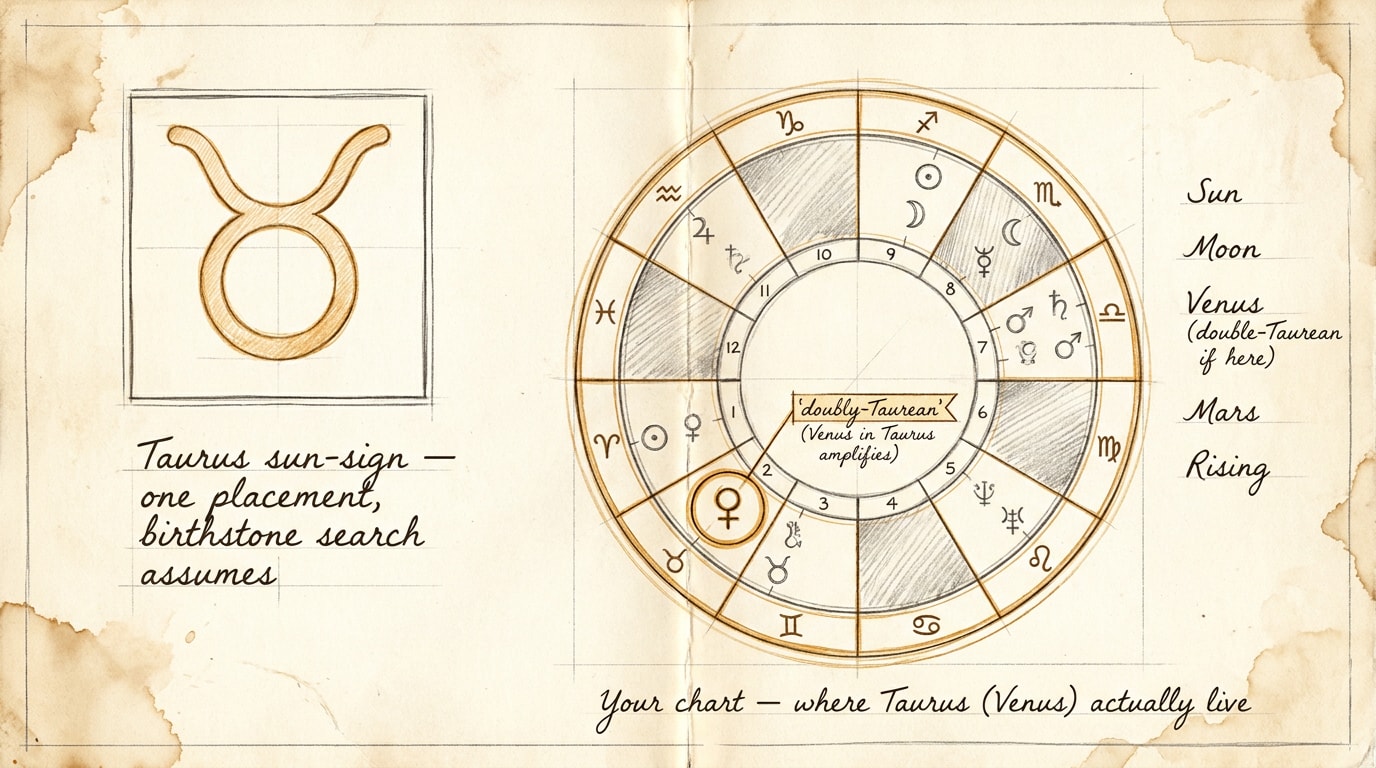
If your Moon is in Taurus, the way you settle and need security is Taurus-coloured — you feel calmer with familiar comforts and predictable rhythms, uneasy when those are disturbed. If your Mercury is in Taurus, your thinking moves at the careful pace of someone who'd rather get it right than get it fast. If your Venus is in Taurus, your aesthetic and the way you give and receive affection lean toward sensory pleasure and the durable — and for the birthstone question this is doubly interesting, because Venus rules Taurus in the first place, so Venus in Taurus is the rulership doubled in a single placement (the Venus-stone correspondences read with extra resonance, by this logic). If your Mars is in Taurus, the way you push for what you want has Taurus's patience and Taurus's reluctance to be hurried. Your Sun in Taurus, by contrast, is your sense of self, your will, the part of you that asks to be seen and settled — the placement a sun-sign birthstone search assumes you have but never checks.
If you'd like to see where Taurus actually lives in your chart — Sun, Venus, Moon, Rising, or somewhere else entirely — and where your Venus sits in particular, WowAstro will calculate a free birth chart for you. Give it your birth date, your birth time and where you were born, and a minute or two later it's done. The stone is a small symbol. The chart is the longer description, and for Taurus the Venus-position is the doubly-Taurean answer.
Questions readers ask
What is the actual Taurus birthstone?
There isn't one — there are three honest answers, depending on which question you're asking, and a small piece of accidental harmony that makes Taurus's case unusually tidy. If you mean «what stone does the modern commercial calendar give people born in May», that's emerald (per GIA's standardised birthstone list, the industry reference since 1912). April-Tauruses born 20-30 April get diamond by the same calendar logic. If you mean «what stones did the astrological tradition associate with Taurus as a Venus-ruled sign», that's the Venus-correspondence pool — most often emerald again, rose quartz, malachite, green agate and jade, drawn from Culpeper's 1652 Complete Herbal and Agrippa's 1533 De Occulta Philosophia. Emerald lands twice for Taurus, for two unrelated reasons — the rare coincidence between the modern May calendar and the ancient Venus-rulership tradition. If you mean «what stone actually means something for me», the question changes again: it depends on where Taurus (and Venus) sit in your chart. Pick the question you're actually asking, and the answer follows.
Is emerald or rose quartz the real Taurus birthstone?
Both are real, and they're real answers to different questions. Emerald is the modern May birthstone, set by jewellery-industry convention since 1912 and used by every high-street jeweller in the UK; it's also the primary Venus stone in Culpeper's 1652 herbal and Agrippa's 1533 De Occulta, which means it answers the «Taurus is Venus-ruled» astrological question too. Rose quartz is one of the Venus-pool stones in the same correspondence tradition, picked up most prominently in twentieth-century crystal-revival writing as Venus's pink stone — fits the Venus-of-earth register by colour. Neither is the «real» one — they answer slightly different questions inside the same tradition. If you want the singular stone that lands in both the modern calendar and the ancient astrological tradition, that's emerald, and Taurus is the only sign where those two traditions agree on the same gem. If you want a softer, gentler stone that still belongs to the Venus-pool and is much easier to find at any price point, rose quartz is a perfectly good answer.
What is the lucky stone for Taurus?
«Lucky» is a word that belongs to a different conversation than the one tradition is having. Astrological correspondence-tradition says «this stone was associated with this planet, for these reasons»; it doesn't promise the stone will bring you luck, love, money or any particular outcome. The stones most commonly named in connection with Taurus, in answer to the «lucky stone» framing, are emerald (the May calendar stone and the Venus stone simultaneously) and rose quartz (the most prominent of the softer Venus-correspondence stones). If you'd like a stone for symbolic association rather than for a promised outcome, either is a reasonable choice. If you'd like a stone because you find it beautiful, that's a perfectly good reason on its own.
Why is emerald considered both a May birthstone AND a Taurus / Venus stone?
For two reasons that have nothing to do with each other and yet land on the same gem. The May-birthstone claim comes from the 1912 American National Association of Jewelers standardisation, formalising centuries of European month-by-month gem traditions into a single industry list. The Venus-stone claim is much older — Venus's planetary-correspondence stone in Western lapidary tradition is emerald, named explicitly by Agrippa's De Occulta Philosophia of 1533 and Culpeper's Complete Herbal of 1652. The two traditions are several centuries apart and have entirely different logics — calendar month versus planetary rulership — and yet both arrived at emerald for Taurus. For Libra (Venus's other ruling sign) the two traditions diverge: October calendar gives opal, Venus tradition gives rose quartz. For Taurus they agree. There's no esoteric reason for the agreement; it's a coincidence of two long histories, and it's a nice one to have.
Astrology, as we use it at WowAstro, is a tool for self-reflection and self-observation, not a method for predicting events, health, or financial outcomes. Traditional correspondence-stones are symbolic associations, not medical recommendations or guaranteed luck-bringers. Take what's useful from any tradition, leave the rest.
Written by Oksana Miatova, astrologer and writer at WowAstro. Charts calculated using the Swiss Ephemeris, the same astronomical data working astrologers use. Historical correspondences drawn from Nicholas Culpeper's «Complete Herbal and English Physician» (1652), Heinrich Cornelius Agrippa's «De Occulta Philosophia» (1533) and Marbode of Rennes' «Liber Lapidum» (~1090); modern birthstone list per the Gemological Institute of America; classical emerald references from Pliny the Elder's «Natural History» (~77 CE).
Read your own natal chart
A personal AI reading, from £1
⭐ +50 Wow Stars cashback · sign up and get 100 ⭐
Build my chart →Comments
New here? Get −30% off your natal chart
Leave your email and we will send you the promo code WELCOME30. Straight after that you can comment — no passwords, all automatic.
Quick sign-in
Sign in with Telegram — one click.
Or by email (with a gift)
Already have an account? Enter the same email — we'll email you a sign-in link.