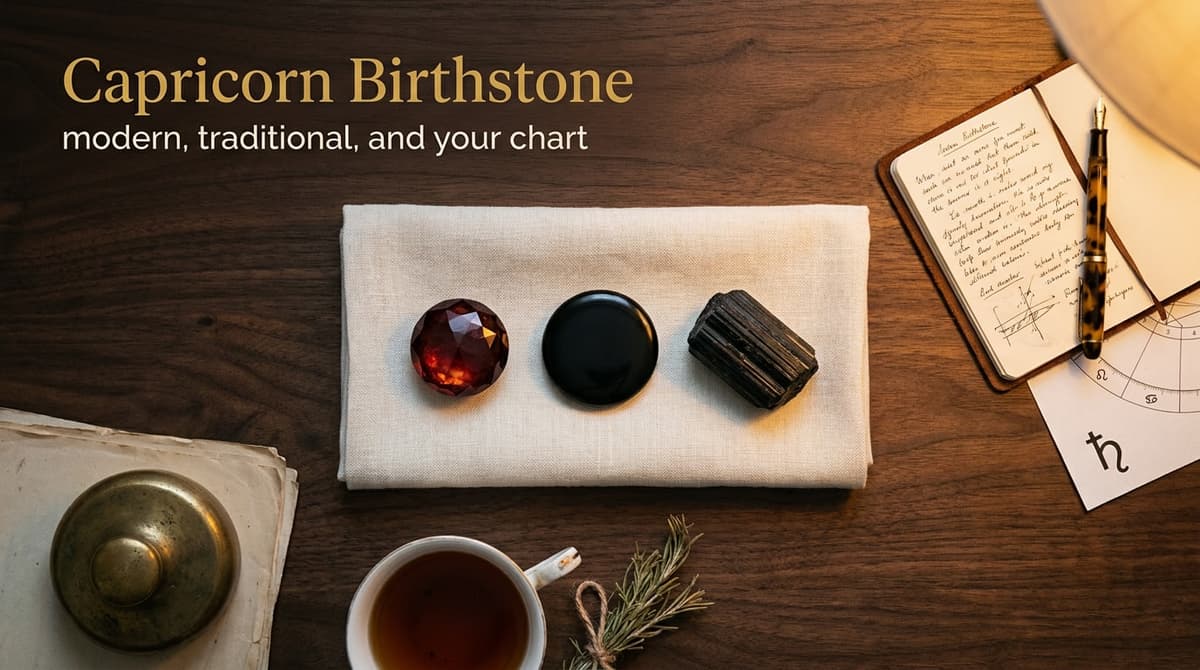
Nadia opens a third browser tab. The first article said the Scorpio birthstone is topaz, and showed a glowing pinkish-orange imperial topaz the colour of late autumn sun. The second said it's citrine, the bright lemon-yellow stone, with a brief footnote that citrine was added to the November list in 2002. The third was firmer and stranger: «The true Scorpio stones are obsidian, hematite, garnet, jasper — the deep, magnetic, Mars-Pluto pool. Anything yellow misses the point.» She closes all three. Her birthday is the 8th of November. She'd just wanted to know what to ask for.
Here's the honest answer those three articles skipped. There isn't one Scorpio birthstone, because there isn't one question. Three different traditions answer «what's the Scorpio stone» in three different ways, the Mars-Pluto co-rulership underneath the deep-stone pool is the reason it looks the way it does, and a fourth layer (your own birth chart) sits quietly behind all of them. None of these answers is wrong; they're answering different questions. Once you can see which is which, choosing one becomes much less of a debate.
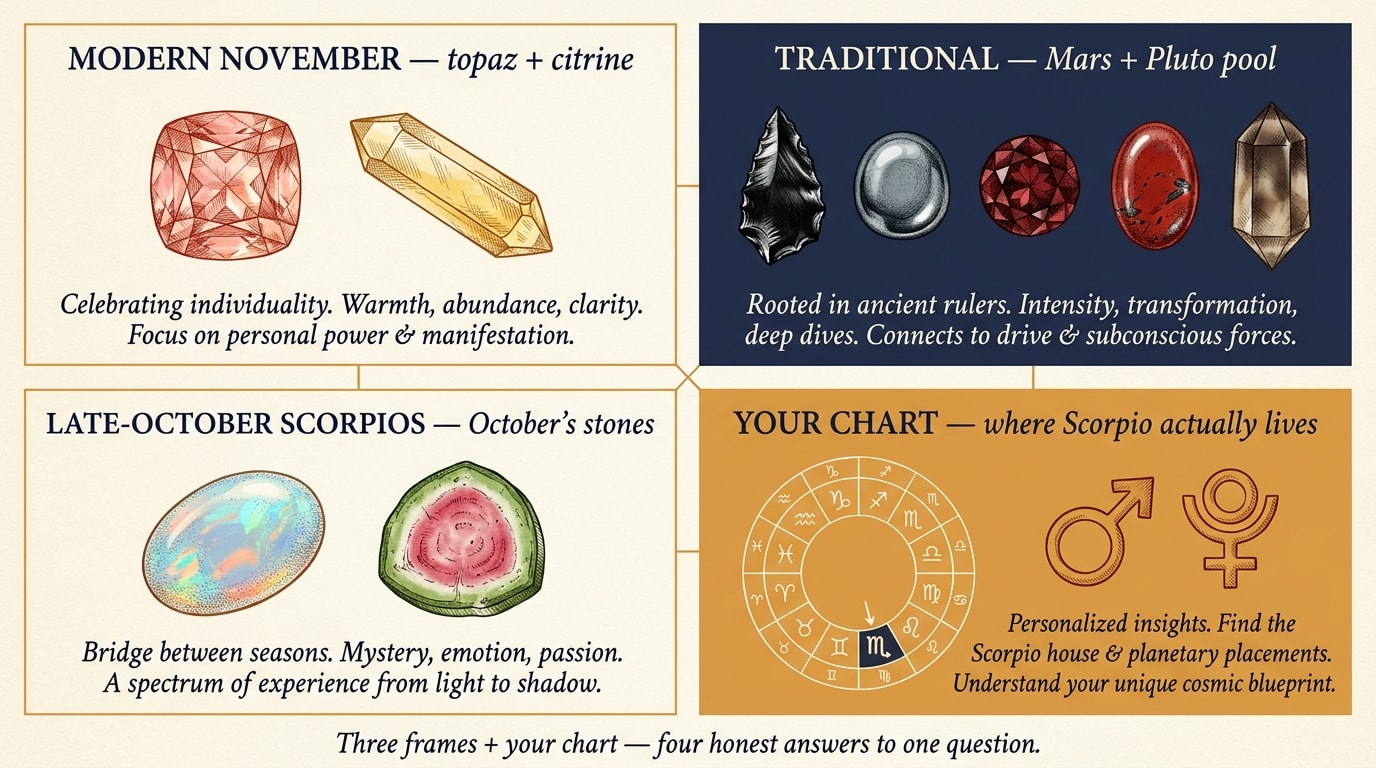
In short. «The Scorpio birthstone» is three lists answering three different questions. The modern commercial calendar assigns topaz and citrine to November, per GIA's standardised list (1912, citrine added in 2002 as the affordable yellow alternative to imperial topaz). The traditional astrological tradition ties the stones of Scorpio to its two rulers, Mars (Hellenistic through modern) and Pluto (added as co-ruler after the planet's discovery in 1930) — producing the deep-and-magnetic family: obsidian, hematite, garnet, jasper and smoky quartz. And your own birth chart may have Scorpio placed somewhere other than your Sun, with Mars-in-Scorpio and Pluto-in-Scorpio especially carrying weight as the sign's two rulers, which changes the question entirely.
 Two stones, two completely different answers.
Why there isn't one Scorpio birthstone
«Scorpio birthstone» is three different questions stacked into one phrase, which is why the search results sit there flatly disagreeing with each other, and that's before you reach the odd part — why the dark, dense pool of Scorpio stones looks nothing like the bright yellow one. The pages you turn up come from three quite separate lineages, each built to answer its own question, and almost none of them tells you which lineage it's drawing from. One is the shopfront calendar your high-street jeweller stocks by, which sorts stones under the month of birth. Another is the old European lapidary line, which sorts stones under planets — and here Scorpio is unusual, because the modern system hands it two rulers rather than one: Mars, the ruler it has carried since Hellenistic astrology, and Pluto, brought in as co-ruler once the planet was found in 1930. The third frame ignores both and asks where Scorpio actually lands in your own chart instead of assuming it sits on your Sun. Take any one of them on its own terms and it holds together cleanly; the contradictions only surface when a writer tips all three into a single bowl and calls it one answer.
There's also a smaller note about the calendar that's worth holding. Scorpio season runs roughly 23 October to 21 November, almost entirely a November month, so the calendar gives most Scorpios November's stones (topaz and citrine) cleanly, but a few late-October Scorpios sit close to the Libra-Scorpio cusp and the calendar still hands them October's stones (opal, tourmaline) by birth-month. And one last point about Pluto, which trips up readers who pay attention to astronomy: the International Astronomical Union reclassified Pluto as a «dwarf planet» in 2006, but astrologers treat that change as administrative and continue to read Pluto as a full ruler. The deep-stone pool isn't going anywhere. The three sections below walk through the frames one at a time — calendar first, then the two rulers, then your own chart.
Topaz and citrine: what the November calendar gives a Scorpio
In the modern commercial system used by GIA and the British Gemmological Association, November's birthstones are topaz and citrine, and the two have been the official November pair since 2002, when citrine was added by Jewelers of America as a commercially-accessible yellow-tone alternative to rare imperial topaz. This is the list every high-street jeweller is working from, the list that decides which gem sits in the «November» tray at Hatton Garden, and the list every birthstone-ring website cites by default. The modern list was standardised in 1912 by the American National Association of Jewelers, formally adopted by Jewelers of America, and is maintained by GIA. The 2002 addition of citrine was part of the same update that added tanzanite to December, with the same reasoning: more accessible price points without abandoning the colour-register the older single-stone tradition had carried.
The history sits at the back of every November ring. Topaz has been mined commercially in Brazil's Ouro Preto region since the eighteenth century, where the prized «imperial topaz», a pinkish-orange to sherry-coloured natural stone, not the blue most people now associate with the name, was first systematically extracted. Blue topaz on the market is almost always heat-treated and irradiated colourless topaz, a disclosed trade norm rather than a fault, and the deep saturated blue that fills supermarket jewellery counters is a twentieth-century commercial product. Citrine is yellow quartz, mined in Brazil and Madagascar, and most natural citrine is a quiet pale-yellow. The deeper amber-yellow stones common on the cheap end of the market are usually heat-treated amethyst, a routine industry treatment that turns purple quartz golden — disclosed under UK Trade Descriptions in reputable shops and quietly undisclosed elsewhere.
A note for cusp-dwellers. Scorpio season runs ~23 October — 21 November. If your birthday is between 1 and 21 November, the calendar gives you November's pair (topaz and citrine) outright. If your birthday is 23-31 October, you're a Scorpio by Sun sign but the calendar still hands you October's stones (opal and tourmaline) by birth-month. The calendar isn't being mystical about this; it's just a month-by-month list that pre-dates the standardised tropical sign-dates and never reconciled with them. The traditional astrological answer (next section) doesn't care about the month and gives the same answer either way.
The deep-and-magnetic pool: stones of Mars and Pluto
In the traditional astrological lapidary tradition, the stones of Scorpio are the stones of its rulers — Mars in the older system, with Pluto added as co-ruler in the modern system after the planet's discovery in 1930. This isn't a calendar-month assignment. It's a planetary-correspondence assignment, derived from the way medieval European, Arabic and earlier Hellenistic astrologer-physicians grouped substances by planet, then extended forward by modern astrologers integrating Pluto into the canon. Mars in Culpeper's «Complete Herbal and English Physician» (1652) and William Lilly's «Christian Astrology» (1647) is the planet of iron, blood-red minerals, dense and heavy stones with a heat or warlike association; the Mars-correspondence pool gathers garnet, ruby, jasper, blood-coral and similar deep-red, weighty substances. Marbode of Rennes, writing around 1090, places red and lead-coloured stones in the Mars family for the same reasons.
 A traditional Scorpio stone is a serious-coloured stone with weight in the hand.
Pluto changed the picture without replacing it. Clyde Tombaugh discovered the planet at Lowell Observatory in February 1930, and astrologers spent the next half-century working out what it meant in chart-reading terms. By the time Liz Greene wrote «The Astrology of Fate» in 1984 and Howard Sasportas wrote «The Gods of Change» in 1989, the consensus was settled: Pluto extended Mars's territory rather than overwriting it, taking the iron-and-blood logic deeper into underworld terrain. The Pluto-correspondence stones that came in alongside the older Mars list are the dark, dense and opaque end of the spectrum — obsidian (volcanic glass with an inner darkness like still water at night), hematite (heavy iron-oxide with a metallic grey-to-silver lustre), smoky quartz, and a continued role for black tourmaline. Garnet, hematite and jasper sit comfortably in both pools because Pluto wasn't a replacement for Mars but a deepening of the same archetypal register, and Scorpio carries the full pool rather than splitting one against the other. The result is a recognisable colour palette: deep red, dense grey, opaque black, the occasional warm brown. Once you see the pool laid out, the «why is this stone in here» question stops needing an answer.
Other Mars-Pluto correspondence and Scorpio-associated stones
Beyond obsidian, garnet and hematite, a wider pool of stones gets named on Scorpio lists, and the honest accounting separates the older Mars-Pluto correspondence canon from more recent additions made for thematic-fit reasons. Worth knowing as a shortlist if the three core stones feel out of reach, don't suit you, or simply don't appeal.
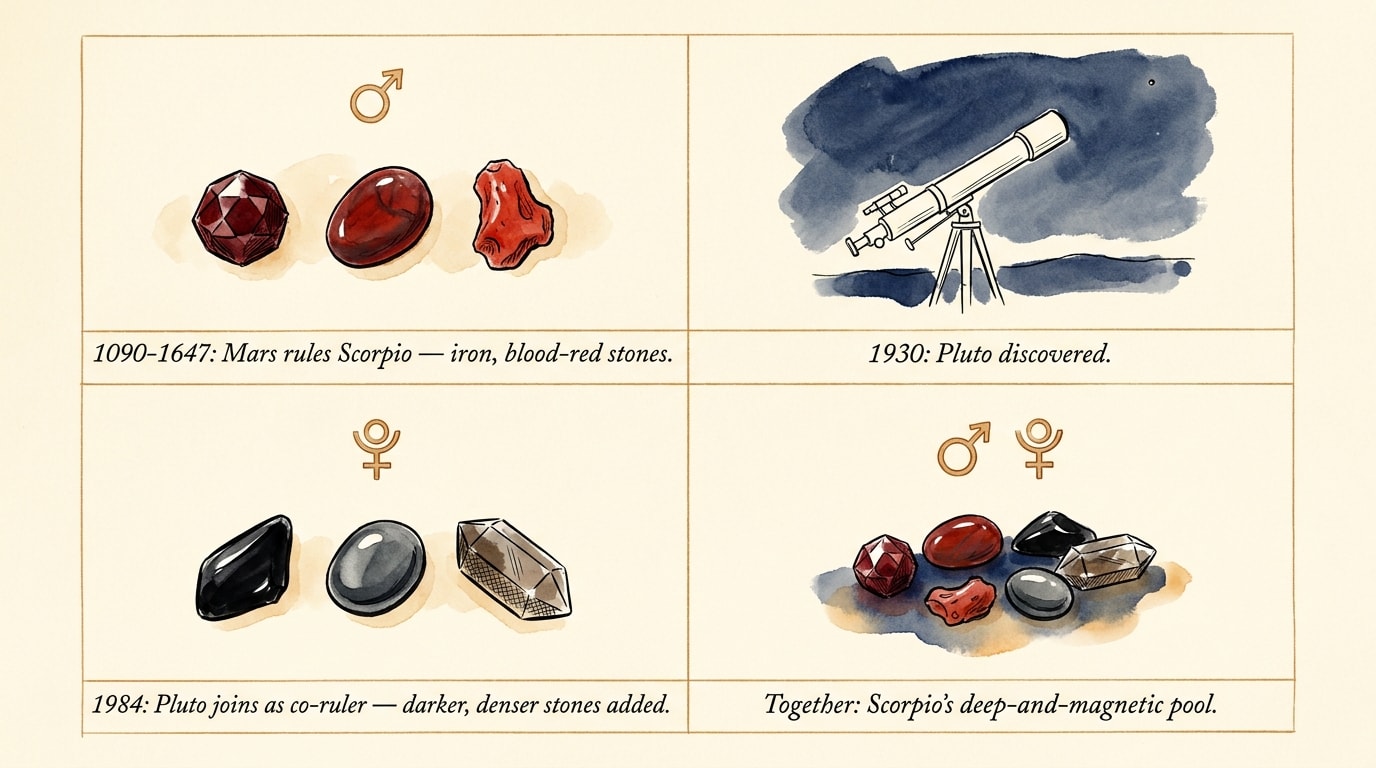
Jasper, especially the deep-red and blood varieties, is opaque cryptocrystalline quartz that sits comfortably in the Mars-correspondence pool by colour, weight and historical association. Pliny the Elder mentions jasper in his Natural History (around 77 CE) in connection with Roman soldiers, who carried small jasper amulets as protective talismans on campaign. The link to Mars's warlike register is direct, and the deep red colour places it firmly in the same family as garnet and blood-coral.
Smoky quartz is translucent brown-grey quartz, the smoke-tinted member of a very familiar mineral family. Older astrological-mineralogical texts grouped it with Saturn rather than Mars (the colour reads sober and slow rather than warlike), but modern Pluto-correspondence writing brought it across into the Scorpio pool for the same reasons it sits in the Saturn group: the appearance is grounded, the lustre is more reflective than radiant, and the colour suggests depth without drama.
Black tourmaline, schorl to gemmologists, is an opaque black silicate that turns up on most modern Scorpio-correspondence lists. Older European lapidaries don't separate tourmalines from one another (the species wasn't isolated as a distinct mineral until the eighteenth century), but the colour and weight fit the Pluto-correspondence family without strain, and the modern addition is fair as long as it's flagged.
Malachite is banded deep green with concentric eye-patterns, and its inclusion on modern Scorpio lists is more thematic than canonical. The colour isn't a Mars or Pluto colour (deep green traditionally sits closer to Venus). The stone's association with «transformation», the visible bands suggesting layered renewal — has made it a Scorpio-friendly addition in twentieth-century crystal-revival writing rather than from medieval lapidary canon. Honest to flag as modern, fair to wear if it appeals.
What a birthstone tradition can and can't claim. Traditional planetary correspondence says: «this stone was associated with this planet, for these reasons». It doesn't say: «this stone will heal you, open your sacral chakra, attract magnetic confidence, or protect you from Pluto's intensity». Those claims belong to a separate modern crystal-healing genre that sits outside the astrological canon. Buy and wear what you find beautiful; the symbolic association is the gift, the medical promise isn't on offer.
Buying a real Scorpio stone without overpaying
So you've landed on topaz, or one of the deep Mars-Pluto stones, and now you want to part with money for the genuine article rather than a glass impostor or a marked-up one. What follows is the plain, unglamorous sort of advice you get from someone with nothing to sell you — boring, but the kind of boring that keeps cash in your pocket.
Where to look, in the UK. For the widest choice, head to Hatton Garden — Britain's main jewellery quarter, crammed into a few central-London blocks where roughly three hundred dealers trade, most happy to let you browse off the street without booking ahead for everyday gems. Boodles, the independent heritage UK jeweller founded in 1798, carries reputable stock and has been doing so for long enough that its buyers know their topaz varieties cold. Liberty's gem counter, Selfridges and the better independent regional jewellers (your county's old high-street name, often family-run for several generations) frequently offer better value than the big names. For free education, the V&A's gem gallery in South Kensington, the William and Judith Bollinger Gallery, to give it its full name — is unbeatable: you can see the difference between natural and treated stones, in good light, without anyone trying to close a sale.
What to read on the tag. Citrine is the stone most likely to be something other than what it claims, because a large share of the inexpensive «citrine» on the market is heat-treated amethyst, a routine industry treatment that turns purple quartz golden, disclosed in reputable shops as «heat-treated» and quietly undisclosed in market-stall jewellery. Natural citrine tends pale and quietly yellow; the deep amber-yellow you see in cheap pendants is usually the heated kind. If the colour looks too saturated for the price, that's your answer. Topaz divides cleanly: imperial topaz (the pinkish-orange Brazilian stone) is natural and pricier, while blue topaz is almost always colourless topaz that's been heat-treated and irradiated to colour, a normal disclosed trade practice. Obsidian needs a different kind of caution, real obsidian is volcanic glass with a distinctive conchoidal fracture and an inner darkness when held up to light, while cheap «obsidian» pieces in market jewellery are sometimes just moulded black glass with no natural origin at all. Garnet is a family, not a single stone, almandine is the deep wine-red workhorse most people picture, pyrope is a slightly lighter red, rhodolite is pink-violet, demantoid and tsavorite are the green and luxury-priced varieties — and a tag saying «garnet» without a species name usually means almandine, which is perfectly honest if disclosed.
What to ignore. The moment a listing starts promising you a stone's «vibration», «energy frequency», «sacral-chakra alignment» or what it «will transform», you've wandered off the gemmologist's map and into a different conversation altogether. Neither the November calendar nor the old Mars-Pluto lapidaries ever traded in claims like that. A description leaning hard on healing talk usually means the seller is pricing the story, not the stone. The label that earns your attention carries carat weight, country of origin, treatment status and clarity grade — that's the gemmologist's tag, and it's the one that tells you what you're actually paying for.
From «Scorpio birthstone» to your Scorpio placements
A Scorpio birthstone search assumes Scorpio is your Sun, but Scorpio might be living somewhere else in your chart entirely, and where it actually lands changes which stone-correspondence has anything to do with you. A chart isn't a single sign; it's a spread of ten bodies — Sun, Moon, Mercury, Venus, Mars, Jupiter, Saturn, Uranus, Neptune and Pluto — each parked in one of the twelve signs, with a Rising sign and a Midheaven pinned down by the exact minute you were born. Scorpio can be holding any of those slots, and for Scorpio two of them carry extra freight: Mars, the traditional ruler, and Pluto, the modern co-ruler. Mars-in-Scorpio is the placement traditional Scorpio writing names most directly; Pluto-in-Scorpio belongs to a whole generation at once, those born roughly between November 1983 and November 1995.
 One stone, one symbol, ten placements in a chart.
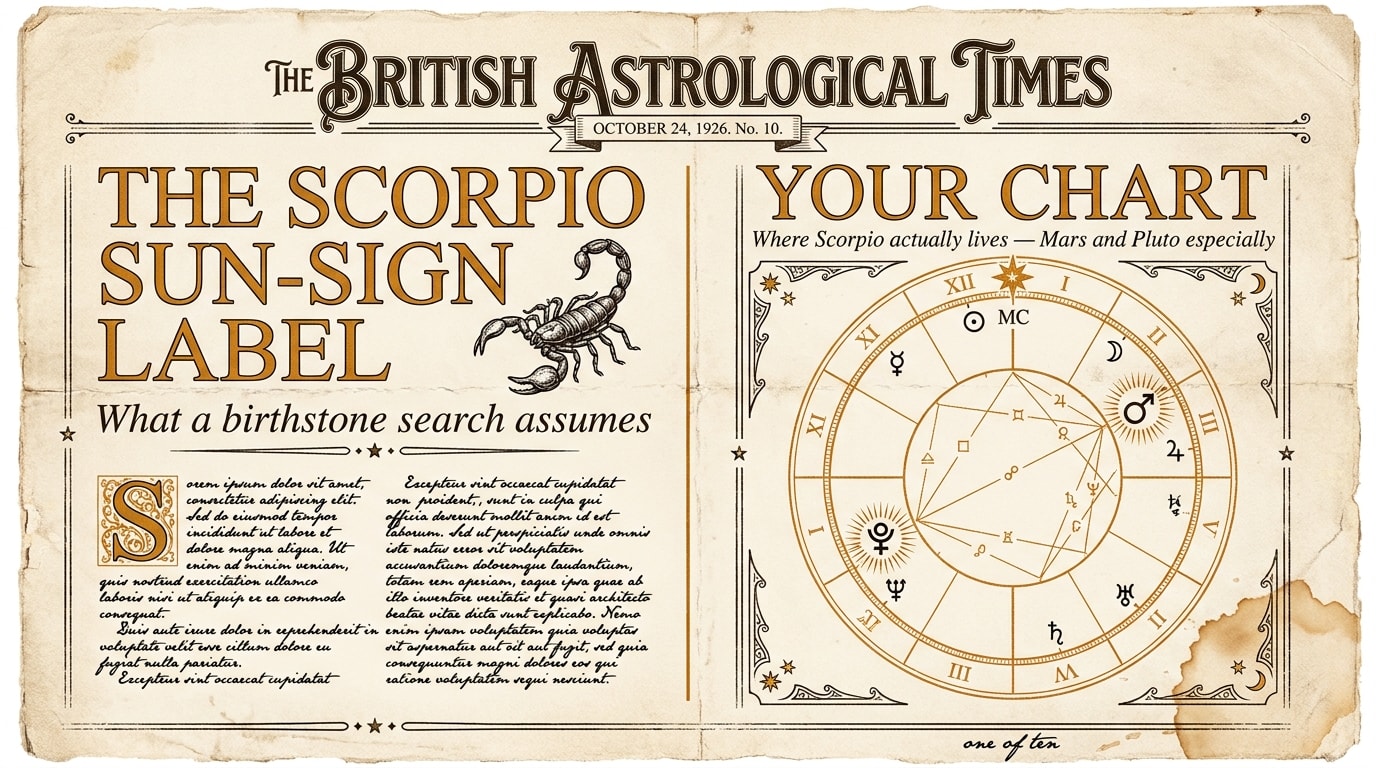
If your Moon is in Scorpio, your emotional baseline is built for private depth and held intensity; you grieve quietly and remember everything. If your Venus is in Scorpio, your affection is given slowly and completely, with a preference for one deep loyalty over many shallow ones. If your Mars is in Scorpio, your drive is focused and undeflected in the sign Mars rules, work pursued past the point most people would stop, projects finished with a quiet thoroughness. If your Rising is in Scorpio, your first impression carries a held intensity that people read as either magnetic or guarded depending on what they brought to the conversation. And if your Pluto is in Scorpio (the cohort born roughly between November 1983 and November 1995), the transformation themes that Pluto carries through the wider chart land in their home sign for your generation — a generational mark that shows up in cultural appetite for the dark, the depth-psychological, the rebuild-after-collapse story. A birthstone for your Sun is one thing; a birthstone for the placement that's actually loudest in your chart might be quite another, and the only way to know which is which is to look at the whole chart rather than the sun-sign label.
If you'd like to see where Scorpio actually lives in your chart rather than the sun-sign label, WowAstro will calculate a free birth chart for you. Give it your birth date, your birth time and where you were born, and a minute or two later it's done. The stone is a small symbol; the chart is the longer description.
Questions readers ask
What is the actual Scorpio birthstone?
There isn't one; there are three honest answers, and the question of which to follow depends on what you're actually asking. If you mean «what stone does the modern commercial calendar give people born in Scorpio season», the answer is the November pair: topaz and citrine, per GIA's standardised birthstone list, which has been the industry reference since 1912 and was updated in 2002 to add citrine as a commercially-accessible yellow alternative to rare imperial topaz. (Late-October Scorpios on the Libra-Scorpio cusp still get October's stones, opal and tourmaline, by birth-month.) If you mean «what stone did the traditional astrological tradition associate with Scorpio as a Mars-ruled and Pluto-co-ruled sign», the answer is the deep-and-magnetic family, obsidian, hematite, garnet, jasper, smoky quartz — drawn from Culpeper, Lilly and Marbode for the Mars side and from modern astrologers like Liz Greene and Howard Sasportas for the Pluto extension after the planet's 1930 discovery. If you mean «what other stones get named in modern Scorpio lists», that includes black tourmaline for Pluto-correspondence reasons and malachite for thematic ones. Pick the question you're actually asking, and the answer follows.
Is topaz or obsidian the Scorpio birthstone?
Both are real, they're real answers to different questions, and neither is more «right» than the other. Topaz is one of November's two birthstones in the modern commercial calendar (along with citrine), the list every high-street UK jeweller works from, and the calendar gives it to most Scorpios by birth-month. Obsidian is in the traditional astrological pool for Scorpio because it sits in the Pluto-correspondence family, added to the canon after Pluto's 1930 discovery — alongside hematite, garnet, smoky quartz and the rest of the deep-and-magnetic stones. If you want the answer the high-street jeweller is giving, the answer is topaz (or citrine). If you want the answer traditional astrology is giving, the answer is one of the deep pool. If you want both at once, wearing both is fair, and many people do.
What is the lucky stone for Scorpio?
The word «lucky» sits in a different register from the one the tradition actually speaks in. Correspondence-tradition says «this stone was tied to this planet, for these reasons» — and stops there; it makes no promise that the stone will deliver luck, love, transformation, magnetic confidence or any other outcome. When the «lucky stone» question is aimed at Scorpio, the names that come back most are topaz and citrine (the November calendar pair), garnet (Mars-correspondence, the affordable deep-red), and obsidian (Pluto-correspondence, the black volcanic-glass stone). If you'd like a stone for symbolic association rather than for a promised outcome, any of those is a reasonable choice. If you'd like a stone because you find it beautiful, that's a perfectly good reason on its own.
Can I wear a different birthstone if I'm a Scorpio?
Yes — and tradition raises no objection. These lists hand you correspondences, not commands. Neither the modern commercial system nor the historical astrological one contains any rule binding a Scorpio to topaz or obsidian over emerald, amethyst, sapphire or whatever else draws the eye. Fall for a stone that «belongs» to another sign and wear it anyway: traditional astrologers would likely respect a genuine preference far more than a stone worn out of dutiful habit. Treat the birthstone tradition as a way in to choosing something that means something, not a closed system you're obliged to obey. Wear the one you'll actually want to look at.
Astrology, as we use it at WowAstro, is a tool for self-reflection and self-observation, not a method for predicting events, health, or financial outcomes. Traditional correspondence-stones are symbolic associations, not medical recommendations or guaranteed luck-bringers. Take what's useful from any tradition, leave the rest.
Written by Oksana Miatova, astrologer and writer at WowAstro. Charts calculated using the Swiss Ephemeris, the same astronomical data working astrologers use. Historical correspondences drawn from Nicholas Culpeper's «Complete Herbal and English Physician» (1652), William Lilly's «Christian Astrology» (1647), and Marbode of Rennes' «Liber Lapidum» (~1090); modern Pluto-correspondence work from Liz Greene and Howard Sasportas; modern birthstone list per the Gemological Institute of America.
Read your own natal chart
A personal AI reading, from £1
⭐ +50 Wow Stars cashback · sign up and get 100 ⭐
Build my chart →Comments
New here? Get −30% off your natal chart
Leave your email and we will send you the promo code WELCOME30. Straight after that you can comment — no passwords, all automatic.
Quick sign-in
Sign in with Telegram — one click.
Or by email (with a gift)
Already have an account? Enter the same email — we'll email you a sign-in link.