Sophia opens a third browser tab. The first article said the Sagittarius birthstone is turquoise. The second said it's topaz. The third gave a list of eight stones, all of them apparently «the Sagittarius stone». A fourth tab said «December birthstones are tanzanite, turquoise and zircon — pick one». Her mother, also a Sag, born on 25 November, had been told categorically her stone was topaz. Sophia's 8 December birthday hadn't earned her the same simple answer.
Here's the honest version those tabs skipped. There isn't one Sagittarius birthstone, because there isn't one question, and a calendar split sits quietly down the middle of Sagittarius season that none of the tabs mentioned. Three different traditions answer «what's the Sag stone» three different ways, the calendar adds a November/December divide most lists pretend doesn't exist, and a fourth layer (your actual birth chart) sits behind all of them. Not one of those Sag answers is a mistake — they simply set out to answer separate things, the way an archer aims at one target while ignoring the others. Once you can see which is which, it becomes a lot easier to pick one, or to put your phone down and choose what you actually like.
In short. «The Sagittarius birthstone» is three lists answering three different questions, plus a calendar split. The modern commercial calendar assigns topaz and citrine to November, and turquoise, zircon, tanzanite and blue topaz to December, per GIA's standardised list (1912, updated 2002). Sagittarius season straddles both months, so Nov-born Sags get one list and Dec-born Sags another. The traditional astrological tradition ties Sagittarius's stones to its ruler Jupiter — the sky-blue family: turquoise, sapphire, lapis lazuli and amethyst — chosen for the colour of the far horizon Jupiter rules. And your own birth chart may have Sagittarius placed somewhere other than your Sun (Rising and Jupiter-in-Sag especially carry weight), which changes the question entirely.
 The honest answer rarely sits at the top of the search results.
Why there isn't one Sagittarius birthstone
«Sagittarius birthstone» is three different questions in a trench coat, which is why the search results contradict each other so cheerfully, and that's before we even get to the calendar problem that's unique to Sag. Spend an evening reading Sag birthstone pages and you're actually reading three separate bodies of knowledge stacked on top of one another, with nobody pausing to say which shelf they've reached up to. One shelf is the modern shop-counter calendar, the version your high-street jeweller reaches for, which files stones under the month you were born. Another is the old European lapidary line of thought, which files stones under the planet they answer to — and because Jupiter rules Sagittarius, the archer inherits Jupiter's stones, the deep and regal blues. A third, looser shelf sweeps up whatever else has been pinned to Sag or to Jupiter over the years, on grounds of colour, worth or old mythology. Read on its own terms each shelf hangs together perfectly; the apparent contradiction only appears when you tip all three into the same basket and shake.
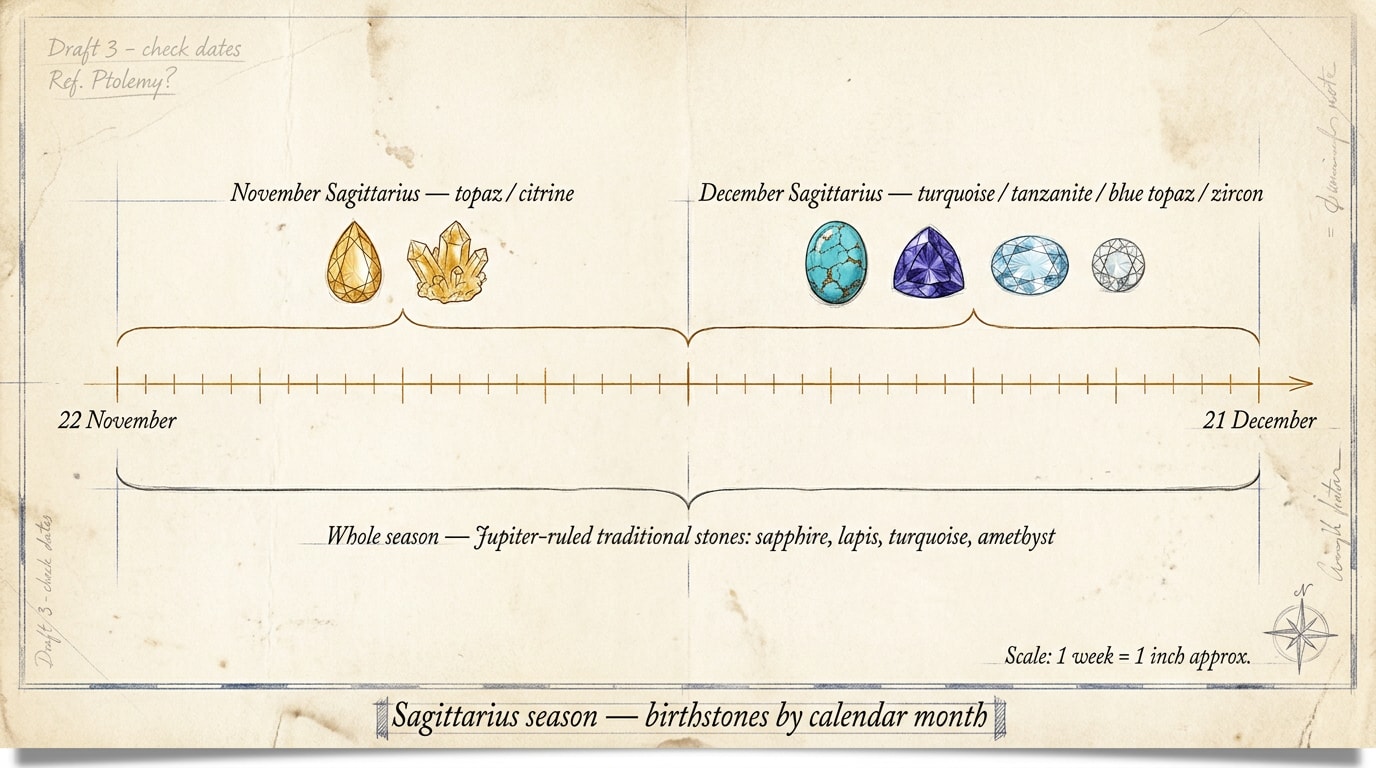
There's also the calendar problem, which is specific to Sag and nobody mentions it. Sagittarius season runs roughly 22 November to 21 December, which means birthstone lists, assigned by month, hand Sag two different answers depending on which side of 1 December your birthday lands. Late-November Sags get the November list. December Sags get the December list. Same sign, different stones. The practical way through all of this is to ask yourself which question you're actually asking. The next three sections take the three traditions one at a time, and the cusp problem gets its own paragraph.
The calendar's answer: November and December Sags get different stones
In the modern commercial system used by GIA and the British Gemmological Association, November's birthstones are topaz and citrine, and December's birthstones are turquoise, zircon, tanzanite and blue topaz. This is the list every high-street jeweller is working from, the list that decides which gem sits in the «November» or «December» tray at Hatton Garden, and the list every birthstone-ring website cites by default. The modern list was standardised in 1912 by the American National Association of Jewelers, formally adopted by Jewelers of America, and is maintained by GIA. Tanzanite was added to December in 2002, a generation after the stone itself was discovered.
The history sits at the back of every Sag birthstone. Turquoise has been mined in Persia (modern Iran) for around five thousand years and in the Sinai for nearly as long, which is why turquoise jewellery shows up in pharaonic tombs and Persian royal courts alike. Tanzanite, by contrast, is barely older than colour television. It was discovered in northern Tanzania in 1967, mined commercially from a single small area near Mount Kilimanjaro, and added to the December list in 2002, partly because Tiffany & Co. wanted a new winter stone for the calendar. Blue topaz on the market is almost always heat-treated and irradiated colourless topaz, a disclosed trade norm rather than a fault. Citrine's warm honey colour, like late autumn light caught in a glass, made it a natural pairing with November's golden topaz.
A note for cusp-dwellers, on both edges of Sag season. If your birthday is 20-22 November (Scorpio-Sag cusp), the calendar gives you November's stones (topaz, citrine) whether you turn out to be late-Scorpio or early-Sag, because the calendar doesn't care which sign you've slid into, only what month you were born in. If your birthday is 19-22 December (Sag-Cap cusp), the calendar gives you December's stones (turquoise, tanzanite, blue topaz, zircon), again regardless of whether the exact sign-change put you in late-Sag or early-Cap. The traditional astrological answer, in the next section, doesn't care about either edge.
The traditional Jupiter stones
In the traditional astrological lapidary tradition, the stones of Sagittarius are the stones of its ruler, Jupiter, and the Jupiter stones cluster very noticeably around one colour. This isn't a calendar-month assignment. It's a planetary-correspondence assignment, derived from the way medieval European, Arabic and earlier Hellenistic astrologer-physicians grouped substances by planet. The metals, woods, herbs and stones each planet «ruled» were chosen for metaphors of resemblance: colour, weight, visible quality, cultural association. Jupiter, the planet of expansion, sky and meaning, was metaphorically grouped with stones the colour of the far horizon — the blues. Sapphire's deep blue, lapis's flecked night-sky, turquoise's southern-sky pale, amethyst's regal violet, all in the same metaphorical family. Nicholas Culpeper, the seventeenth-century English physician whose «Complete Herbal and English Physician» (1652) remains the most widely-cited British source for this tradition, lists tin as Jupiter's metal and groups bluish stones with the planet. Marbode of Rennes, writing around 1090, and the Picatrix (the 12th-century Latin translation of a 10th-century Arabic magical text) both place sapphire and lapis among the most regal Jupiter correspondences.
 The far horizon is the colour of every traditional Sag stone.
The logic that ties blue stones to Jupiter is metaphorical rather than chemical, and once you see it the canon stops feeling arbitrary. Jupiter was the big planet, the slow but generous planet, the planet of large meaning and large distance. Medieval astrologers placed substances under Jupiter that felt the same way: tin (the metal cast for ceremonial cups, lighter than lead but bigger than gold), forest trees that grew tall enough to mark a horizon, and stones that caught the eye the way the cloudless sky does — by depth rather than by sparkle. Turquoise has been called the «sky stone» in nearly every culture that ever mined it. Sapphire was the stone of medieval bishops, who wore it on the principle that it pointed the eye upward. Lapis lazuli, the deep blue with flecks of gold-coloured pyrite, was so prized by Egyptian and Mesopotamian rulers that it was ground into pigment for the robes of painted gods. Amethyst, slightly off the blue spectrum into violet, was Jupiter-grouped for its regal saturation and its association with sober good judgement. None of this is a healing claim. It's a metaphor that gave craftsmen and astrologers a way to organise the world without modern chemistry. If you're asking «what stone did the old tradition associate with my Jupiter-ruled sign», the answer is one of the sky-blue family, and the same answer holds whether you were born in November or December.
The stones on the edge of the Sag list
Beyond the four core blues, several other stones get named on Sag lists, and the honest accounting separates the older Jupiter-correspondence canon from the more recent additions made for thematic-fit reasons. Worth knowing as a shortlist if the four core blues feel out of reach, don't suit you, or simply don't appeal.
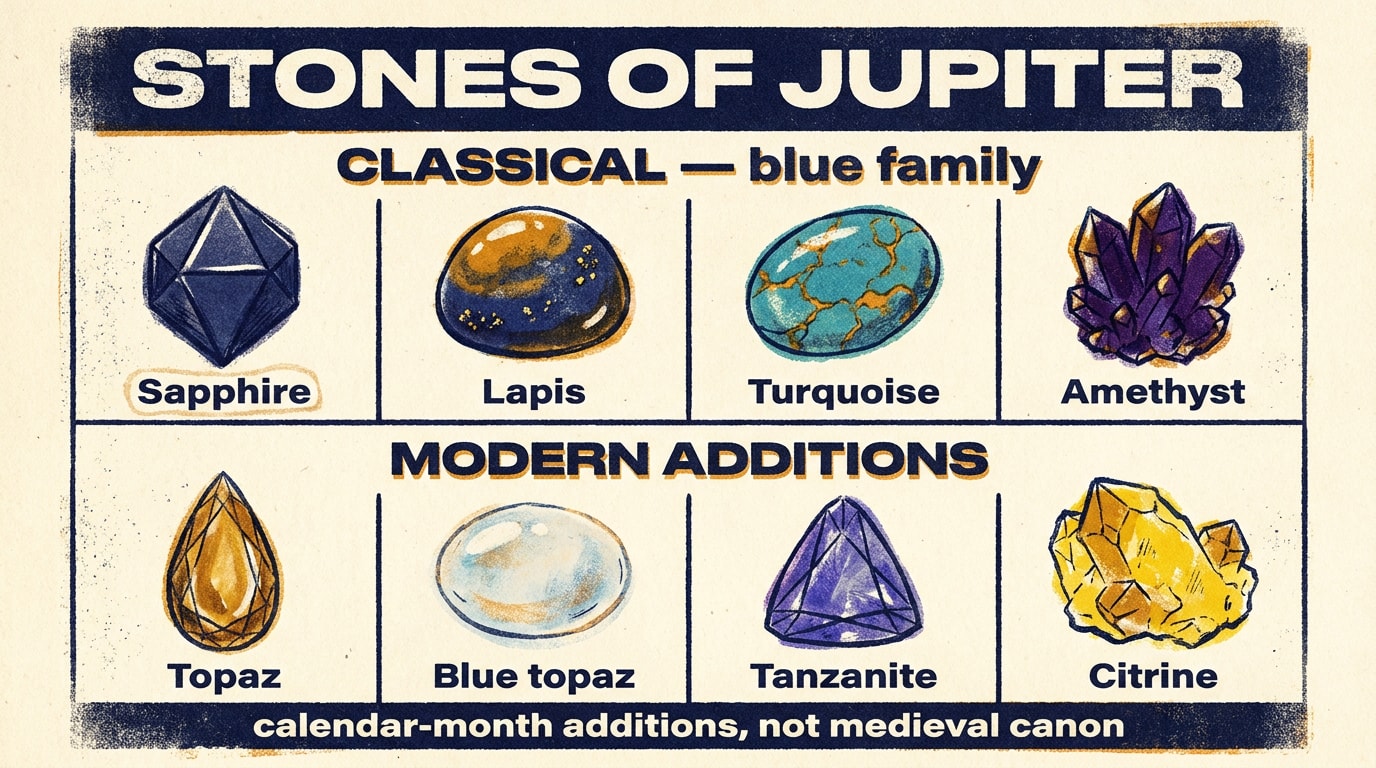
Topaz, the warm golden-yellow variety, sits in two lists at once. It's the modern November birthstone (per GIA), and it also turns up in some Renaissance Jupiter correspondences on the strength of being a golden, sun-warm stone in a tradition that grouped Jupiter loosely with abundance and generous wealth. (Jupiter was called the «greater benefic» in classical astrology, the planet of large blessings.) For a November Sag, topaz is therefore a natural pick from either frame.
Blue topaz is the modern December birthstone, and almost all of it on the market is colourless topaz that has been heat-treated and irradiated to give it the blue colour. This is a disclosed trade practice, not a fault, but it's worth knowing that the blue you're paying for is chemically encouraged rather than naturally occurring. The Jupiter-blue colour-logic still applies; the chemistry is recent.
Tanzanite, the violet-blue gem discovered in 1967 and added to December in 2002, is too new for any traditional correspondence, but its colour fits the Jupiter-blue family if you accept the broader frame. It's also rare and expensive (mined from a single small region), and the supply is finite, so prices have been trending upward for years.
Citrine, the warm yellow-to-amber quartz, is the modern November alternative to topaz. It's more often Sun-associated by colour in older traditions, but its inclusion on modern Sag lists works on the same Jupiter-as-warm-and-generous logic that brings golden topaz into the frame. Most citrine sold today is heat-treated amethyst, which is disclosed in the trade.
What a birthstone tradition can and can't claim. Traditional planetary correspondence says: «this stone was associated with this planet, for these reasons». It doesn't say: «this stone will heal you, expand your higher mind, attract travel opportunities, or protect you from misfortune on long journeys». Promises like that come from a much newer crystal-healing trade, a separate world from the lapidary tradition that handed Sag its blues, and the two should not be confused. Buy and wear what you find beautiful; the symbolic association is the gift, the medical or fortune-promise isn't on offer.
Buying a real Sag stone without overpaying
So you've settled on a stone and now you want the genuine article at a fair price rather than a clever markup. What follows is mostly plain and unglamorous, which is exactly how buying notes read when nobody's trying to talk you into anything.
Where to look, in the UK. Start with Hatton Garden in central London, Britain's principal jewellery quarter — roughly three hundred dealers packed into a handful of streets, most of them open to walk-in browsers, with no appointment needed for ordinary stones. Boodles, the independent heritage UK jeweller founded in 1798, carries reputable stock and has been doing so for long enough that its buyers know their sapphires and tanzanites cold. Liberty's gem counter, Selfridges and the better independent regional jewellers (your county's old high-street name, often family-run for several generations) frequently offer better value than the big names. For free education, the V&A's gem gallery in South Kensington (the William and Judith Bollinger Gallery, to give its full name) is unbeatable. You can see the difference between natural and treated stones, in good light, without anyone trying to close a sale.
What to read on the tag — Sag-specific. Turquoise needs the most caution of any stone on the Sag list. A lot of cheap «turquoise» on the market is dyed howlite or magnesite (white stones dyed blue), which is disclosed in reputable shops and undisclosed in market-stall jewellery and on most low-end Etsy listings. If the price seems impossibly low, the answer is usually howlite. Blue topaz is almost always heat-treated and irradiated colourless topaz, a normal disclosed practice rather than a fault. Sapphire is commonly heat-treated to deepen colour (disclosed); «untreated natural» commands a substantial premium; lab-grown sapphire is real sapphire, same chemistry, much cheaper. Tanzanite is virtually always heat-treated (disclosed). Lapis lazuli should show visible pyrite flecks for the best material; too-uniform «lapis» is often dyed jasper or sodalite, and reputable dealers will name the source region.
What to ignore. Talk of a stone's «vibration», its «throat-chakra alignment», its «travel-luck infusion» or whatever it's said to «manifest» comes from a wholly different script than the one a gemmologist works from. Neither the shop-counter calendar nor the old astrological lapidaries ever made any of those promises about Sag's stones. When a seller's blurb is thick with healing language, read it as a tell: the pitch is doing the work the stone can't. The label you actually want lists carat weight, country of origin, treatment status and clarity grade — that's the gemmologist's tag, and it's the only one telling you what you're paying for.
From «Sagittarius birthstone» to your Sagittarius placements
A Sagittarius birthstone search assumes Sagittarius is your Sun, but Sagittarius might be living somewhere else in your chart entirely, and knowing where it actually sits changes which stone-correspondence might mean anything to you. A full chart spreads ten planets — the Sun, the Moon, Mercury, Venus, Mars, Jupiter, Saturn, Uranus, Neptune and Pluto — across the twelve signs, one apiece, while your Rising sign, the slice of zodiac climbing the eastern horizon at your moment of birth, is pinned down by your exact birth time. Sagittarius can sit on any of those positions, and for Sag specifically, two placements carry extra weight: the Rising sign (the part of you that walks into rooms first) and Jupiter itself, Sag's ruler, wherever it happens to sit in your chart.
 One stone, one symbol, ten placements in a chart.
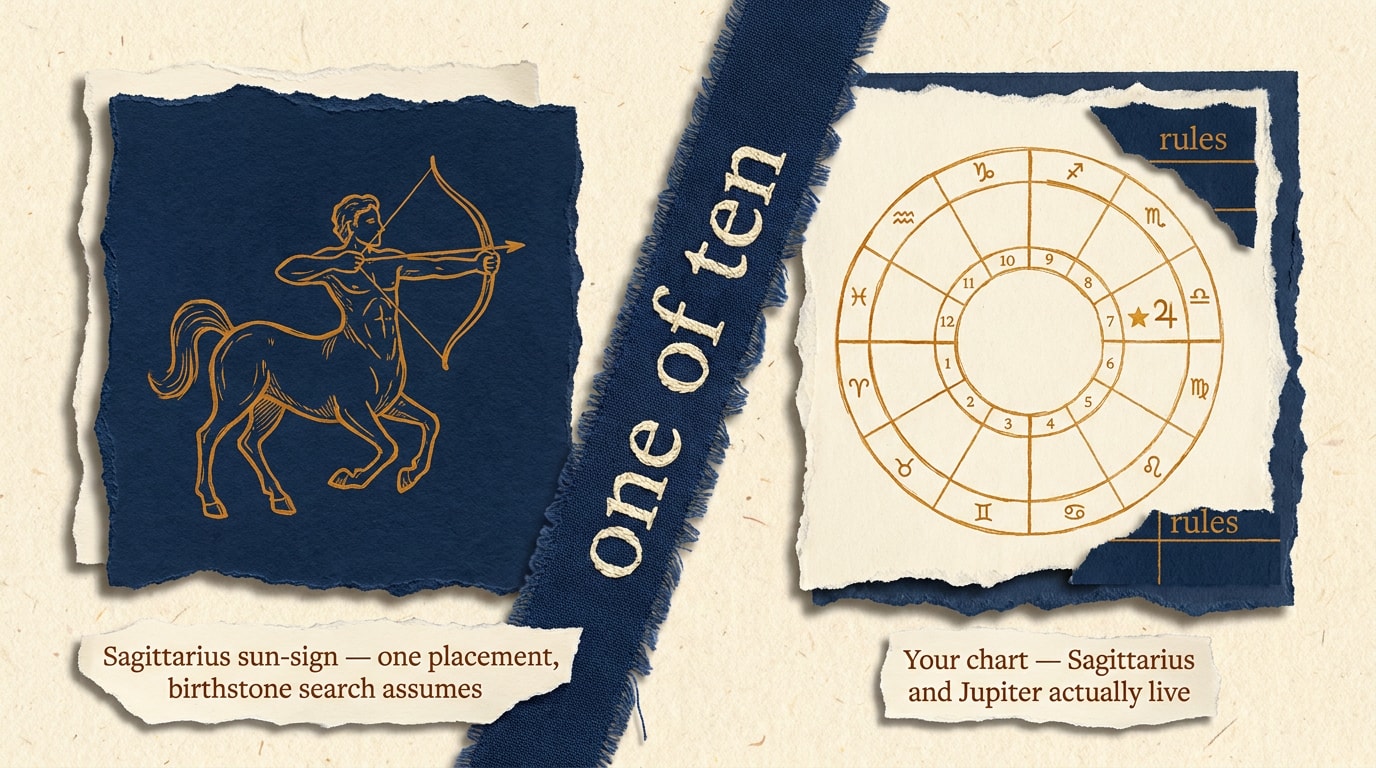
If your Moon is in Sag, your emotional baseline asks for room and the next horizon, you settle by moving rather than by holding. If your Venus is in Sag, your affection comes with adventure-sharing — the love-language of shared journeys and big ideas in cafes. If your Mars is in Sag, the way you push for what you want has Jupiter's optimistic largeness, the door pushed open with the assumption it ought to be. If your Rising is in Sag, you arrive in rooms as the curious one, the one who asks where everyone is from. And if your Jupiter is in Sag — a placement that returns roughly every twelve years, so the cohort born during each Jupiter-in-Sag transit shares it — your appetite for meaning is amplified, the planet sitting in its own sign with extra reach. Choosing a stone for your Sun and choosing one for whichever placement actually dominates your chart can lead you to two completely different gems, and there's no shortcut to telling them apart — you have to read the whole wheel, not just the sun-sign sticker on the front.
If you'd like to see where Sagittarius actually lives in your chart rather than the sun-sign label, WowAstro will calculate a free birth chart for you. Give it your birth date, the time and the town, and a couple of minutes does the rest. The stone is a small symbol. The chart is the longer description.
Questions readers ask
What is the actual Sagittarius birthstone?
There isn't one, there are three honest answers, and the calendar splits one of them in two. If you mean «what stone does the modern commercial calendar give people born in Sagittarius season», the answer depends on your birth-month: November-born Sags get topaz and citrine, while December-born Sags get turquoise, zircon, tanzanite and blue topaz, per GIA's standardised birthstone list, which has been the industry reference since 1912 and was updated in 2002 to add tanzanite to December. If you mean «what stone did the traditional astrological tradition associate with Sagittarius as a Jupiter-ruled sign», the answer is the blue family — turquoise, sapphire, lapis lazuli, amethyst — drawn from Culpeper, Marbode of Rennes and the Picatrix, grouped under Jupiter for the colour of the far horizon. If you mean «what other stones get named in modern Sag lists», that includes blue topaz and tanzanite as 20th-century calendar additions to the broader Jupiter-blue family. Pick the question you're actually asking, and the answer follows.
Is turquoise or topaz the real Sagittarius birthstone?
Both are real, they're real answers to different questions, and your birth-month matters. Turquoise is one of December's birthstones in the modern list, along with tanzanite, blue topaz and zircon. Topaz is one of November's birthstones, along with citrine. If you were born in November, the calendar gives you topaz outright. If you were born in December, the calendar gives you turquoise (or the December alternatives). Both are correct for their month, neither is the «real» one across the whole sign, and the traditional astrological answer — the Jupiter-blue family — sits alongside both as a third frame anyone born under Sag can draw on regardless of birth-month. If you find turquoise beautiful and you were born in November, wear turquoise anyway; the Jupiter-correspondence answer applies to you too.
Why are Sagittarius stones mostly blue?
Because Sagittarius is ruled by Jupiter, and the medieval European lapidary tradition grouped Jupiter with the blue family of stones for reasons of metaphor rather than chemistry. Jupiter was the planet of sky, expansion and far distance, and blue is the colour of the far — the cloudless horizon, the deep distance that doesn't have a near edge. Sapphire's deep blue, lapis lazuli's flecked night-sky, turquoise's southern-sky pale and amethyst's regal violet were all grouped under Jupiter by that colour-logic. Culpeper (1652) lists bluish stones under Jupiter explicitly; Marbode of Rennes (~1090) and the Picatrix both place sapphire and lapis among Jupiter's most regal correspondences. The blue-clustering of Sag stones isn't a coincidence and isn't mystical, it's a metaphor: Jupiter rules the «far», the «far» is the colour of the sky, and the stones that hold that colour got grouped with the planet. The calendar additions (blue topaz, tanzanite) extend the same colour-family with stones the medieval lapidaries never saw, but the underlying logic still tracks.
Can I wear a different birthstone if I'm a Sag?
Yes, and tradition is on your side about this. Birthstone lists give correspondences, not prescriptions. There's no rule, in either the modern commercial system or the historical astrological one, that requires a Sag to wear turquoise or topaz rather than emerald, ruby, garnet or anything else that catches the eye. If the stone that genuinely catches a Sag's eye «belongs» on paper to some other sign, wear it anyway — the old astrologers, who prized an honest love over a dutiful one, would likely nod at the choice. Treat the Sag birthstone lists as a doorway into something that means something to you, not a rulebook the archer is bound to follow. Wear the one you'll actually want to look at.
Astrology, as we use it at WowAstro, is a tool for self-reflection and self-observation, not a method for predicting events, health, or financial outcomes. The planet-stone pairings handed down for Sagittarius are matters of symbolism and old craft, never a promise of healing or of luck secured. Take what's useful from any tradition, leave the rest.
Written by Oksana Miatova, astrologer and writer at WowAstro. Charts calculated using the Swiss Ephemeris, the same astronomical data working astrologers use. Historical correspondences drawn from Nicholas Culpeper's «Complete Herbal and English Physician» (1652), Marbode of Rennes' «Liber Lapidum» (~1090), and the Picatrix (12th-century Latin); modern birthstone list per the Gemological Institute of America.
Read your own natal chart
A personal AI reading, from £1
⭐ +50 Wow Stars cashback · sign up and get 100 ⭐
Build my chart →Comments
New here? Get −30% off your natal chart
Leave your email and we will send you the promo code WELCOME30. Straight after that you can comment — no passwords, all automatic.
Quick sign-in
Sign in with Telegram — one click.
Or by email (with a gift)
Already have an account? Enter the same email — we'll email you a sign-in link.