
A friend mentions in passing that her life path is 7, and it explains everything. You type "numerology" into Google and land on a calculator that hands you back a number with three lines of description and no clue where the number came from. You're not entirely sure whether numerology is the same as astrology, a part of astrology, or a completely separate thing — and the calculator hasn't helped.
This is the plain-English explainer. What numerology actually is, where it came from, the four numbers that make up a basic reading, how to calculate the most important one by hand, and where the system sits next to astrology. Honest about its limits, useful within them.
In short. Numerology is a four-thousand-year-old system that assigns meaning to numbers derived from your birth date and birth name. Modern Western numerology comes mainly from Pythagoras (6th century BCE), with an older parallel tradition called Chaldean (Babylonian). A basic reading produces four numbers, Life Path (from date), Destiny (from full name), Soul Urge (from vowels), Personality (from consonants) — each describing a different facet of you. Numerology offers reflective language, not predictions.
 A number worked out at the kitchen counter — useful, within limits.
What numerology actually is (and what it isn't)
Numerology is a system that turns your birth date and birth name into a small set of single-digit numbers, each treated as a description of a part of your character or path. It's been practised in various forms for several thousand years and shares the same broad lineage as astrology, gematria and other interpretive systems; the modern Western version owes most of its method to Pythagoras and a parallel older tradition called Chaldean. Every numerology reading you'll come across is built from the same maths: digit sums reduced to a single digit between 1 and 9, with three numbers (11, 22 and 33) kept intact by convention. Read numerology as descriptive language, not as forecast; the same caveats that apply to a horoscope apply here.
A useful way to set expectations before going further. Numerology is an interpretive system, not a tested theory; it hasn't been demonstrated empirically in the way a physics result has. What it is, instead, is a structured way of generating descriptive language about yourself from a small, fixed input. It is useful in the way a structured Rorschach is useful; it gives you a pattern to think with, not a verdict on how your life will go. People who get the most out of it tend to be the ones who treat it that way: a quiet character key, a starting point for self-recognition, something to be curious about rather than to bet decisions on.
Where numerology comes from: Pythagoras, the Chaldeans, and a brief history
Modern numerology is a blend of two ancient traditions: Pythagorean (Greek, 6th century BCE) and Chaldean (Babylonian, considerably older). Pythagoras, the Greek mathematician most people know from the right-angled triangle, founded a school that treated numbers as the fundamental substance of reality; his followers assigned meaning to each digit and built a system of correspondences between numbers, letters and personal qualities. The Chaldean system is older, with roots in Babylonian astrology and the Kabbalistic interpretation of Hebrew letters, both of which assigned numerical values to letters long before Pythagoras was born. Most contemporary calculators you'll meet use the Pythagorean alphabet-to-number mapping; a smaller, more traditional set use Chaldean. When two calculators give you two different numbers, this is usually why.
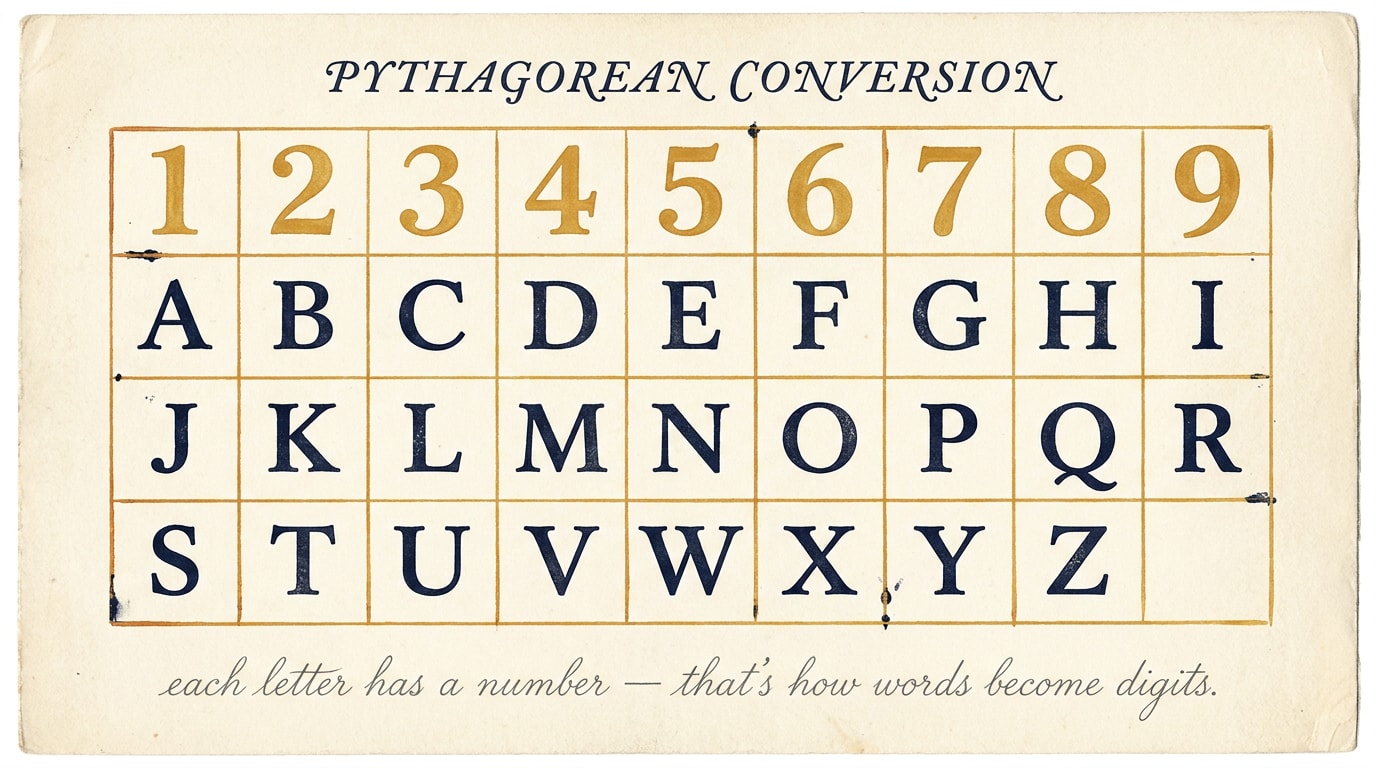
The Pythagorean alphabet runs cyclically: A is 1, B is 2, and so on to I (9), then J resets to 1, K to 2, all the way to Z. The Chaldean alphabet works differently. It runs 1 to 8 only, treats 9 as sacred and unassigned, and assigns numbers by the sound of each letter rather than its position in the alphabet. The Pythagorean version is much more widespread on the English-language internet, and is what almost every popular calculator uses, which is why this guide focuses there. If you stumble across a calculator that gives you a noticeably different result, it's almost certainly using the Chaldean mapping; it isn't wrong, it's another tradition.
A short historical note. Number-as-meaning is one of humanity's older ideas. It shows up in Babylonian and Egyptian astronomy from around 2000 BCE, in the Hebrew tradition as gematria, in Pythagorean Greek thought as the structural basis of reality, and in medieval Christian and Islamic mysticism. The form you'd recognise today, the four-numbers-from-birth-date-and-name system, was assembled mostly in the early twentieth century. The American writer L. Dow Balliett published influential books on the subject in the early 1900s, and Florence Campbell's Your Days Are Numbered (1931) is often credited with codifying the modern Western reading method.
The four core numbers in a reading
A basic numerology reading produces four single-digit numbers, each calculated from a different part of your birth data: Life Path (from date of birth), Destiny, also called Expression, (from your full birth name), Soul Urge (from the vowels in your name) and Personality (from the consonants). Different schools call them slightly different things, Destiny is also called Expression; Soul Urge is sometimes called Heart's Desire — but the calculation method is consistent across the modern Pythagorean tradition. Most numerology systems agree on these four as the "core four" that together sketch a basic profile, with Life Path doing roughly the same descriptive job as your astrological Sun sign (broad direction) and Soul Urge doing roughly the job of the Moon (inner motivation). If you only have time for one, calculate Life Path; it's the most quoted, the most cited, and the one that travels with you regardless of name changes.
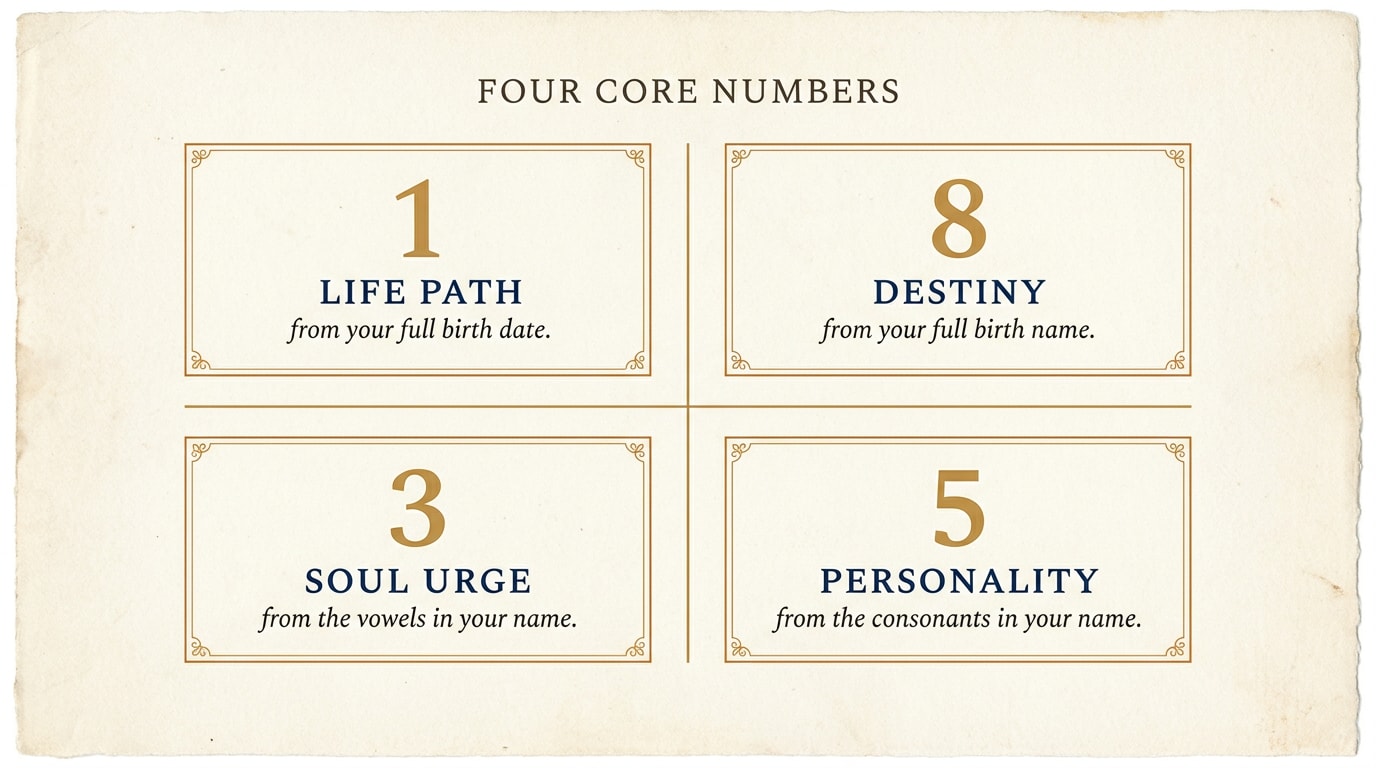
Each of the four numbers does a slightly different job, and reading them together is what produces something approaching a description of a person. Here is the brief version of each, before the calculation method follows in the next section.
Start with the Life Path, calculated from your full date of birth. It describes the broad direction you tend to grow in, what kind of life you find yourself drawn to build, what kind of work suits you, what shape your decades tend to take. It is the most-quoted number because it's the most general; it does the same descriptive job as your astrological Sun sign and is roughly as informative on its own (which is to say, useful as one layer, limited as the whole picture).
Destiny, also called Expression, is calculated from the full name you were given at birth, and describes what you're working towards: the version of yourself you're growing into, the contribution you're inclined to make. Numerologists treat the full birth name as the input because it is, in their view, the name that was assigned to you before you had any say in it. If you've changed your name since, the original name is still used for this calculation; your current name produces a related, secondary number some traditions call a Minor Expression.
The third number, Soul Urge (sometimes called Heart's Desire), uses only the vowels in your full birth name and describes inner motivation: what you actually want underneath what you say you want, the quiet driver behind the choices that don't have obvious external reasons. It is the most personal of the four and the one most often described as the "hidden" reading.
Personality, the fourth, is calculated from the consonants in the same name and describes outer appearance: the version of you others meet first, the impression you tend to leave in a room before you've had a chance to say much. Together with Soul Urge it makes a neat pair: what's inside (vowels) and what shows on the surface (consonants).
In one line. Life Path = direction, Destiny = goal, Soul Urge = motivation, Personality = first impression. Read all four for the rounded version; just Life Path for the headline.
How to calculate your life path number by hand
Your Life Path number is calculated by adding every digit of your date of birth together, then reducing the total to a single digit by adding its digits again — except when the total is 11, 22 or 33 (the master numbers), which by convention are kept as double digits. The calculation is genuinely simple; the only place people get it wrong is in choosing which order to add things. The agreed convention in modern numerology is to add all digits at once (day, month and year as one long string of digits), then reduce. Adding the components separately and reducing each, then adding, is a common variant that produces a different answer in some cases (it can preserve master numbers that would otherwise reduce). For a beginner, use the all-digits-at-once method; it is the convention most calculators and most contemporary books follow.
Here is the whole calculation, worked through on an illustrative person — not a real person, just a name and a date that lets us run the method end to end.
Sarah Jane Mitchell, born 15 March 1990.
First, write the date as a string of digits. Day is 15, month is 3, year is 1990, which gives you 1 5 0 3 1 9 9 0. (March is the third month, written as 3 or 03; either works, because 0 adds nothing.) Now add them all together: 1 + 5 + 0 + 3 + 1 + 9 + 9 + 0 = 28. That's not a single digit yet, so add the digits of 28: 2 + 8 = 10. Still not single, so reduce once more: 1 + 0 = 1. Sarah's Life Path number is 1.
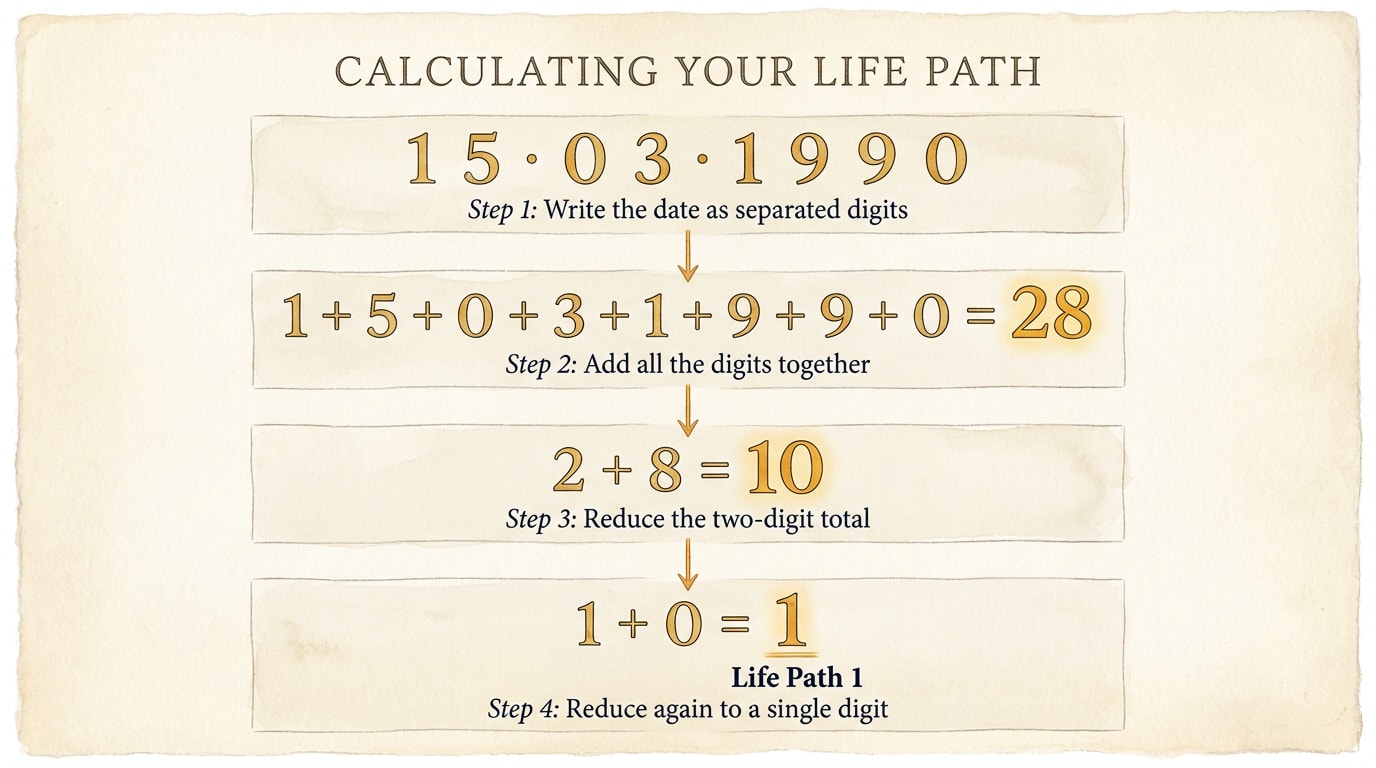
That's the whole method. Try it on your own birth date; the working takes about ninety seconds, and you'll have your Life Path number without needing a calculator. Most paid "numerology readings" online run exactly this calculation behind the form, then paste in the standard description of the number; once you can do the maths, you can read the description directly.
About master numbers. If your calculation lands on 11, 22 or 33 at any reduction step, stop there. By convention, numerologists treat these as "master numbers" and keep them as double digits because they are composed of repeated digits (1+1, 2+2, 3+3). There is no mystical reason — it's a typographic rule the system adopted. A Life Path of 22 stays 22, not 4.
A brief word on the other three numbers. To calculate Destiny or Expression, write out your full birth name (first, middle, last, as it appears on your birth certificate), assign each letter its Pythagorean number using the alphabet chart from earlier in this guide (A=1, B=2 and so on cyclically), add them all up and reduce in the same way. Soul Urge uses only the vowels in that name; Personality uses only the consonants. The maths is the same: digit sum, reduce, stop at single digit or at 11, 22, 33. A worked name example follows the same shape as the date example above; once you have the alphabet chart, the working is mechanical.
What each number means in plain English
Each numerology number (1 through 9, plus the master numbers 11, 22 and 33) carries a short, conventional description that's broadly shared across modern Pythagorean numerology. These meanings have been more or less stable since the early-twentieth-century revival of the system, and you'll find them in similar wording across most contemporary numerology books and websites. They function the way Sun sign descriptions function in astrology: a quick character key, broadly recognisable, useful as a starting point rather than as the whole picture. Read your own number for the broad shape, then read the descriptions of the people in your life as a quick character key; most of what's between you is already there.
Here is the compact reference. Twelve rows because the master numbers are included.
| Number | Brief meaning |
|---|---|
| 1 | The initiator — independent, leadership-oriented, drives the start of things |
| 2 | The diplomat — co-operative, sensitive to others, works best in partnership |
| 3 | The communicator — expressive, sociable, drawn to creative self-expression |
| 4 | The builder — practical, methodical, builds slowly and reliably |
| 5 | The free spirit — restless, change-loving, drawn to variety and travel |
| 6 | The carer — responsible, nurturing, oriented around home and family |
| 7 | The seeker — reflective, analytical, drawn to study and inward questions |
| 8 | The achiever — ambitious, materially focused, drawn to recognition and authority |
| 9 | The humanitarian — broad-minded, idealistic, drawn to the bigger picture |
| 11 (master) | The intuitive — heightened version of 2, with strong inner vision |
| 22 (master) | The master builder — heightened version of 4, capable of large-scale work |
| 33 (master) | The master teacher — heightened version of 6, dedicated to broad service |
 A reading is more annotation than verdict.
A few patterns are worth noticing once you have the table in front of you. The odd numbers (1, 3, 5, 7, 9) tend to be active and outward-facing, they initiate, express, explore, seek, broaden. The even numbers (2, 4, 6, 8) tend to be steadier and more building-oriented; they relate, construct, care for, achieve. The master numbers describe the same energies as their reduced versions but at what numerologists call a more demanding scale: an 11 is, in this language, a 2 with extra intensity; a 22 is a 4 with extra reach; a 33 is a 6 with extra dedication. If you're reading this and your number doesn't quite feel like you, that's also useful information. Most people's full numerology profile has all four numbers pulling in slightly different directions, just as most astrological charts do, the Life Path might say "seeker" while the Destiny says "achiever" and the Soul Urge says "carer", and the friction between those three is often where the most accurate description of a person sits.
Where numerology meets astrology (and where they part company)
Numerology and astrology are sister systems. Both use your birth data to produce descriptive language about you, both work as self-recognition prompts rather than as forecasts of specific events, and both have similar epistemic status: neither has rigorous empirical support, both have long traditions, and both function best when treated as structured language rather than as prediction. The key difference is what they do with your birth data. Numerology reduces it to a small handful of single digits, which is its appeal (clear, compact, memorable, easy to share with a friend) and also its limit (one digit can't carry the weight of a whole person). Astrology unpacks it into ten planets in twelve houses with the angles between them, which is its appeal (structurally rich, individually specific) and also its limit (it takes effort and time to read).
The descriptive overlap, if you map the two systems against each other, is surprisingly clean. Your numerology Life Path number does roughly the same descriptive job as your astrological Sun sign, broad direction of growth, the headline version of you. Your Soul Urge does roughly the job of the Moon, inner motivation, what you actually want. Your Personality number does loosely what the Rising sign does, the first impression you make. Your Destiny / Expression sits somewhere between the Sun and the Midheaven, capturing what you're moving towards in the world. The two systems will often agree on the broad shape of you and disagree, productively, on the detail. If your Life Path is 1 (the initiator) and your astrological Sun is in Capricorn (long-game builder), the two are essentially telling you the same story in different vocabularies. If your Life Path is 5 (free spirit, restless) and your Sun is in Taurus (slow, comfort-keeping), the disagreement is the description, you're probably somebody who lives a steady life but quietly wants more change than they let on.
Most people who get into numerology eventually find astrology, and vice versa. The two systems are not in competition, and reading them side by side often produces a richer description than either alone. If you've got your Life Path number from the calculation above and you want to add the next layer of detail, your astrological birth chart adds ten planets, twelve houses and the angles between them to your reading; the honest guide to your natal chart walks through what that adds. Numerology gives you a short, memorable description; the natal chart gives you a structurally specific one. Both, used well, are reflective tools; neither, used well, is a forecast.
 The actual work happens at the kitchen table — or the cafe window.
What numerology is useful for (and what it isn't)
Numerology is most useful as a structured prompt for self-reflection, a short, memorable description that gives you language to notice patterns in yourself. It's least useful as a tool for decision-making about events you haven't lived through yet. The system is at its best when it tells you something you already half-knew about yourself, in a form that's easy to share or write down, which is why people remember "my life path is 7" but don't usually remember their entire astrological chart. It is at its worst when it's offered as a forecast, "your number means you should expect a career change this year" — because that's a load it was never built to carry. Every reputable numerologist will say more or less the same thing about scope; the practitioners who promise specific outcomes (and there are some) are operating outside what the system actually claims.
A short, honest note on how to use it. Calculate your Life Path. Note the description. Read it as one accurate-ish layer of one chapter of a long book about you. Then, if you find it useful, calculate the other three numbers and read them together, the four numbers as a small character key, the contradictions between them often more informative than any of them alone. Share the broad strokes with the people you live and work with; you'll be surprised how often "my Life Path is 6 and yours is 8, which is why we keep tripping over each other on the question of priorities" turns out to be a useful conversation. Don't let any single digit decide anything you wouldn't have decided anyway. If you'd like to read your astrology alongside your numerology, WowAstro will calculate your free birth chart — date, time and place, takes a couple of minutes, the explanation comes out in plain English, no upsells.
A final note. If you're reading numerology, astrology or anything similar because life feels harder than usual right now and you'd like something to make sense, that's a perfectly reasonable starting place, these systems exist partly because human beings have always wanted language for what's going on internally, and a structured prompt is sometimes more useful than no prompt. If what you're carrying feels heavier than that — persistent low mood, panic that won't lift, thoughts of self-harm, please also talk to your GP, or contact Samaritans on 116 123 (free, 24/7 in the UK). Self-reflection systems can sit alongside professional support; they cannot replace it.
Questions readers ask
What's the difference between Pythagorean and Chaldean numerology?
Pythagorean and Chaldean are the two main schools of numerology, and they differ in how they assign numbers to letters of the alphabet. The Pythagorean system, devised in 6th-century BCE Greece and the basis of almost every modern Western calculator, assigns numbers 1 to 9 cyclically across the Latin alphabet, A is 1, B is 2, all the way to I (9), then J resets to 1 and the cycle repeats. The Chaldean system, much older and rooted in Babylonian astrology, uses only the numbers 1 to 8 (treating 9 as sacred and unassigned) and assigns them according to the sound of each letter rather than its alphabetical position. Both systems use the same digit-sum-and-reduce method, but they often produce different numbers for the same name. Neither is "right" — they are different traditions. Most modern English-language sources use Pythagorean, which is why this guide does too.
Do I use my birth name, my current name, or my nickname for the name-based numbers?
Use your full birth name, the one on your birth certificate — for the Destiny, Soul Urge and Personality numbers. The convention in modern numerology is that the birth name is the "true" name because it was given to you before you had any agency in choosing it; subsequent changes (marriage, deed poll, choosing a different first name) produce secondary numbers that some traditions call a "Minor Expression" or "Modified Soul Urge". If you have changed your name and you find your current name fits you better than your birth name, by all means calculate both and compare; the birth name is the convention, not a rule of physics. Nicknames are generally not used in any standard calculation. The system was built around legal names.
What's a master number, and what should I do if mine reduces to one?
A master number is one of 11, 22 or 33, by convention, these three are the only digit pairs the system keeps intact rather than reducing further. If your Life Path or any other core number reduces, at any step, to 11, 22 or 33, you stop reducing there. The reason given is conventional rather than mystical: these three numbers are composed of repeated digits, and the system treats that as significant. A Life Path of 22 stays 22, not 4. The descriptions for master numbers typically read as more demanding versions of their reduced single-digit counterparts (11 as an intensified 2; 22 as an intensified 4; 33 as an intensified 6), useful to know, but the convention itself is the main thing. Some traditions extend this to 44 or 55, but 11, 22 and 33 are the consensus three.
Is numerology compatible with astrology, or do they contradict each other?
Numerology and astrology are compatible, they are sister systems with the same epistemic status and similar broad aims, and reading them side by side tends to produce a richer description than either alone. Both use your birth data to generate descriptive language; neither claims to predict specific events. Where they appear to contradict — your Life Path 5 "free spirit" versus your Capricorn Sun "long-game builder", say, the contradiction is usually the most informative part of the description: it points to a real internal tension that someone living with both will probably recognise. Numerology compresses; astrology expands. The two systems were never designed to refute each other, and most contemporary practitioners use both. If you've enjoyed working out your numerology and want to add the astrological layer, the honest guide to your natal chart covers it.
A note on what this is. Numerology, like astrology, is a tool for self-reflection and self-understanding — not a method for predicting events, health outcomes, financial returns or the course of relationships. Read your number as a description of patterns, take what's useful, leave the rest.
About this article: WowAstro readings combine traditional astrological methodology (Swiss Ephemeris calculations, Hellenistic and modern psychological frameworks) with AI-assisted writing reviewed by Oksana Miatova before publication. For entertainment and self-reflection only — not medical, legal, or financial advice. Full editorial policy at /editorial-standards.
Written by Oksana Miatova, astrologer and writer at WowAstro. Historical references drawn from the standard public record on Pythagoras (6th century BCE), Babylonian astrology and the early-twentieth-century revival of modern Western numerology, including L. Dow Balliett and Florence Campbell's 1931 Your Days Are Numbered. For the underlying history of the Pythagorean tradition, see Encyclopaedia Britannica's entry on numerology.
Read your own natal chart
A personal AI reading, from £1
⭐ +50 Wow Stars cashback · sign up and get 100 ⭐
Build my chart →Comments
New here? Get −30% off your natal chart
Leave your email and we will send you the promo code WELCOME30. Straight after that you can comment — no passwords, all automatic.
Quick sign-in
Sign in with Telegram — one click.
Or by email (with a gift)
Already have an account? Enter the same email — we'll email you a sign-in link.