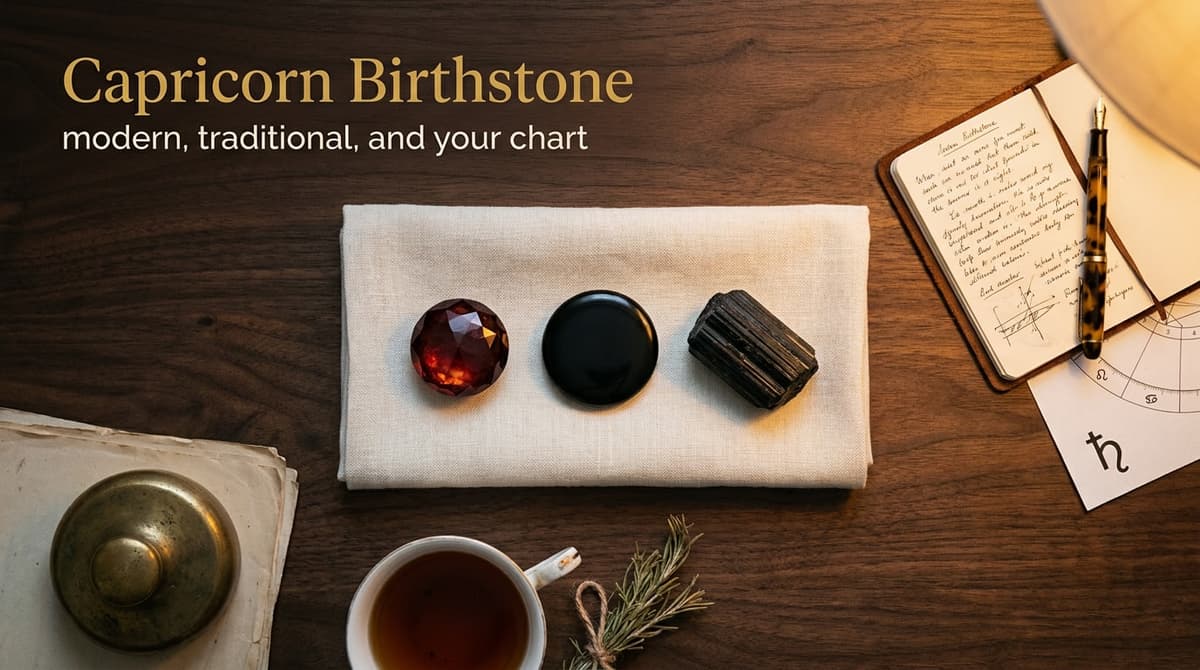
Emma opens a third browser tab. The first article said the Leo birthstone is peridot. The second said it's ruby. The third gave a list of ten stones, all of them apparently «the Leo stone». She closes all three. None of them said the same thing as either of the others, and none of them said why.
Here's the honest answer those three articles skipped. There isn't one Leo birthstone, because there isn't one question. Three different traditions answer «what's the Leo stone» in three different ways, and a fourth (your actual birth chart) sits quietly behind all of them. Not one of those tabs was lying to Emma; each was simply answering a question she hadn't realised she'd asked. Once you can tell the questions apart, picking a stone gets easy, and so does shutting the laptop and going with whatever you happen to love.
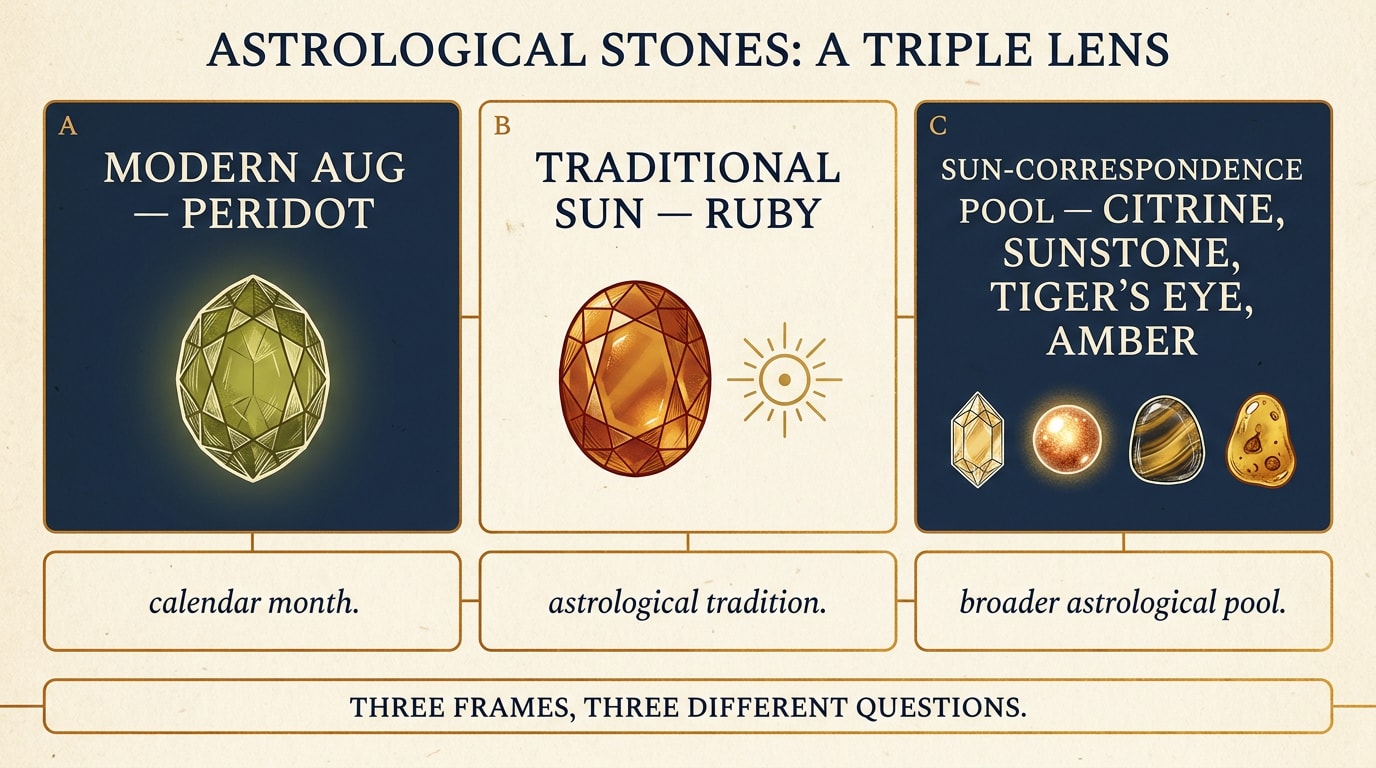
In short. «The Leo birthstone» is three lists answering three different questions: the modern commercial August birthstone (peridot, per GIA's 1912 standardised list), the traditional astrological stone of the Sun (most often ruby, in Culpeper and medieval European lapidaries), and the broader pool of stones traditionally associated with the Sun (citrine, sunstone, tiger's eye, amber). Plus a fourth layer most articles skip: your chart may have Leo placed somewhere other than your Sun, which changes the question entirely.
 The honest answer rarely sits at the top of the search results.
Why there isn't one Leo birthstone
«Leo birthstone» is three different questions in a trench coat, which is why the search results contradict each other so cheerfully. Search the phrase and you collide with three separate traditions stacked on top of one another, none of them labelled, each running on its own internal logic. One is the shopfront calendar your local jeweller stocks by, which files stones under birth months. Another is the old European lapidary line, which files stones under planets — and because the Sun rules Leo, the Leo entry is simply the Sun's stones. The third is a wider astrological gathering of everything the early texts ever filed under the Sun, whether for its colour, its glow, or some thread of myth. Read on its own terms, each tradition holds together perfectly; the clash only appears when a writer ladles all three into one pot and serves it as a single answer.
The practical way through is to ask yourself which question you're actually asking. If you want a stone tied to the month you were born, that's the modern calendar list. If you want the historical astrological stone for your Sun-ruled sign — that's the Sun stone, usually ruby. If you want the broader pool of Sun-correspondence stones to choose from, that's a small shortlist worth knowing. Each frame answers one question well, and none of them answers the others. The next three sections take them one at a time.
Peridot: what the August calendar gives a Leo
In the modern commercial system used by GIA and the British Gemmological Association, the August birthstone is peridot, with spinel and sardonyx as formally recognised alternatives. This is the list every high-street jeweller is working from, the list that decides which gem sits in the «August» tray at Hatton Garden, and the list every birthstone-ring website cites by default. Its modern form dates to 1912, when the American National Association of Jewelers fixed the month-by-month assignments; Jewelers of America later adopted it formally, and GIA keeps it current today. The August slot gained spinel as an alternative in 2016 — recognition of spinel's standing as a gem in its own right, and a way to give buyers a wider band of colour to choose from.
The history sits at the back of every peridot ring. Peridot has been mined from Egypt's Zabargad Island since around 1500 BCE, and Cleopatra's famous «emeralds» were probably peridot rather than emerald, the distinction being a Victorian one rather than an Egyptian one. Peridot's green is the result of iron in the mineral structure (it's the gem-quality variety of olivine), and unlike emerald, peridot is mined in volcanic rock and even, occasionally, in meteorite. None of which makes it the Leo stone in the astrological sense; all of which makes it a perfectly genuine August stone if you were born in that month.
A note for cusp-dwellers. If your birthday falls on 23-31 July, the calendar names ruby as your birth-month stone, but you may well have a Sun in Leo (the sign begins around 22-23 July depending on year). Which means the calendar gives you ruby, and the astrological tradition also gives you ruby, for entirely different reasons. The two lists happen to agree for late-July Leos. For August Leos, they diverge: calendar says peridot, tradition says ruby. Both are correct answers to different questions.
Ruby: the Sun's stone, and so the lion's
In the traditional astrological lapidary tradition, the stone of the Sun (and therefore the stone of Leo, since Leo is the Sun's only ruling sign) is most often ruby. This isn't a calendar-month assignment. It's a planetary-correspondence assignment, derived from the way medieval European and earlier Mesopotamian astrologer-physicians grouped substances by planet — gold, frankincense, sunflowers and certain stones all sat under the Sun for reasons that combined colour, value, and visible inner glow. Nicholas Culpeper, the seventeenth-century English physician whose «Complete Herbal and English Physician» (1652) remains the most widely-cited British source for this tradition, lists gold and ruby as the Sun's metal and stone. Marbode of Rennes, writing around 1090, called ruby «carbunculus» — the «little coal», and described it as the king of stones, the one that shines as if lit from within.
 Tradition gives you a name, not a verdict.
The logic that ties ruby to the Sun is straightforward once you see it. The Sun is hot, the Sun is bright, the Sun has the colour of fire late in the day, and ruby is the red stone that holds that colour without going dim. Medieval lapidaries grouped substances metaphorically rather than chemically: visible properties stood in for invisible ones, and a ruby's deep red glow stood in for the Sun's heat and centrality. The same logic placed gold (the Sun's metal — heavy, warm, untarnishable) under the same heading. If you're asking «what stone did astrologers traditionally associate with my Sun-ruled sign», the answer is ruby, and it's the same answer whether you were born in July or August, because the question isn't about the calendar at all.
Astrological Sun-correspondence stones
Beyond ruby, four other stones are traditionally associated with the Sun and therefore loosely with Leo, and unlike ruby, these are easier to find at any price point and in any size. They sit in the same correspondence tradition as ruby, grouped with the Sun for combinations of colour, glow and cultural association rather than for any single tidy reason. Worth knowing as a shortlist if ruby feels out of reach, doesn't suit you, or simply doesn't appeal.
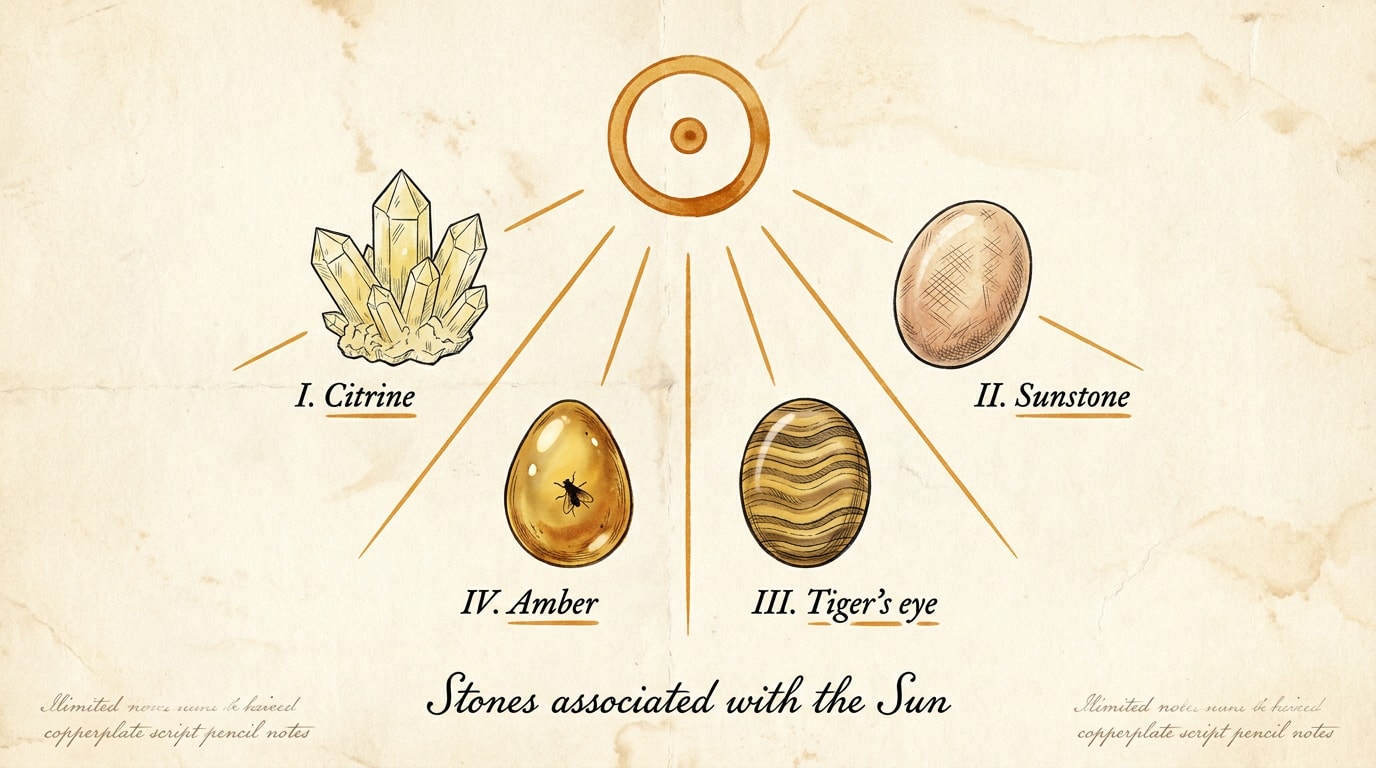
Citrine is yellow quartz, named for its citrus colour. Old astrological-herbal texts sometimes call it a «sun-stone» on the strength of its colour alone, and the visual case is clear: citrine catches winter light in the same way a quartered orange does. Most citrine sold today is heat-treated amethyst, which is disclosed in the trade; natural citrine is rarer and slightly more expensive.
Sunstone is an orange-pink feldspar with a metallic shimmer (called aventurescence by gemmologists). The name is self-explanatory and very old; Greek references to «heliolite» (sun-stone) survive, and Norse legend attributes a navigational sun-stone to Viking sailors, though whether that was sunstone proper or some other crystal remains a question that working gemmologists still argue about over coffee.
Tiger's eye is a banded golden-brown quartz, a chatoyant stone (the gemmological word for the silky line of light that moves across its surface). Its inclusion in the Sun-correspondence list is more modern: most nineteenth-century lapidary texts don't mention it, and its current popularity owes more to twentieth-century crystal-revival writing than to medieval tradition. Honest to flag, fair to wear.
Amber isn't strictly a stone; it's fossilised tree resin, often holding inclusions of plants or insects that lived forty million years ago. It carries the Sun association by mythology rather than by mineralogy. In Greek myth, amber is the tears of the Heliades, the daughters of Helios the Sun, weeping for their brother Phaethon. Amber's warm honey colour and visible inner glow secured it a place in every old correspondence list that touched the Sun.
What a birthstone tradition can and can't claim. Traditional planetary correspondence says: «this stone was associated with this planet, for these reasons». It doesn't say: «this stone will heal you, attract wealth, balance your energy, or protect you from negativity». That second set of promises comes from twentieth-century crystal-healing writing, a parallel genre with no roots in the old astrological texts. Buy and wear what you find beautiful; the symbolic association is the gift, the medical promise isn't on offer.
Buying a real Leo stone without overpaying
So you've settled on peridot, ruby, or one of the Sun's lesser stones, and now you want to hand over money for the genuine article rather than a marked-up one. What follows is the plain, unglamorous sort of advice you get from someone with nothing to sell you — boring, but the kind of boring that saves you cash.
Where to look, in the UK. For the widest choice, head to Hatton Garden — Britain's main jewellery quarter, packed into a few central-London blocks where roughly three hundred dealers trade, most happy to let you browse off the street without booking ahead for ordinary stones. Liberty's gem counter, Selfridges and Boodles all carry reputable stock at department-store and heritage-jeweller price points. Independent regional jewellers (your county's old high-street jeweller, often family-run for several generations) are frequently better value than anywhere in London. For free education, the gem gallery at the V&A in South Kensington is unbeatable — you can see the difference between natural and treated stones, in good light, without anyone trying to close a sale.
What to read on the tag. «Natural» and «lab-grown» are both real stones, they have the same crystal structure and chemical composition, just different origins. Lab-grown is significantly cheaper and ethically simpler; natural costs more for reasons of rarity and provenance rather than physical merit. «Heat-treated» appears on most ruby and almost all citrine sold today, and is a normal, disclosed practice that improves colour stability — not a fault. «Synthetic» means lab-grown and disclosed; «simulant» means a different material made to look similar (cubic zirconia for diamond, glass for ruby) and should also be disclosed in writing.
What to ignore. When a listing starts promising you a stone's «vibration», «energy frequency», «chakra alignment» or what it «will activate», you've wandered out of gemmology and into something else entirely. Neither the August calendar nor the old Sun-stone lapidaries ever made claims like that. A description heavy on healing talk usually means the seller is pricing the story, not the stone. The label worth your attention carries carat weight, country of origin, treatment status and clarity grade — that's the gemmologist's tag, and it tells you what you're actually paying for.
From «Leo birthstone» to your Leo placements
A Leo birthstone search assumes Leo is your Sun, but Leo might be living somewhere else in your chart entirely, and knowing where it actually sits changes which stone-correspondence might mean anything to you. A chart isn't one sign; it's a spread of ten bodies — Sun, Moon, Mercury, Venus, Mars, Jupiter, Saturn, Uranus, Neptune and Pluto — each parked in one of the twelve signs, plus a Rising sign pinned down by the exact minute you were born and the horizon overhead at the time. Leo could be holding any of those slots, and the slot it holds shifts what the lion's stone has to do with you.
 One stone, one symbol, ten placements in a chart.
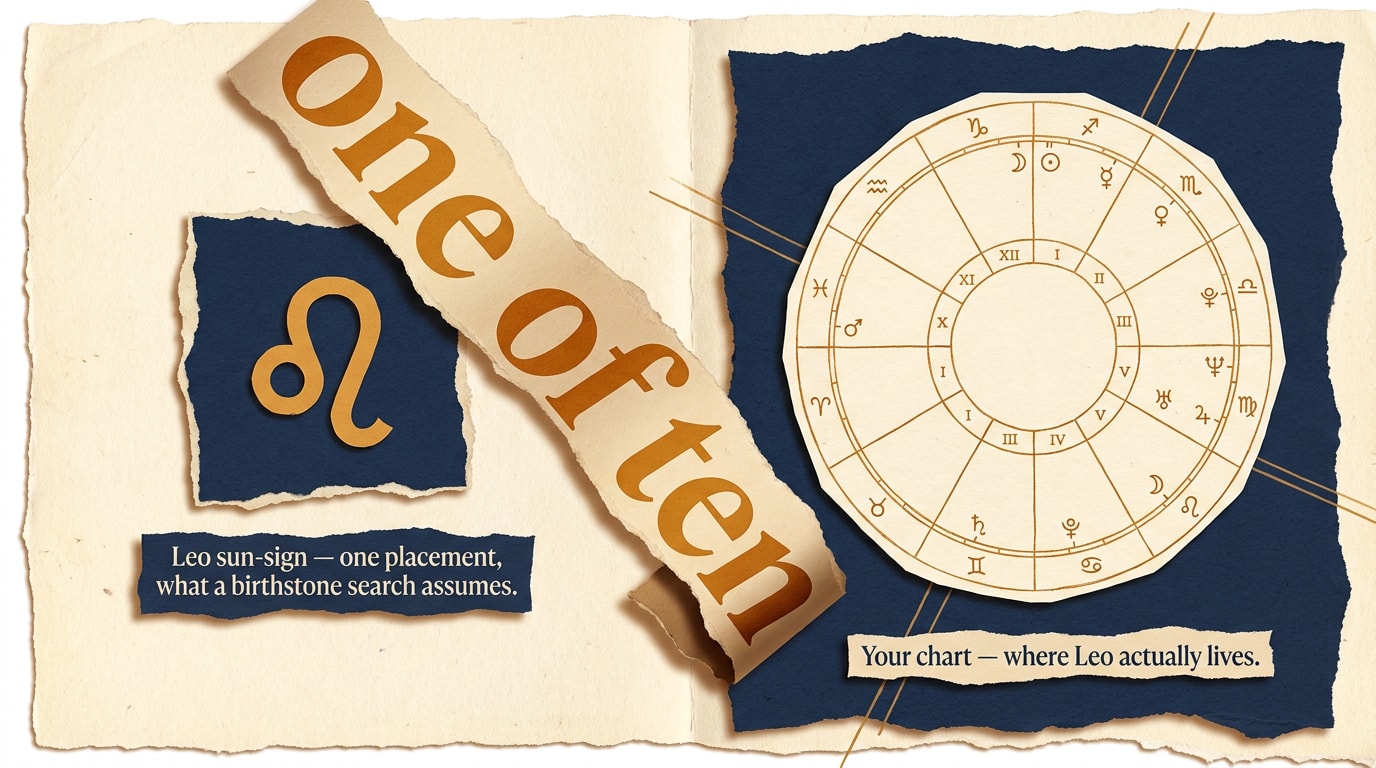
If your Moon is in Leo, your emotional weather is Leo-coloured — you feel things warmly, you feel them out loud. If your Venus is in Leo, your aesthetic and the way you give affection lean towards the generous and the visible. If your Mars is in Leo, the way you push for what you want has Leo's warmth and a Leo's reluctance to do anything quietly. Your Sun in Leo, by contrast, is your sense of self, your will, the part of you that asks to be seen. Choosing a stone for your Sun is one thing; choosing one for whichever Leo placement actually dominates your chart can point you somewhere altogether different, and the only way to tell them apart is to read the full chart instead of trusting the headline sun-sign.
If you'd like to see where Leo actually lives in your chart rather than the sun-sign label, WowAstro will calculate a free birth chart for you. Give it your birth date, your birth time and where you were born, and a minute or two later it's done. The stone is a small symbol; the chart is the longer description.
Questions readers ask
What is the actual Leo birthstone?
There isn't one, there are three honest answers, depending on which question you're asking. If you mean «what stone does the modern commercial calendar give people born in August», that's peridot (with spinel and sardonyx as recognised alternatives, per GIA's standardised birthstone list, which has been the industry reference since 1912). If you mean «what stone did the traditional astrological tradition associate with Leo as a Sun-ruled sign», that's ruby — the Sun's stone in Culpeper's 1652 «Complete Herbal» and in earlier medieval European lapidary texts. If you mean «what other stones are traditionally associated with the Sun, and so loosely with Leo», that's a small pool that includes citrine, sunstone, tiger's eye and amber. Pick the question you're actually asking, and the answer follows.
Is peridot or ruby the real Leo birthstone?
Both are real, they're real answers to different questions. Peridot is the modern August birthstone, set by jewellery-industry convention since 1912 and used by every high-street jeweller in the UK. Ruby is the traditional Sun stone, and Leo is the Sun's ruling sign, so ruby is the historical astrological correspondence-stone for anyone born under Leo regardless of the precise calendar date. If you were born late in July (the cusp between Cancer and Leo, where Sun-in-Leo begins), the calendar gives you ruby anyway, so both answers agree. If you were born in August, the calendar gives you peridot and the astrological tradition gives you ruby — both are correct, neither is the «real» one, and the choice is yours.
What is the lucky stone for Leo?
«Lucky» is a word that belongs to a different conversation than the one tradition is having. Astrological correspondence-tradition says «this stone was associated with this planet, for these reasons» — it doesn't promise the stone will bring you luck, money, love, or any particular outcome. When people ask for Leo's «lucky stone», the two names that come back most often are ruby (the Sun's stone) and peridot (August on the calendar). Want one for the symbolism rather than a guaranteed result? Either fits. Want one simply because it's beautiful? That reason needs no defending.
Can I wear a different birthstone if I'm a Leo?
Yes — and tradition has no quarrel with it. These lists hand you correspondences, not orders. Nothing in the August calendar or the old Sun-stone lapidaries says a Leo must pick ruby or peridot over amethyst, sapphire, or whatever else catches the eye. Fall for a stone that «belongs» to some other sign and wear it anyway: the old astrologers would likely respect a genuine preference far more than a stone worn out of dutiful habit. Think of the tradition as a doorway into choosing something that means something to you, not a rulebook you're bound to. Wear the one you'll actually want to look at.
Astrology, as we use it at WowAstro, is a tool for self-reflection and self-observation, not a method for predicting events, health, or financial outcomes. Traditional correspondence-stones are symbolic associations, not medical recommendations or guaranteed luck-bringers. Take what's useful from any tradition, leave the rest.
Written by Oksana Miatova, astrologer and writer at WowAstro. Charts calculated using the Swiss Ephemeris, the same astronomical data working astrologers use. Historical correspondences drawn from Nicholas Culpeper's «Complete Herbal and English Physician» (1652) and Marbode of Rennes' «Liber Lapidum» (~1090); modern birthstone list per the Gemological Institute of America.
Read your own natal chart
A personal AI reading, from £1
⭐ +50 Wow Stars cashback · sign up and get 100 ⭐
Build my chart →Comments
New here? Get −30% off your natal chart
Leave your email and we will send you the promo code WELCOME30. Straight after that you can comment — no passwords, all automatic.
Quick sign-in
Sign in with Telegram — one click.
Or by email (with a gift)
Already have an account? Enter the same email — we'll email you a sign-in link.