It's a Tuesday evening in a Clapham café and your partner of two years hasn't answered the message you sent at six. It's now seven. Your stomach has done that small sliding thing it does, and the thought has arrived on its usual schedule: something's wrong, he's going off me, I can feel it. You know, because you've read enough of the internet, that this is what people now call anxious attachment. You took the quiz a year ago. You got the label. The label did not, in the event, stop your stomach from sliding.
A label is a useful start. It is not a vocabulary you can sit inside on a Tuesday evening at seven. Attachment theory describes four well-documented default patterns for how adults connect (secure, anxious, avoidant and disorganised), and they are, broadly, the best framework psychology has for what runs underneath your reactions in close relationships. But theory naming a pattern isn't the same as having language to notice yourself with. Astrology, used honestly, can offer a second language for the same defaults: a chart-language that quietly mirrors what attachment theory describes, without trying to be diagnosis.
This article isn't a quiz, and it isn't therapy. It's an overview of the four patterns and the four places in a birth chart that tend to describe the same shapes. If the way you connect to someone you love is causing serious distress (panic, dissociation, fear for your safety in the relationship), please skip ahead. This article isn't the resource you need tonight; Mind on 0300 123 3393 or the BACP register of qualified UK therapists are.
In short. Attachment theory describes four default patterns for how adults connect: secure, anxious, avoidant and disorganised. They aren't personality types — they're the operating system that runs in close relationships when you're not consciously choosing. Astrology, used reflectively, has chart-language for the same shapes: Moon, Venus, Ascendant and the seventh-house ruler each describe a piece of the same pattern. The chart names. It doesn't fix.
 A Tuesday at seven, before the message comes back.
What "attachment style" actually means — and what astrology won't claim
Attachment style is the default way you connect with someone you depend on emotionally, how you reach for closeness, and what you do when that closeness feels uncertain. The framework comes from the British psychologist John Bowlby, who published the first volume of Attachment and Loss in 1969; his colleague Mary Ainsworth then tested the theory empirically with infants in the Strange Situation study in 1978, identifying three patterns. A fourth pattern, disorganised, was added in 1986 by the developmental researcher Mary Main, looking at infants whose responses didn't fit neatly into the first three. Modern adult-attachment research, summarised in Mikulincer and Shaver's textbook Attachment in Adulthood, carries the four-pattern framework forward into romantic life.
The patterns are defaults, not personality verdicts. They develop in early caregiving and they tend to persist into adulthood, but they're modifiable. Researchers call the process of moving toward a more secure default earned security, and it typically happens through some combination of long-term therapy, a long stretch of relationship with a securely-attached partner, and patient self-work over years rather than months.
This article uses astrology as a reflective vocabulary for the same patterns. It is not a diagnostic instrument, not a treatment, and not a substitute for the work of moving toward earned security. If your reactions in relationships are seriously distressing (the anxious wave you can't ride out is daily, the avoidant pull-back is starting to cost you the people you love, the push-pull is leaving you uncertain who you even are after a row), the right next step is a qualified therapist. The BACP register is the most reliable UK starting point.
The four attachment patterns, briefly
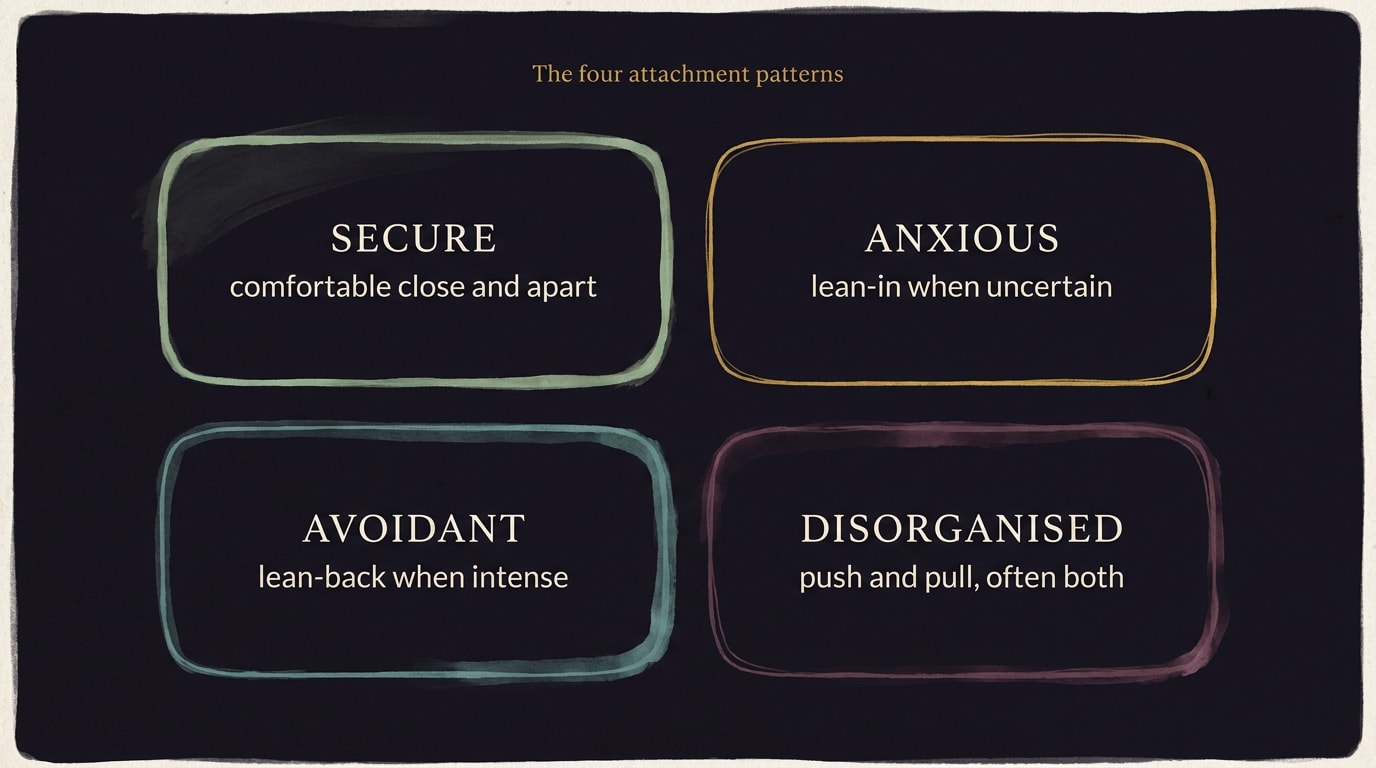
Here are the four patterns, in plain English, before the chart side of any of this.
Secure
Roughly half of adults, more or less, sit here in non-clinical populations. The default is comfort with closeness and comfort with distance: when something is wrong, the move is to say so; when the other person is busy, the move is to assume there's a reason. Conflict pattern: we disagreed, we repaired, the relationship is fine. It looks unspectacular from the outside, and that's the point. Secure attachment is the absence of the specific dramas the other three patterns produce.
Anxious (anxious-preoccupied)
The lean-in pattern. When closeness feels uncertain, the move is closer: the message, the question, the check-in. The internal voice runs hot on a hair-trigger: is something wrong? have I done something? are they going off me? The anxious default isn't a personal failing; it's a strategy that learned, somewhere early, that closeness has to be reached for actively or it slips away. Often paired with avoidant attachment in the relational pattern people call the anxious-avoidant trap.
Avoidant (dismissive-avoidant)
The lean-back pattern. When closeness intensifies past a certain threshold, the move is space: the slightly longer reply, the evening on your own, the unspoken sense that things are getting a bit much. The internal voice often runs: too close, need air, this is a lot. It isn't coldness, and it isn't a refusal to love. It's a strategy that learned, somewhere early, that closeness costs autonomy, so autonomy gets protected first.
Disorganised (fearful-avoidant)
The push-pull pattern. The lean-in and the lean-back live in the same person, often within the same hour: wants connection, fears it, reaches for the partner, then needs them to leave. The disorganised default often (not always) sits close to a history of trauma in early caregiving, and it's the style most clearly served by therapy rather than by self-help reading. If reading this paragraph lands hard (if it describes a daily experience rather than an occasional one), please consider talking to a qualified therapist before you read on. Mind on 0300 123 3393 maintains a free directory of UK support, and your GP can refer you into NHS talking therapies.
How astrology mirrors these patterns: four placements, four lenses
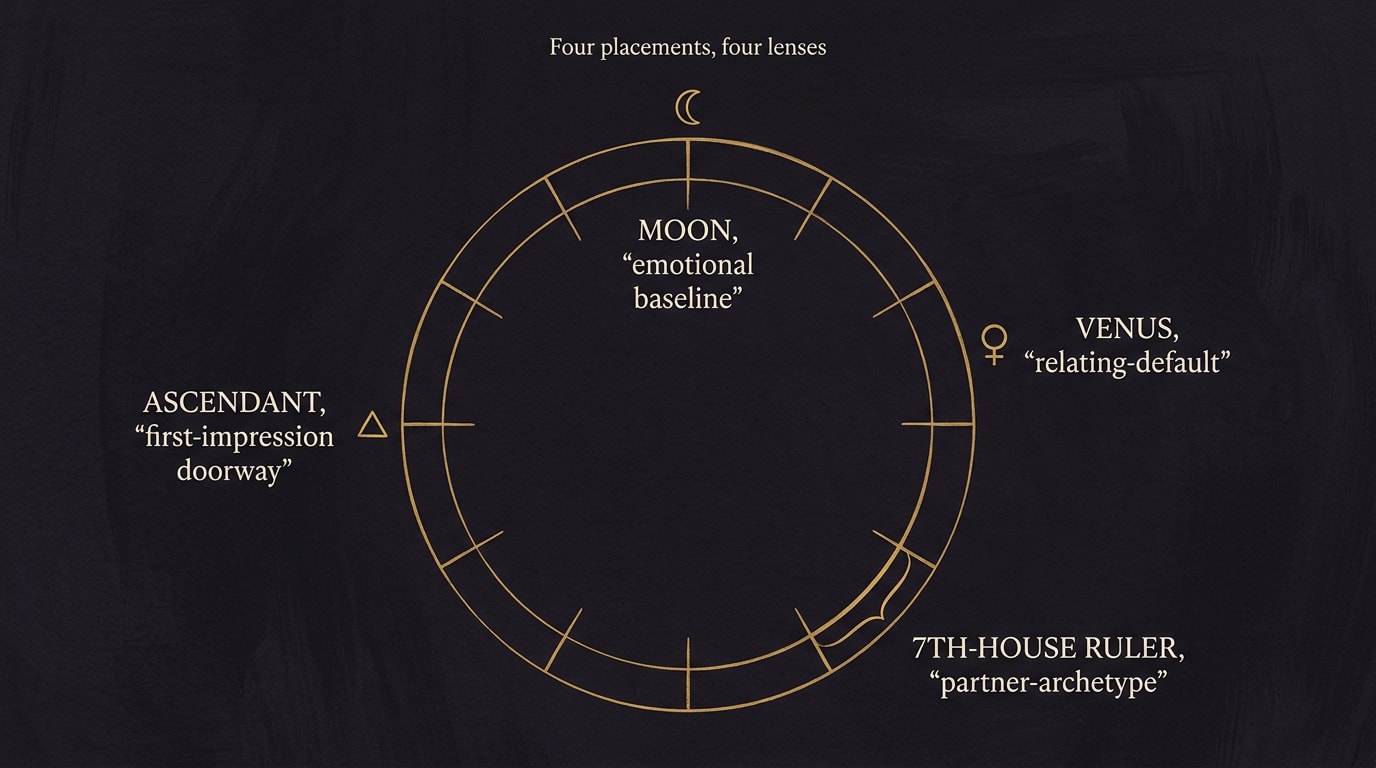
No single placement in a birth chart determines your attachment style. The chart isn't a quiz with a hidden answer. But four parts of the chart describe the same defaults attachment theory does, and they describe them as a kind of map of how you do closeness, quietly, before any thinking-self gets involved.
The four placements aren't picked at random. They're the chart's natural emotional-and-relational anatomy. The Moon describes your emotional baseline, how you regulate alone, what you reach for when stressed. Venus describes your relating-default, what attracts you, how you express affection, what you do with friction. The Ascendant, also called the Rising sign — is the first-impression doorway: how the room reads your safety signals in the opening minute. And the ruler of your seventh house describes the partner-shape you tend to mirror, the recurring archetype you find yourself opposite.
| Placement | What it describes in a chart | What attachment theory calls the same thing |
|---|---|---|
| Moon | Your emotional baseline — how you regulate alone, what you reach for when stressed | Internal working model: am I safe to feel? |
| Venus | Your relating-default — what attracts, how you express affection, how you do friction | Relational schema: how do I do closeness? |
| Ascendant | The first-impression doorway — how strangers read you | Initial-attachment cues: how others read your safety signals |
| Seventh-house ruler | The partner-shape you tend to mirror | Repetition-compulsion / partner-archetype |
The chart doesn't diagnose your attachment style. It offers a parallel vocabulary for the same default: a second language for the same shape. Used like that, it's not in competition with attachment theory; it sits next to it. Two languages, one phenomenon, both useful for noticing yourself a little more honestly. WowAstro calculates charts using the Swiss Ephemeris, the same astronomical data working astrologers rely on.
Four short worked examples, one per pattern
These four sketches are illustrative composites — plausible chart combinations chosen because they show each default-pattern at its clearest, not real people. They're here to give the four placements something concrete to do.
Secure — a Libra Moon with a Taurus Venus
Composite: Libra Moon, Taurus Venus, Sagittarius Ascendant. The Libra Moon's emotional baseline is peace-seeking and repair-oriented: when something feels off, the instinct is to name it and put it back together. The Taurus Venus relates steadily, affection through reliability rather than declaration. The Sagittarius Rising reads open and frank in the first minute. None of this is saintly; it's just that the placements aren't fighting each other. The relationship doesn't avoid storms; it weathers them and carries on.
Anxious — a Cancer Moon with a Scorpio Venus
Composite: Cancer Moon, Scorpio Venus, Pisces Ascendant. Same Tuesday evening, different chart. The Cancer Moon's emotional baseline is porous: absence reads as cold before any actual cooling has happened. The Scorpio Venus relates all-or-nothing; distance is a signal of ending. The Pisces Ascendant absorbs whatever atmosphere is in the room. Put those three together and the un-answered message becomes an internal weather system within twenty minutes. The wave is real, the chart is real, and the partner is just on the Tube without signal.
Avoidant — an Aquarius Moon with a Capricorn Venus
Composite: Aquarius Moon, Capricorn Venus, Virgo Ascendant. Three months in, his partner wants to have the relationship conversation: where is this going, can they make plans for Christmas. The Aquarius Moon reads the request as a slow door closing on its independence; the Capricorn Venus prefers to demonstrate care through reliability rather than declaration; the Virgo Ascendant arrives precise and contained. He doesn't withdraw to hurt anyone. He withdraws because his chart's relational default, in close quarters, is to make room, and the room he needs is larger than the room she's asking him to occupy.
Disorganised — a Scorpio Moon with a Sagittarius Venus and hard aspects
Composite: Scorpio Moon, Sagittarius Venus, a square between Moon and Mars, a seventh-house ruler in difficult shape. The Scorpio Moon wants merger, deep, total, knowing-and-being-known. The Sagittarius Venus wants the open road — freedom, motion, the choice not to choose. The Moon-Mars square turns the contradiction into something that hurts. The push-pull is internal as much as external: pulled toward closeness by the Moon, pulled out of it by the Venus, set on edge by the aspect. The chart describes the structural conflict honestly. It cannot resolve it on its own, this is the configuration most clearly served by therapy rather than by reading articles like this one. If the description above describes a daily experience, please give yourself the gift of a therapist; BACP is the UK register, and your GP can refer you into NHS talking therapies.
The chart describes a shape; it doesn't issue a verdict. None of these placements are "bad". None of them determines an attachment style on their own. The chart is a parallel language for what attachment theory calls the four default patterns — useful precisely because it doesn't pretend to be diagnosis. Astrology sits alongside the work of moving toward earned security; it can't do that work for you.
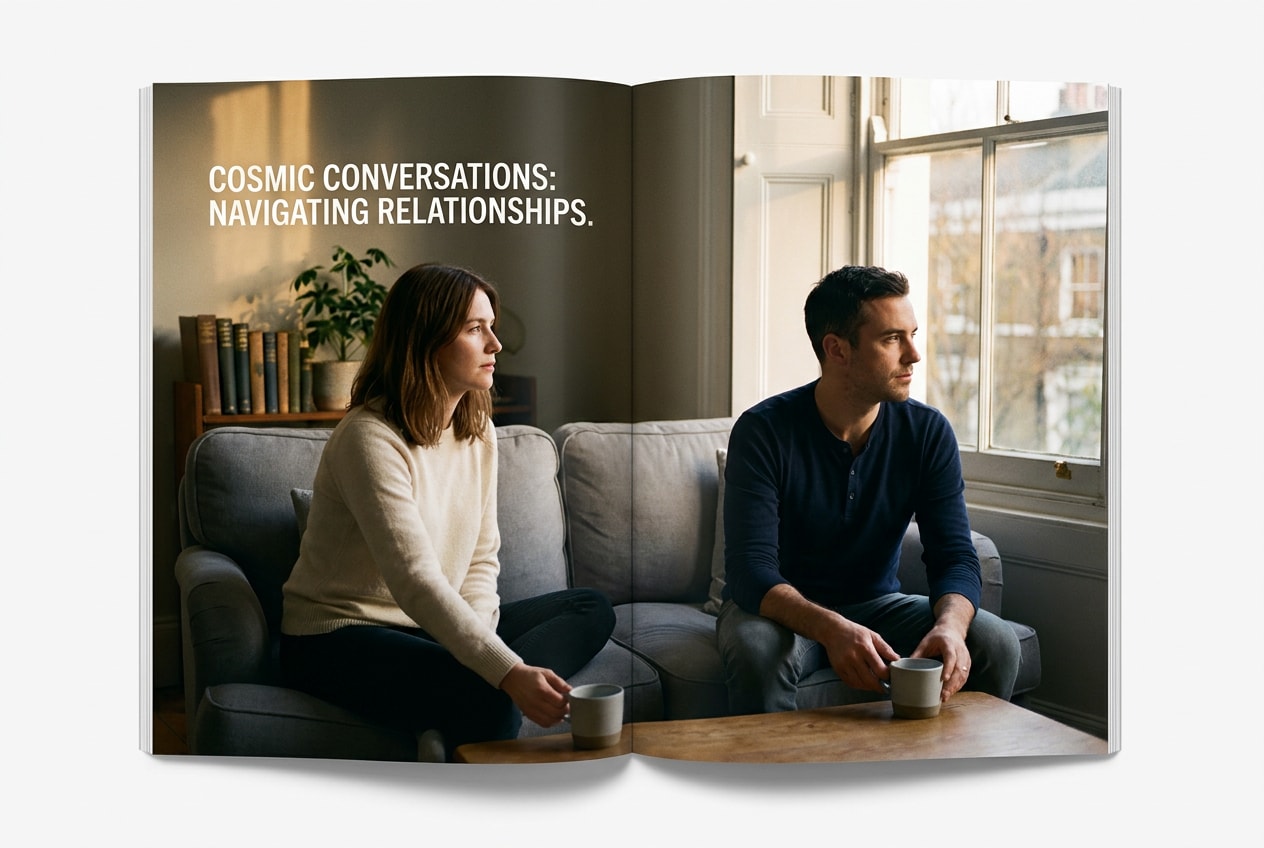 Sunday afternoon, the kind of conversation neither of you arranged.
A reflective practice: naming, not diagnosing
Once you have a name for your default, and a chart-language for the same thing, the next move is reflection rather than correction. This is journal territory, or a quiet walk, or the kind of conversation you have with one trusted friend who isn't trying to fix you. It is not a substitute for the work that happens in therapy.

Three questions worth turning over slowly, with no obligation to answer them quickly.
When closeness feels uncertain, what is my first move: toward, away, both at once, or steady? Which sign of my Moon best describes that move, and does the description sit comfortably with how I actually behave?
When my partner does something that doesn't make sense, what does my chart-Venus default to: pursuit, distance, frustration, or curiosity? Is that default serving the version of relationship I actually want?
The partner-shape that keeps showing up, across more than one relationship: does it match the temperament of my seventh-house ruler? What might that recurring shape be asking me to integrate in myself, rather than to find again in someone else?
Sit with the questions, not the answers. The work isn't producing a verdict on your attachment style, it's noticing the default has a shape, and the shape has a name in two languages. If the noticing brings up more than the noticing can hold — if the default in your relationships is causing real distress, please don't make this a self-help-only project. NHS 111 can help you access talking therapies via self-referral in most areas; the BACP register lists qualified private therapists across the UK; Mind on 0300 123 3393 is the UK mental-health charity that can point you to local support.
 Some afternoons the next step is just walking it out.
What an astrology lens does here — and what it really doesn't
Astrology can offer chart-language for the same default-patterns attachment theory describes. That is the size of the claim. Not bigger. It can lower the heat of pattern-recognition by naming the structure in a second vocabulary; sometimes the second name makes the first one easier to sit with. It can give you a reflective lens that doesn't pretend to be a diagnosis.
It cannot diagnose your attachment style; only a clinical assessment can do that. It cannot fix the default; the actual shift toward earned security happens through therapy, through trusted long-term relationships, through patient self-work over years. It cannot predict whether your next partner will be different. It cannot assess safety in a relationship; if you're afraid of someone, the resources you need aren't astrological.
"Isn't this just borrowing psychology's language and dressing it up?" A fair question. The claim isn't that astrology causes attachment patterns or measures them the way Bowlby's colleagues measured infants in the Strange Situation. The claim is much smaller: the chart names a structural default, emotional baseline, relating mode, partner-shape — that attachment theory also names, in different words. Two vocabularies, one phenomenon. Use whichever one helps you notice yourself more honestly. If both help, use both. Astrology sits alongside the psychology; it doesn't compete with it.
If you want to see how your four placements show up next to your partner's, the chart-level version of why we keep landing in this shape, WowAstro's compatibility reading walks through it. Two birth charts, the four placements that matter most, in plain English. A couple of minutes to set up if you have both birth times.
Frequently asked questions
What is my attachment style?
You can't determine your attachment style from a single quiz or a single placement in your chart, but the four well-described patterns can give you a useful starting frame. Secure, anxious, avoidant, and disorganised are the names. Online quizzes can give you a working hypothesis in about ten minutes; lived patterns across more than one relationship confirm or complicate it; a qualified therapist can clarify it further, especially if the pattern is causing distress. Astrology adds a parallel reflective language; the four placements (Moon, Venus, Ascendant, seventh-house ruler) describe the same defaults in chart-terms. It's a lens, not a diagnostic answer.
Can my attachment style change?
Yes. Attachment styles are developmental defaults, not fixed traits. The process of moving toward a more secure default is what attachment researchers call earned security; it typically happens through therapy, a long-term relationship with a securely-attached partner, patient self-work over years, or some combination. Astrology won't accelerate the process and can't substitute for it. It can sit alongside the work as a reflective tool. If your current default is causing real distress in your relationships, the BACP register (bacp.co.uk) is the right place to start in the UK.
Which placements in my chart show my attachment style?
No single placement determines your style, but four parts of the chart describe the same defaults attachment theory names. The Moon describes your emotional baseline (how you regulate, what you reach for when stressed). Venus describes your relating-default (what attracts you, how you express affection, how friction comes out). The Ascendant describes the first-impression doorway. The ruler of your seventh house describes the partner-archetype you tend to mirror. Hard aspects (squares, oppositions) between Moon and Venus, for example, often correlate with a more conflicted default; harmonious aspects (trines, sextiles) often suggest more settled relating. None of this is diagnosis — it's reflective lexicon, not a verdict.
Does astrology help with anxious or avoidant attachment?
Astrology does not treat attachment patterns, and isn't a substitute for the work of moving toward earned security. It can describe the default and give it a name in a second vocabulary, which sometimes makes the pattern feel less personal and easier to sit with. If your attachment default is causing real distress, panic in safe relationships, persistent dissociation, intrusive thoughts about abandonment or about being engulfed — the right next step is a qualified therapist (the BACP register lists UK practitioners) or your GP. In the UK you can also call Samaritans on 116 123 (free, 24/7) or Mind on 0300 123 3393. Astrology can sit alongside that conversation; it is not a substitute for it.
By Oksana Miatova, astrologer and writer at WowAstro. Charts calculated using the Swiss Ephemeris.
Astrology, as we use it at WowAstro, is a tool for self-reflection and self-understanding, not a method for predicting events, health, or financial outcomes.
If feelings of distress in close relationships are overwhelming or persistent, please speak with a qualified therapist or your GP. In the UK you can also contact Samaritans on 116 123 (free, 24/7), Mind on 0300 123 3393, or NHS 111 for urgent mental-health support. The BACP register lists qualified therapists across the UK. Astrology can sit alongside that conversation; it is not a replacement for it.
See what your charts say about each other
A personal AI synastry reading — not a sun-sign table, but an analysis of both natal charts across 8 areas of the relationship
Comments
New here? Get −30% off your natal chart
Leave your email and we will send you the promo code WELCOME30. Straight after that you can comment — no passwords, all automatic.
Quick sign-in
Sign in with Telegram — one click.
Or by email (with a gift)
Already have an account? Enter the same email — we'll email you a sign-in link.