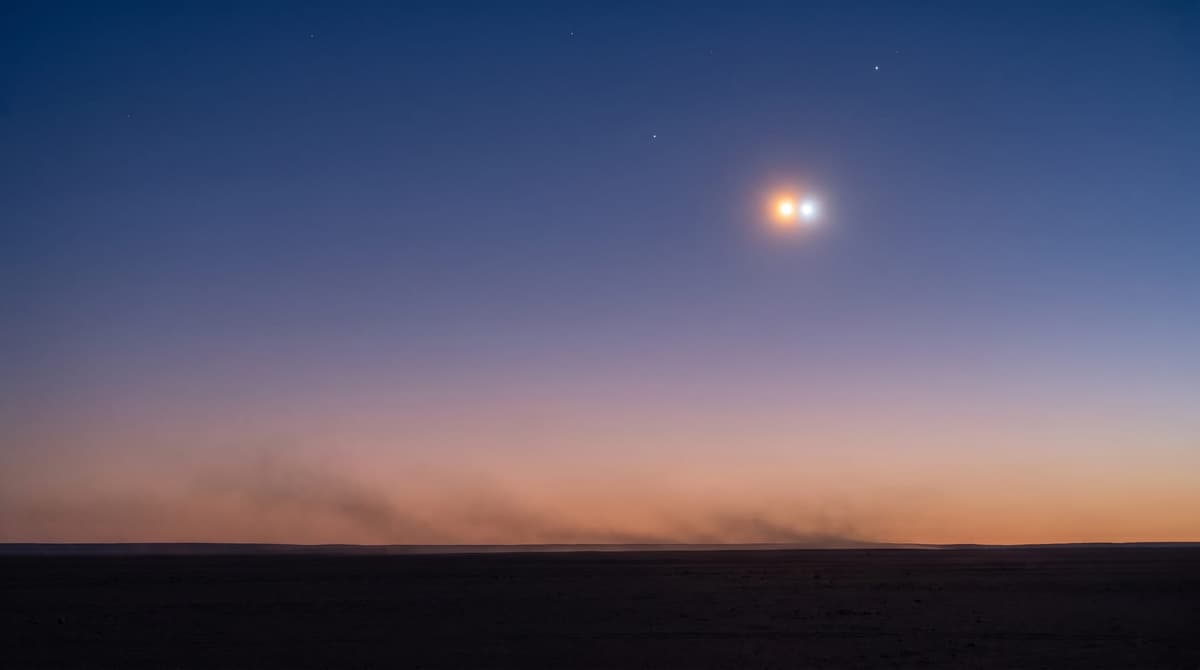
If this conjunction sits in your natal chart, your emotional life is wired differently from most of the people around you. The Moon governs how you react before you've thought — to the smell of childhood, to a stranger's voice, to an empty flat at the end of the day. Uranus governs the sudden shift, the need to break out, the dislike of rules handed down by someone else. When the two stand at one point, those processes don't separate. Feeling and the urge to change arrive together. You're upset, and an hour later you've rearranged everything; you grow attached, and almost at once take fright that someone will try to keep you.
From the outside it often looks like inconstancy. From the inside it's a very high sensitivity to pressure. The slightest attempt to tame you, to explain how you ought to feel, how a family should be run, what time supper is, which relationships are normal, raises a wave you can't argue down. You can be a warm, caring, home-loving person — as long as you're left an exit. The moment the door is shut, something trips inside, and the same person who was ready to build a shared home yesterday starts working out how to leave.
The theme of the mother is nearly always live here. Not necessarily dramatic, but never quite smooth. Often it's a story where your mother was emotionally unpredictable, or you learned early not to depend on her moods, or you were handed to a grandmother, moved house, lived through a divorce, gained a stepfather. Sometimes it runs the other way: your mother was so free-spirited and alive that you grew up sure that closeness needn't mean a cage. In any version, your sense of safety is tied not to the constancy of someone's presence but to the right to leave at any moment. That isn't a diagnosis; it's the make of psyche you were born with.
Sleep and the body answer to this as well. Insomnia before something important, a tremor in the hands the night before a difficult conversation, that buzzing live-wire feeling in the chest on an otherwise quiet day — for a Moon like this, that's a normal backdrop, not a malfunction. The nervous system runs at a slightly higher frequency than it does for people with a calm Moon. Ignore the trait and try to live 'as one is supposed to', and it will surface as symptoms: a wave of panic, a breakdown, a compulsive urge to change everything precisely when, on the surface, all is well.
With money and work the same configuration produces two poles. At one is the ability to drop a stable post the instant it begins to suffocate, and to assemble a life again from scratch. At the other is a chronic rootlessness, a chain of broken-off projects and the feeling that you can't get a grip anywhere. The difference between those poles isn't in the chart but in how well you can tell a genuine need for the new from the automatic urge to run the moment anxiety strikes.
In relationships you have two tasks. The first is to stop fighting yourself — not to pretend you want a calm, identical morning to a timetable if the truth is that it stifles you. The longer you lie to yourself, the louder the eventual blow-up. The second is to learn not to mistake a flash for love. Your switch-ons are vivid, and every one of them feels like 'this is it'. More often it's an over-strung nervous system answering to someone close but unlike you, and a month on it all goes out, because there was never anything beyond the spark.
I often say to people with a Moon like this: you aren't broken, you're built differently. The point is to build yourself a rhythm that has room for both the warm and the empty. A room of your own, your own hours of quiet, the right not to answer the phone straight away, a flexible household where nothing is fixed beyond changing. When your Moon has that space, Uranus stops working as an emergency and starts working as a tuning — towards honesty, towards lightness, towards living your own life rather than someone else's. From there it's worth looking at exactly how your Moon fits into the rest of the chart: which sign, which house, what other aspects it's caught up in.