Skip to content
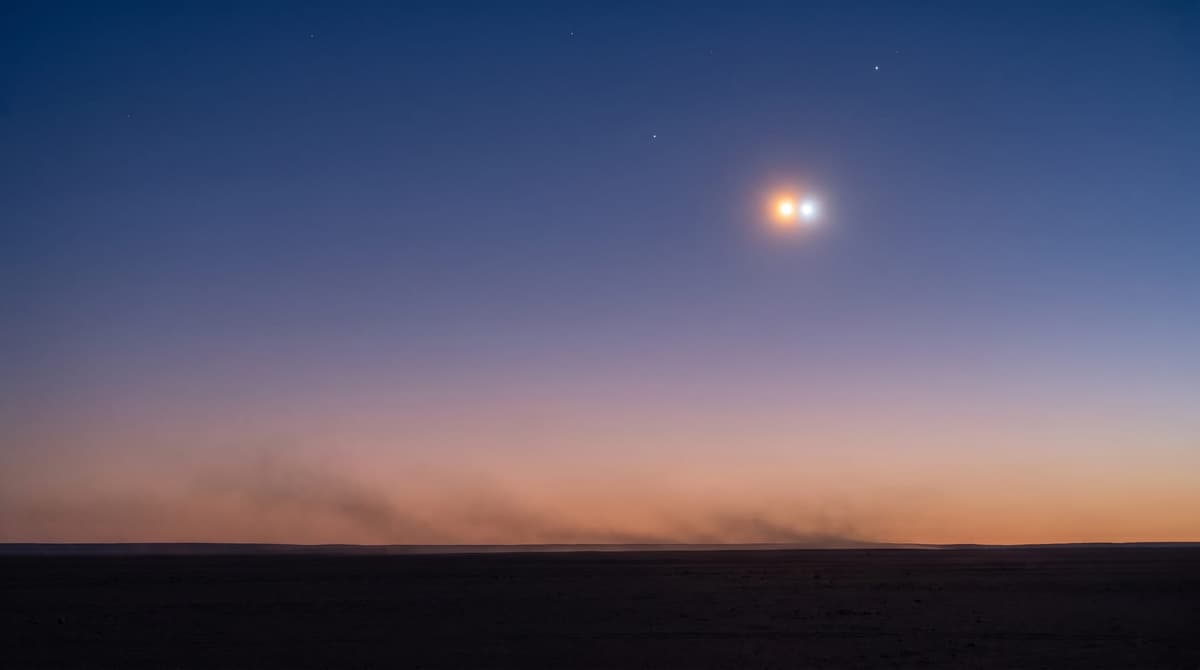
Conjunction Moon–Mars — symbolic illustration

Conjunction · 0°

Moon conjunction Mars

A neutral aspect: it amplifies both planets, and how it plays out depends on the signs they sit in and the rest of the chart.

Orb up to 8°NeutralNatal · synastry · transit
0°Moon conjunction MarsOrb up to 8° · major aspect
Oksana MiatovaWritten by Oksana Miatova·10 min read

For entertainment and self-reflection only. Not medical, legal, financial or psychological advice. Consult a qualified professional for important decisions.

The short answer

Moon conjunct Mars is feeling and the impulse to act fused at a single point of the chart. The emotion becomes a reaction before the pause that usually sits between them has a chance to form. Strong vitality, plain speech and a quick temper tend to arrive as one package.

What a conjunction is

The geometry behind the reading

A conjunction is a separation of zero degrees between two planets, and classically it is the strongest of the major aspects, with a textbook orb allowed up to eight degrees. The two bodies sit in the same degree and run as a single engine: their functions can't be teased apart, and each colours the other. Unlike a trine or a square, a conjunction sets no direction for the exchange — it simply fuses the energies, and the tone depends on which planets have merged. When it's the Moon and Mars, two very different inhabitants end up under one roof: the inner child and the inner fighter, the need for safety and the need to push back. That is why a Moon–Mars conjunction is best described as neutral by geometry but tense by nature — there is, by design, very little stillness in it.

Three ways to read it

The same aspect, three different stories

One aspect reads differently depending on where you find it: inside a single birth chart, between two people, or moving across the sky right now. Read each as a way to notice patterns, not as a forecast.

Moon conjunct Mars in the natal chart

If this aspect sits in your natal chart, you live with one feature that other people tend to notice before you do: between what you feel and what you say or do, there's almost no gap at all. You're sad, so you're up and busy. You're anxious, so you've started cleaning. Someone slights you and you've answered before you've weighed whether you should. In most charts that one second of delay comes built in from birth. In yours it never quite installed itself. That isn't a flaw and it isn't an advantage — it's simply a fact of the wiring.

Here's where it comes from. The Moon is our emotional nature, the home we carry inside, everything we call feeling and bodily sensation. Mars is the impulse to act, the will, the capacity to get up and go. In most charts those two forces stand apart: first the feeling arrives, then the analysis switches on, then perhaps the action follows. In yours the Moon and Mars stand at the same point. They aren't distinct. Feeling becomes body at once, body becomes deed at once.

From the outside this reads as strong vitality. You recover quickly, you've plenty of energy in the first half of the day, your body is responsive. You rarely complain of a slump for no reason — if your energy has dropped, it's because you genuinely overdid it. You're good at protecting your own: for a parent, a child, a partner, you'll stand up without a long deliberation. And your speech about feeling is direct — what you felt is what you said, without the cushioning of 'perhaps', 'it seemed to me', 'I'm not quite sure'.

From the inside it gives you trouble with one specific skill: the skill of the pause. You can be clever, deeply reflective, a reader of books on emotional intelligence, perfectly aware of your own machinery — and still, in a moment of tiredness, hunger or too little sleep, you'll react before the mind has had time to recall the theory. That isn't a weakness of character. It's how the aspect is built. Mars on the Moon hurries the reaction, and it hurries it every time.

So what do you do with it? The good news is that the pause is a skill, not an inborn trait, and a skill can be grown. The less good news is that it won't appear on its own from reading — you have to install it through the body. The techniques that actually work for people with this conjunction are the ones that halt the physical movement before the speech: a four-count exhale, five steps to one side, a glass of water sipped slowly. There's no magic in any of it. It's simply redirecting the Martian impulse off the tongue and onto a small action that doesn't break anything. After a couple of years of regular practice the reaction stays just as fast but has time to turn in a more accurate direction.

The second great resource is sport — and not gentle yoga, stretching or meditation in the first instance, but exercise with load and ideally with contact: boxing, wrestling, sprint swimming, running, lifting. Mars gratefully hands its surplus over to the session, and the Moon finds calm not because you've talked it round but because the tension has genuinely left the body. Many people with this conjunction notice that three workouts a week change the atmosphere at home more than any amount of working on themselves with words.

A third thing worth knowing in advance is family. A Moon–Mars conjunction often inherits a parent's pattern. If a raised voice was the household language of feeling in childhood — if emotion came out as a shout, a slammed door, a cutting word — the adult with this aspect will tend to repeat the same model automatically, even while consciously rejecting it. That isn't blame; it's an imprint. The work on it is slow, done through the body, through therapy, through that steady return to the pause. But it's real work, and thousands of people do it.

Within the chart as a whole, this aspect is the base note of temperament. Much of the rest is decided by the sign the conjunction falls in, the placement of Saturn, and the contacts to Mercury — the planet of the second voice that can talk you down. To see the whole picture rather than this single note, the chart has to be read as a whole.
When it flows

  • Vitality from childhood — plenty of physical and emotional energy, and a body that bounces back quickly
  • Plain speech about feelings: what you felt is what you said, with none of the long detours
  • A readiness to defend your own — you'll stand up for a parent, a child or a partner without stopping to weigh it
  • Emotion turns into action faster than it does for most: sad and you're cooking, anxious and you're tidying

When it grates

  • Irritability that rides in on tiredness and hunger — the reaction lands before you've realised you simply need to eat
  • Flare-ups you're ashamed of afterwards: a sharp word said, then regretted, but hard to stop in the moment
  • The body reacts to stress at speed — a racing heart, a flush, a tremor; Mars on the Moon makes the response physical
  • Trouble separating 'I'm hurt' from 'this must be sorted out now' — the pause simply isn't built into the system

The shadow side, and what to do with it

The shadow of Moon conjunct Mars often traces back to a household where a raised voice was the normal currency of feeling. A child learns that expressing emotion means shouting, slamming a door or crying at full stretch, and in adulthood that surfaces as flare-ups towards the people closest to you, the ones you'd least want to wound. The way through rests on one simple rule: put the body between the feeling and the reaction. Breathe out first, take five steps, drink a glass of water, and only then speak. Mars still gets its action, the Moon gets its pause, and nobody has to be suppressed. A contact sport with clear rules — boxing, wrestling, sprint swimming — frequently does more here than any amount of talking.

Conjunction — symbolic still life

How close is close

The orb decides the volume

A conjunction is rarely exact. The smaller the gap between the two planets — the orb — the louder the aspect plays. Here is roughly how the three bands read.

Tight

0–2°

Reads as a defining feature

At 0–2° the conjunction is exact and the fusion is at its most complete. Feeling and action genuinely can't be told apart — you don't catch the emotion before it has already become a deed. The strength is enormous and so is the risk of getting it wrong in the moment. These are often the people others describe as 'acts first, thinks later', which serves them well in sport, in a crisis, under real pressure, and badly at the family table. This band asks you to treat the pause as a skill to be practised, not as a trait you happen to lack.

Medium

2–5°

A steady background pattern

At 2–5° the conjunction is a meaningful, workable force without the overheating. Feeling and action are still linked, but there's a one-second gap between them, and into that second you can fit a breath. This is the most comfortable range: enough of Mars's drive that you don't get stuck in the feeling, enough separation that not every flash of irritation becomes a deed. Most people with an orb in this band learn to handle the energy by around thirty and live with it calmly thereafter.

Loose

5–8°

A faint colouring, felt in crises

At 5–8° the conjunction sits on the edge and works mostly in the background. The link between the Moon and Mars is there but doesn't dominate the chart. Feeling and reaction run separately more often than together, and they fuse mainly under heavy stress or a bright surge of energy. From the outside such a person looks balanced; from the inside they're sometimes surprised by their own sharpness. In this band the aspect is a potential switched on by circumstance, not a constant note of character.

Conjunction with a partner — what does it mean for the two of you?

A full synastry reading — every aspect between your two charts

Moon conjunction Mars inside one chart is an inner mechanism. Between two charts it becomes the dynamic of a relationship. Enter both birth details and get a synastry reading — where the conjunctions sit, where the squares pull, where the oppositions draw you together — all calculated with the Swiss Ephemeris. Read it as a way to notice patterns, not a forecast.

Check your compatibilityfrom £1 · for entertainment

Compare with a neighbouring aspect

Same planets, a different distance

Moon opposite Mars tells a different story. If you're reading this to make sense of a specific chart, it's worth glancing at the neighbouring aspect too.

Moon opposite Mars
  • A conjunction fuses the Moon and Mars at one point — feeling becomes action straight away, with no gap
  • An opposition sets the Moon and Mars at opposite ends of an axis, with a distance between them where conscious choice can live
  • The conjunction makes the reaction automatic; the opposition turns it into something you hold up for inner debate
  • With a conjunction you learn to insert the pause; with an opposition you learn to reconcile two poles without crushing either
  • The conjunction gives more vitality and less reflection; the opposition gives more awareness and less speed

Lived examples

A few charts where you can see it

Public figures with a verified Rodden birth-data rating (AA/A/B). No invented data.

Frequently asked questions

What does Moon conjunct Mars mean in the natal chart?
It is your emotional nature (the Moon) and your impulse to act (Mars) merged at a single point of the chart. You tend to respond to feelings with your body and with action faster than you can think them through. The bright side is strong vitality, plain speech about how you feel, and a real readiness to protect the people you love. The other side is a quick temper, irritability when you're tired or hungry, and a body that reacts physically to stress. Read it as a pattern to notice in yourself, not a verdict on your character.
Is Moon conjunct Mars a good or a bad aspect?
A conjunction is neutral by geometry, but the Moon and Mars are very different by nature, so their merge gives a tense combination: plenty of force and not much automatic calm. In the hands of someone who has learned to work with their own emotion and body, it's an enormous resource — drive, courage, the ability to act when others freeze. For someone who hasn't yet learned to put a pause between feeling and reaction, it becomes a source of friction with the people closest to them. It isn't a sentence either way; it's an energy you learn to steer.
Is Moon conjunct Mars good for a relationship in synastry?
It almost always brings strong physical attraction and emotional intensity. It also carries a risk of heightened conflict: one partner regularly catches the other's tender spot, often without meaning to, because the Moon is the most vulnerable point in a chart and Mars is fused with it. It suits couples who can argue without doing damage and make up quickly, and who treat repair as a shared job. It suits less well anyone for whom a quiet, even atmosphere at home matters most. As ever, this is a way to understand a couple's patterns, not a prediction about them.
What orb should I use for Moon conjunct Mars?
The classical orb for a conjunction is up to 8°. Within 0–2° the contact is exact and at its most intense. From 2–5° it's a workable force without the overheating, and that's the most comfortable band. From 5–8° it runs in the background and gets switched on by circumstance. For synastry the orb is usually tightened to about 5–6°, and past roughly 10° the conjunction is considered to have dissolved.
Is Moon conjunct Mars different for a man and a woman?
The mechanics are the same; the cultural reading differs. In a man's chart it has often been read as a 'proper masculine character' — decisive, protective, with an assertive delivery. In a woman's chart the same energy was for a long time labelled 'too sharp' or 'unfeminine', whereas now it's far more readily seen as leadership and welcomed as such. Inside the chart the machinery is identical: feeling and action fused. None of this is destiny; it's simply a lens for noticing how the energy tends to express itself.
How does a transiting Moon over my natal Mars work?
The transiting Moon crosses your natal Mars roughly once a month and holds for about two hours. It's a short window of heightened emotional excitability: you might snap at someone close over a trifle, or make an abrupt move you later regret. Big decisions about family or large purchases are better postponed, and the energy is better channelled into the body — a workout, a walk, some physical work. Treat it as a brief pressure spike to ride out, not a day to settle anything weighty.
How does transiting Mars over my natal Moon work?
Transiting Mars crosses your natal Moon roughly every two years and lasts a day or two at exact orb, up to about a week with the approach and separation. It's a stretch of sharpened bodily reaction to stress: you may notice it in your sleep, your appetite or in small everyday knocks and strains. It suits active tasks tied to home and family, and it suits serious emotional conversations with loved ones rather poorly. When Mars stations and retrogrades near the point, the same window can repeat across several months.
Which celebrities have Moon conjunct Mars?
Accurate examples need checking against AstroDatabank at a Rodden rating of AA or A. Angelina Jolie has the Moon in Aries with Mars nearby on a wide orb, and her career as an actress and humanitarian shows neatly how feeling turns into action. Be wary of names quoted casually, though — Madonna, for instance, is often listed but on inspection has the Moon and Mars in tense aspect, not a conjunction. I avoid passing along figures I haven't verified, so as not to hand on an error.
What can I do if Moon conjunct Mars is getting in the way of my relationships?
Set yourself a rule: five minutes and a glass of water between the feeling and the reply. It sounds slight, but it works, because it puts the body in the gap where the pause should be. Regular physical exercise drains off Mars's background charge and the Moon settles as a result. If the flare-ups keep repeating, it's worth working through early-childhood family scripts with a therapist — this aspect often inherits a parent's pattern of the raised voice, and naming that pattern is the first step to not repeating it. Read this as self-reflection, not a fix-all promise.
Can I check Moon conjunct Mars myself?
Yes. Open your natal chart and find the positions of the Moon and Mars. If they're in the same sign and less than 8° apart, you have a conjunction; if they're in neighbouring signs but still under 8° — say Moon at 28° Cancer and Mars at 2° Leo — it counts as a conjunction across the sign cusp and works a little more weakly. Past about 10° the aspect has formally dissolved. For entertainment and self-reflection, that quick check is all you need — the full picture depends on the sign, the house and the other planets involved.

Related pages

The other aspects between Moon and Mars

The same two planets at a different angle — each reads differently.

Oksana Miatova
Oksana Miatova

Astrologer, co-founder of WowAstro

Oksana Miatova is a practising astrologer and co-founder of WowAstro. Natal charts, synastry and forecasts grounded in the Western classical tradition — explained through real-life examples and plain language.

More about the author →

For entertainment and self-reflection only. Not medical, legal, financial or psychological advice. Consult a qualified professional for important decisions.