Skip to content
Moon in Cancer — symbolic illustration

Natal astrology

Moon in Cancer

A water, cardinal sign ruled by Moon. What this placement tends to look like in real life — read for self-reflection, not as a forecast.

WaterCardinalRuler: Moon21 June – 22 July

Essential dignity

Domicile

The planet at home

Moon in Cancer

Moon is at home in Cancer. The planet expresses its function naturally and strongly: its nature lines up with the nature of the sign.

The Moon in Cancer is in domicile: feeling tends to arrive before thought, and the sense of safety is built on belonging — to people, to a home, to a remembered place. It's a placement that softens around what it loves and tightens when that bond feels under threat.

Oksana MiatovaWritten by Oksana Miatova·4 min read

For entertainment and self-reflection only. Not medical, legal, financial or psychological advice. Consult a qualified professional for important decisions.

What's inside

Six things you might recognise

  • Reads the mood of a room within seconds of walking in
  • Recalls a years-old conversation almost word for word
  • Starts feeding and looking after others the moment they themselves feel anxious
  • Puts off replying to a message that felt cold, sometimes for days
  • Goes back to the same cafés and neighbourhoods for years on end
  • Defends the people close to them quietly, often at their own expense

What people with this placement rarely realise about themselves is how completely their life is organised around attachment. Decisions that might hurt someone close are agonising to make, even when they're plainly the right call. They run on a different wiring: the body reacts first, with a tight chest or a lump in the throat, and the reasoning catches up afterwards. Kept too long away from family and familiar surroundings, this kind of person tends to feel it physically — the way anyone else feels run down by sustained stress. None of that is a flaw to fix; it's a pattern worth noticing in yourself rather than apologising for.

Want the whole chart, not just this placement?

A full natal reading — every planet, house and aspect

Enter your date, time and place of birth and get a detailed reading of your whole chart, written in plain language — where you tend to default, where you burn fuel, and what's worth paying attention to.

Build your natal chartfrom £1 · for entertainment

Strengths

What this placement does well

  • Deep relational intuition — often senses what someone feels before they've worked it out themselves
  • Builds a home and an atmosphere out of almost nothing, in a rented flat or a hotel room on a work trip
  • A working memory for details and stories that runs like a living archive of family and friends
  • Cares without drama — daily, through small practical kindnesses rather than grand gestures
  • Sits patiently with other people's hard feelings instead of turning away

Shadows

Where it burns fuel

  • Gets stuck in old grievances and replays the same conversation dozens of times
  • Absorbs other people's anxiety and carries it around as if it were their own
  • Controls those close to them through care, then feels hurt when the gratitude doesn't come
  • Delays decisions that might upset someone and lets them drag on for years
  • Retreats into family or the house when the moment actually calls for stepping out and being seen
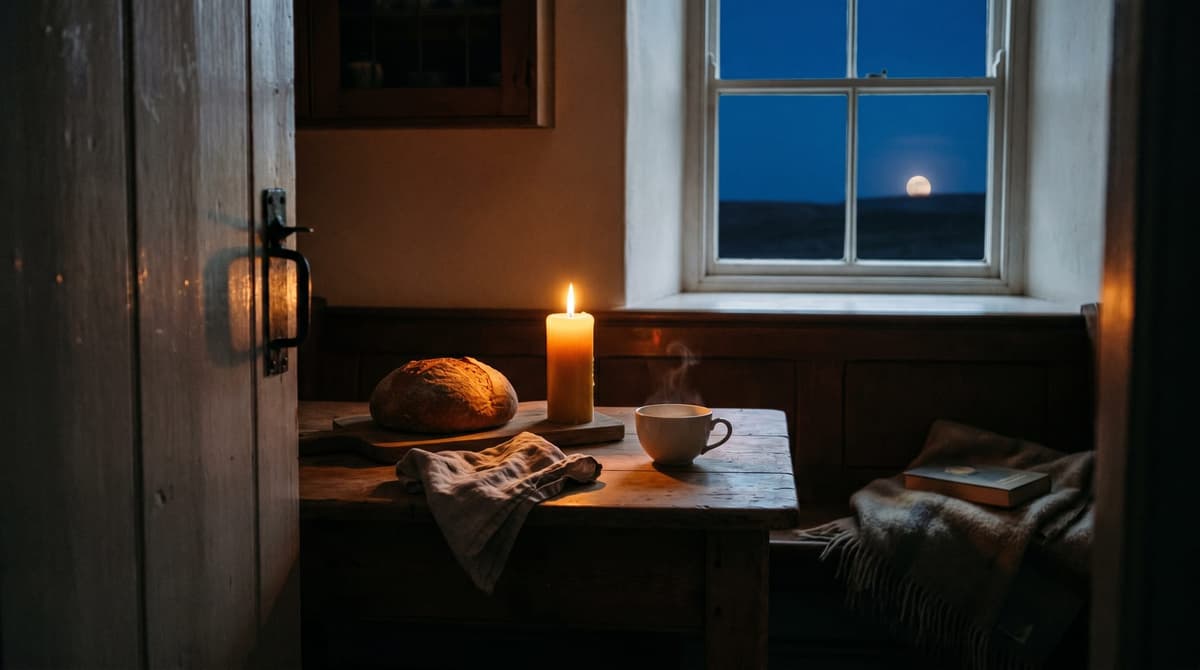
Moon — symbolic still life

Love

Love and relationships

In relationships, the Moon in Cancer is looking for a family rather than a partner. I often watch a client with this placement arrive for a reading and say, quite calmly, "it's been three months and we're moving in together" — and for them that's sensible, not reckless. What they need is deep involvement: a shared daily life, contact through the small things, not the occasional date in a pretty restaurant. A partner who keeps their distance, or lives to their own rhythm without much thought for anyone else, slowly becomes a source of low, constant ache for this Moon.

They fall in love slowly and attach for the long haul. Often the choosing itself runs for months, sometimes years of friendship, while someone watching from outside has no idea that inside it's all been decided already. Once the choice is made, though, retreat is almost impossible — the emotional bond grows into the body, and a break-up is felt like an amputation. A person with this placement can spend a decade recovering from a divorce, and keep the old letters of someone long gone for the rest of their life.

Conflict tends to come out through silence rather than plain speech. If something has hurt them, they won't say so straight away — sometimes won't say so at all — and will instead wait to be noticed. To a partner used to direct conversation, this can read as a riddle, occasionally as manipulation. In truth there's no scheming in it: the fear of wounding the other person, or of being rejected, simply outweighs the wish to clear the air. In my experience the couples who do well are the ones who learn to name a grievance out loud and at once, instead of through a week of quiet — and it's precisely that skill that tends to save the relationship.

Work and vocation

Where this person thrives

This placement does its best work where there's direct contact with people and where sensitivity matters more than volume. Therapeutic practice, especially around the themes of family and childhood. Paediatrics and work with infants. Teaching the youngest years, childminding, midwifery. Cooking as a craft, particularly home cooking and working with clients in person. Antiques, restoration, museum work — anything to do with preserving memory and objects that carry a history. What sits badly are environments built on competitive aggression: cold sales, politics, anywhere that calls for being hard-edged with strangers all day.

In my practice, the strongest career paths for clients with this Moon tend to look like this: they find one theme, or one community, and work with it for decades, deepening rather than widening. A clean vertical climb up a big corporate ladder is a rare story for them, and it usually comes with a quiet inner sense of "I'm not at home" even when everything looks successful from the outside. Private practice, a small business, a family enterprise, or a job in a little team where everyone knows each other by name — those formats give them a long, steady footing.

They tend to settle naturally into the role of an informal centre. Not necessarily the manager on paper, more the person others come to with something personal, the one people seek out for advice, the one whose kitchen everyone gathers in after work. Without that sense of belonging to a circle, the job quickly curdles into a chore. And if a career doesn't let them be that centre by default, this kind of person builds the circle anyway — through shared rituals, communal lunches, a quiet habit of looking after their colleagues. None of this is fixed in stone; it's a tendency worth recognising in yourself, not a track you're bound to.
Five practices

Ways to work with this placement

Less a description, more a few things you could try this week to see whether the placement starts working for you rather than against you.

  1. 01

    Conversation script

    A line for a hard conversation

    When you notice a grievance has been sitting inside you for a week and you've quietly been carrying it, say one plain sentence out loud: 'Something hurt me back then, and it's still alive in me. I'd rather not store it up — can we look at it together?' No justifying, no accusing. In my experience that kind of direct opener clears away half of what was stuck.

  2. 02

    Ritual

    An evening wind-down by water

    Before sleep, put the phone away for fifteen minutes and spend them quietly near water — a bath, a warm mug, a window with rain on it. This Moon tires of information noise faster than most and recovers through gentle contact with warmth and water. Skip the pause and the anxiety builds up and goes into the body instead.

  3. 03

    Journaling prompt

    A weekly question

    Once a week, answer one question on paper: 'Who did I worry about today more than they were worrying about themselves?' Write the name, the situation and how you felt. Re-read the list a month later. You'll start to see where your energy actually goes and where it's safe to let go a little.

  4. 04

    Body practice

    Time in the water

    Twice a week, swim, go to the pool, or at the very least take a long warm shower with deliberate attention to the sensations in your belly and chest. For this Moon, water works as a release — the body lets go of what the mind has been gripping all week.

  5. 05

    Relational exercise

    An exercise for the people close to you

    Once a month, ask a partner or a child a single question: 'Where did my looking-after land as too much, or in the wrong place, this month?' Don't defend yourself — just write the answer down. After three months you'll see clearly which scenes your care is smothering rather than supporting.

The house Moon sits in

Three typical houses for Moon in Cancer

The sign tells you which energy the planet works with. The house tells you in which area of life that energy becomes visible.

4

4th house — home and roots

The most concentrated form of this placement. Family and lineage become the central axis of the biography. Such a person may spend a whole life feathering one nest — or, just as readily, spend it hunting for the home that finally feels right, moving every few years. The second story is just as much Moon in Cancer as the first, simply turned inside out. People with this often end up as the keepers of the family archive: the photographs, the recipes, the half-remembered stories about grandmothers.

7

7th house — partnership

Here the Moon is looking less for a partner than for a family. Only deep involvement satisfies it — constant contact, shared daily life, mutual care. The partner often slips into a parental role, or becomes that kind of parent in return. The bond tends to be warm and domestic, occasionally suffocating. The strain shows up when the partner needs personal space and the Cancer Moon reads their wish to be alone as a threat rather than a breather.

10

10th house — career and public role

A paradoxical position. The Moon's qualities are pushed onto a public stage, and the career gets built through caring, feeding, or the image of mother and keeper of tradition — frequently work with children, with women, or around themes of family and wellbeing. The difficulty is that visibility comes hard to this Moon: it wants to be backstage, while circumstances keep nudging it into the spotlight. By midlife it usually finds a format where it can be seen without feeling exposed.

Sphere radar

The placement across seven spheres

This profile shows which spheres the placement plays loudly in, and which it keeps quiet. High values aren't 'better' — they're amplitude, not a score.

Love0Career0Health0Money0Family0Shadow0Gift0

0 = quiet, 100 = the loudest this sphere plays for this placement

Oksana Miatova, co-founder of WowAstro

Oksana's advice

Three things for Moon and Cancer starting out

If you or someone close to you has Moon in Cancer, try not to fight the energy — it doesn't break, it only reroutes. Give it a job where this nature becomes a strength rather than a nuisance, and you get a steadier, warmer person instead of one worn out by an inner tug-of-war. Read it as a way to notice your own patterns, not a verdict on who you are.

Oksana Miatova, co-founder of WowAstro

Frequently asked questions

What does the Moon in Cancer mean for a woman?
This often reads as a woman with a deeply developed nurturing instinct, frequently showing up long before any children arrive. She looks after friends, colleagues and pets, and for her that's simply a natural way of being in the world. In relationships she tends to look for a steady partner who wants to build a family with her, rather than a dazzling hero. The strain comes when her surroundings demand toughness and a competitive edge — she can buckle inwardly faster than most. It's a reading for self-reflection, not a verdict.
What does the Moon in Cancer mean for a man?
This often reads as a man with an emotional sensitivity that runs against the usual cultural script. He notices moods and remembers small things about the people close to him, and frequently becomes the family go-between, the one who keeps the connections alive. He tends to be gentle with women and deeply involved as a father, sometimes over-protective of his children. In my experience these men reach a point where they need to learn to mark out boundaries, otherwise their kindness gets quietly drained by other people's anxieties.
Which public figures have the Moon in Cancer?
Our internal reference doesn't yet hold any examples for this exact placement that are verified to a strong Rodden rating. The names sometimes floated in popular sources usually rest on rectified or disputed birth times, and it wouldn't be honest to list them as fact. When properly sourced charts come in, we'll add them to this section.
What is the Moon in Cancer compatible with?
Emotionally, Cancer tends to fall into step easily with the other water Moons — Scorpio and Pisces — sharing an element and a similar depth. With earth (Taurus, Virgo, Capricorn) it can build a dependable, domestic bond where care meets practicality. Fire (Aries, Leo, Sagittarius) is trickier: the pace and volume can tire and bruise this tender Moon. Air (Gemini, Libra, Aquarius) is the hardest fit, since a partner's reasoning can land as coldness. You can never read compatibility from the Moon alone — it takes the whole chart, and it's best treated as a bit of fun rather than a rulebook.
What does the Moon in Cancer in the 7th house mean?
It's a position where family becomes the main theme of relationships. Such a person often marries early — or, conversely, searches a long time for 'the one', sensing that a partner will change the whole shape of their life. The union tends to be full of care, a shared home and everyday warmth. The friction gathers around personal space: the Cancer Moon wants to be close all the time, while the partner needs the occasional pause. A full chart reading shows where your footholds are and where the risk zones sit.
Sun in Aries with the Moon in Cancer — is that a conflict?
It's the classic pairing of opposites inside one person: the will straining outward into action and the public world, the feeling pulling homeward and into the rear. From the outside such a person can look like a fighter, while inside they're shielding a vulnerability they rarely show. It isn't a conflict in the bad sense so much as a live tension — the capacity to act decisively sitting alongside the capacity to attach deeply. A specific reading shows which houses this combination plays out through for you.
How is the Moon in Cancer different from the Sun in Cancer?
The Sun in Cancer governs the conscious will and the public identity — that person builds a life around family and care as a deliberate choice. The Moon in Cancer works on a deeper layer, governing the habitual emotional weather, the reactions to stress and the needs of the body. A Sun in Cancer can happily work in a bank; a Moon in Cancer will still ache for home halfway through the working day. They're different registers of the same theme.
Why is the Moon in Cancer called a domicile?
In classical astrology, domicile means the sign where a planet feels at home, on its own territory. For the Moon that sign is Cancer, where the lunar qualities — memory, feeling, attachment, care — show up in pure form, without resistance. The status doesn't depend on modern interpretation; it was set in the tradition roughly two thousand years ago and is still in use today.
What should I do if the Moon in Cancer is in a tense aspect with Saturn?
Feeling collides with an inner brake — every emotion runs into a quiet 'is it really appropriate to show this now?'. In youth this often plays out as a kind of estrangement from one's own feelings, learning to hide or freeze them. With age, and with some inner work, the aspect can become a strength: deep sensitivity plus the ability to give it structure — a rare combination for work as a therapist, mentor or leader. It needs an individual reading, since the orb, the houses and other configurations change the picture a great deal.
Is the Moon in Cancer reading a prediction?
No. It describes tendencies you might recognise, not events that will happen. Astrology in this reading is a vocabulary for noticing your own emotional patterns — the choices and the life you build stay entirely yours. Treat it as a prompt for self-reflection and a bit of fun, not a forecast of how things will turn out.

Related pages

Related placements for Moon and Cancer

Neighbouring placements that already have a reading of their own.

Oksana Miatova
Oksana Miatova

Astrologer, co-founder of WowAstro

Oksana Miatova is a practising astrologer and co-founder of WowAstro. Natal charts, synastry and forecasts grounded in the Western classical tradition — explained through real-life examples and plain language.

More about the author →

For entertainment and self-reflection only. Not medical, legal, financial or psychological advice. Consult a qualified professional for important decisions.