Skip to content
Conjunction Venus–Mars — symbolic illustration

Conjunction · 0°

Venus conjunction Mars

A neutral aspect: it amplifies both planets, and how it plays out depends on the signs they sit in and the rest of the chart.

Orb up to 8°NeutralNatal · synastry · transit
0°Venus conjunction MarsOrb up to 8° · major aspect
Oksana MiatovaWritten by Oksana Miatova·11 min read

For entertainment and self-reflection only. Not medical, legal, financial or psychological advice. Consult a qualified professional for important decisions.

The short answer

Venus conjunct Mars is the principle of attraction and the principle of desire fused into a single impulse — a person, or a moment, where 'I like it' and 'I want it' are no longer separable. It gives strong sexual and creative charge, but very little pause between the feeling and the act.

What a conjunction is

The geometry behind the reading

A conjunction is a separation of zero degrees between two planets, and it is classically counted as the strongest of the major aspects. The orb allowed for a conjunction is generous — up to eight degrees — because two planets sitting in the same patch of the zodiac fuse into a shared function rather than working as two separate principles. Geometrically the conjunction is neutral: it is neither harmonious nor challenging on its own, and how it plays out depends entirely on which two planets have merged and in which sign. With Venus and Mars the merge brings together attraction and desire, aesthetics and instinct — the two poles of a person's romantic and sexual nature meet at one point and start acting as one.

Three ways to read it

The same aspect, three different stories

One aspect reads differently depending on where you find it: inside a single birth chart, between two people, or moving across the sky right now. Read each as a way to notice patterns, not as a forecast.

Venus conjunct Mars in the natal chart

If Venus and Mars sit conjunct in your natal chart, the two main planets of your romantic and sexual nature aren't kept apart — they're poured into a single function. What that means in practice is that you rarely feel plain fondness without a thread of desire running through it, and you rarely feel desire without an aesthetic element attached. There isn't a separate room inside you for 'I just enjoy this person's company' and another room for 'I'm drawn to this person'. Both doors open onto the same space, and often you can't tell yourself which one swung open first.

From childhood this shows up as a particular relationship with beauty. You notice early that people like you, you notice early that you like someone, and both processes are tied to the body for you. Aesthetics isn't an abstract category here; it's the thing your body answers to with a movement towards it. You can see it in how you choose clothes, in how you carry yourself, in the way you walk into a room. Venus and Mars working as one function make you noticeable to others not through volume but through a kind of physical composure.

In adolescence this conjunction tends to unfold through early, intense infatuations. You don't fall for the idea of a person; you fall for their particular presence — the voice, the smell, the way they move. The partners a Venus–Mars conjunction picks usually aren't the ones you could describe with a tidy list of good qualities. They're the ones the body responds to before the head has caught up. Sometimes you spend years afterwards trying to explain to friends what you saw in someone, and you can't quite put it into words yourself.

The creative side of the conjunction works through any craft that has the body in it. Dance, sport, applied art, cooking — any pursuit where the result is born through the hands and through movement comes to you more easily than the purely intellectual. Venus carries the form; Mars carries the energy that makes the form. When the two are fused you have a rare ability to work directly in a material — wood, fabric, paint, sound or your own body — without a long gap between the idea and the doing. People with this aspect often find their truest expression somewhere physical, where taste and drive arrive together.

There is a harder side, of course, and impulsiveness in love is its headline. You catch a glance, you make a move, and a week later you realise you've nothing much to say to this person — but by then feelings have set in, sometimes promises, occasionally a shared front door. The conjunction leaves no pause between 'I saw' and 'I started moving'. Learning that pause is conscious work: asking yourself the questions, giving yourself the time, checking whether you've mistaken desire for genuine liking. None of that comes naturally, because the merge wants to act, and the acting feels like honesty.

Jealousy is a frequent companion of this aspect, sharpest in a tight orb and in the signs of Scorpio, Taurus or Leo. When desire and attraction are fused, a partner becomes 'yours' at the level of the body, and their attention to someone else is felt as a threat to the bond itself. That doesn't mean you're doomed to be jealous — it means it helps to know the reaction is coming and to learn not to act on it the moment it arrives. The feeling is real; what you do with it is the part you get to shape.

A mature Venus–Mars conjunction is a person whose strong romantic and sexual energy chooses where it flows. It isn't suppressed and it isn't blocked, but neither is it spent on a run of short episodes — it's invested in one deep bond and in one piece of work where body and aesthetics pull together. If this conjunction sits in your chart, it's worth knowing what it asks of you. The sign it falls in, the house it occupies and its aspects to other planets all decide how exactly it shows up, and the whole chart has to be read together to see your particular version of it.
When it flows

  • Real charisma in love and creative life — you draw attention without setting out to
  • Love and passion are inseparable for you, so relationships with no spark rarely take hold
  • Creative output through the body and through pleasure — dance, sport, crafts, applied art
  • Quick recognition of 'your' kind of person, an instinctive choice of partners without long deliberation

When it grates

  • Impulsiveness in love — rushing the confession and the first move, then the recoil and the regret
  • Genuine trouble telling fondness from passion, romantic pull from plain physical wanting
  • A habit of falling in love through sex and then building a relationship around it, even with little in common
  • Jealousy and a possessive streak the moment a partner chooses something other than you

The shadow side, and what to do with it

The shadow of Venus conjunct Mars in the natal chart is the difficulty of feeling desire without acting on it. You catch someone's eye and the body is already carrying you towards them before the thought arrives. Over a long stretch that tends to give a string of short, vivid episodes instead of one deep bond. The way through is to learn to leave a pause between the impulse and the step — not to crush the wanting, but to acknowledge it and ask the honest question: do I want this person, or do I want the sharpness of the feeling? A mature Venus–Mars conjunction is strong sexual energy that chooses where it flows rather than flowing on its own.

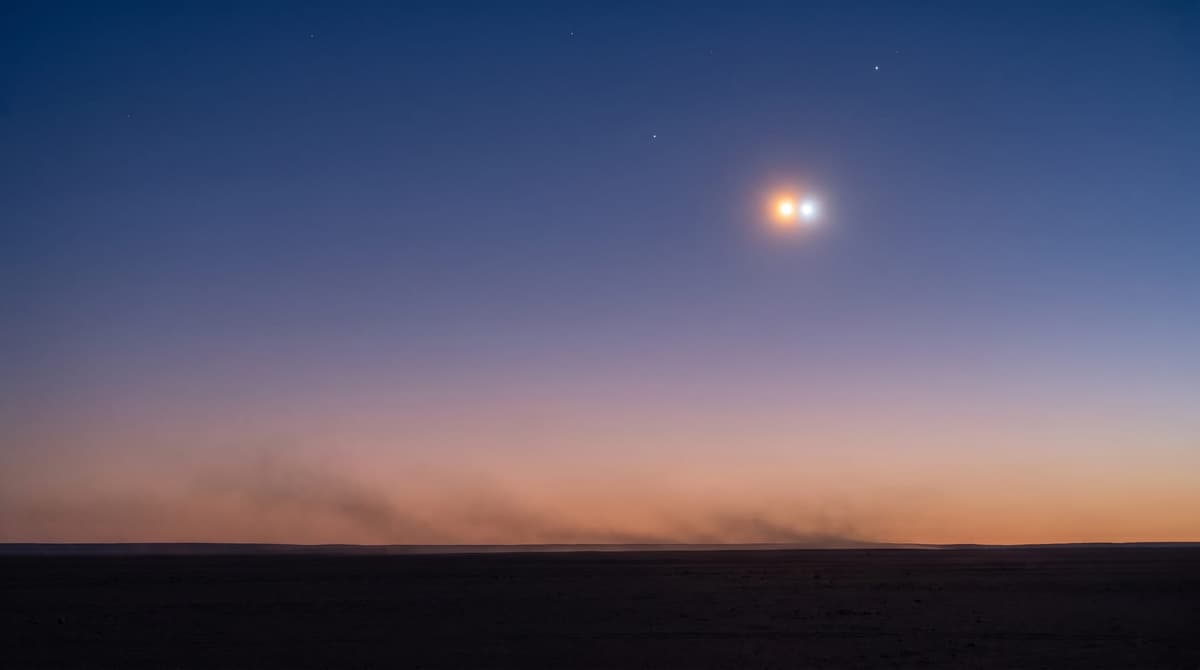
Conjunction — symbolic still life

How close is close

The orb decides the volume

A conjunction is rarely exact. The smaller the gap between the two planets — the orb — the louder the aspect plays. Here is roughly how the three bands read.

Tight

0–2°

Reads as a defining feature

At 0–2° the conjunction is exact and Venus and Mars work as a single composite planet. It becomes impossible to separate what is speaking in you at a given moment — the wish for contact or the wish to possess. In life this gives the most intense love stories and the most direct creative output through the body. Someone with a tight conjunction usually finds that a partner's allure and their physical desirability are stamped into one another: to want a person is to find them beautiful, and to register their beauty is already to want them.

Medium

2–5°

A steady background pattern

At 2–5° the conjunction is clearly marked and works steadily in love and creative life. You can feel the two planets separately, but they fuse quickly under any load — a strong impression appears and the desire switches on right behind the attraction. In synastry this band gives a steady physical pull that doesn't evaporate after a couple of months. In transit it opens a two- to three-week window of heightened personal charge.

Loose

5–8°

A faint colouring, felt in crises

At 5–8° the conjunction reads as proximity rather than fusion — a background note rather than the structure of the personality. You can tell the difference between liking someone aesthetically and actually wanting them. That makes for a more measured romantic nature: there is a pause, and there is a choice. In synastry a wide orb works more gently, without the sense of sexual inevitability. In transit it is simply a slightly more sensitive period, without the dramatic impulses.

Conjunction with a partner — what does it mean for the two of you?

A full synastry reading — every aspect between your two charts

Venus conjunction Mars inside one chart is an inner mechanism. Between two charts it becomes the dynamic of a relationship. Enter both birth details and get a synastry reading — where the conjunctions sit, where the squares pull, where the oppositions draw you together — all calculated with the Swiss Ephemeris. Read it as a way to notice patterns, not a forecast.

Check your compatibilityfrom £1 · for entertainment

Compare with a neighbouring aspect

Same planets, a different distance

Venus opposite Mars tells a different story. If you're reading this to make sense of a specific chart, it's worth glancing at the neighbouring aspect too.

Venus opposite Mars
  • A conjunction fuses Venus and Mars into one function; an opposition sets them at the two poles of an axis
  • The conjunction gives an automatic merging of desire and attraction; the opposition makes you reconcile them on purpose
  • In synastry the conjunction is powerful mutual attraction from both sides; the opposition pulls partners together through contrast
  • The conjunction is easier to live with but harder to see clearly; the opposition is harder to carry but yields more self-understanding
  • Under a transiting conjunction you want to act; under an opposition you want to choose between two attractions

Lived examples

A few charts where you can see it

Public figures with a verified Rodden birth-data rating (AA/A/B). No invented data.

Frequently asked questions

What does Venus conjunct Mars mean in the natal chart?
It is the principle of attraction and the principle of desire merged into one function. In your chart 'I like it' and 'I want it' work as a single thing — you rarely fall for someone without a sexual undertone, and you rarely want someone who doesn't appeal to you aesthetically. In practice this gives strong charisma, creative productivity through the body, and a leaning towards impulsive love stories. Read it as a pattern to notice in yourself, not a verdict on how your love life has to go.
Is Venus conjunct Mars good or bad in synastry?
It is strong physical attraction between two people from the very first meeting. That is wonderful for a couple wanting an affair with bright chemistry, and less helpful for a couple meaning to build a shared life, because the conjunction on its own says nothing about everyday routine, money or long-term fit. Treat it as a powerful start rather than the only thing holding you up. As always, this is a way to understand a relationship's patterns, not a prediction about it.
What orb should I use for Venus conjunct Mars?
The classical orb for a conjunction involving personal planets is up to eight degrees. A tight conjunction within two degrees works as a full fusion. A medium orb of two to five degrees gives a marked but still distinguishable merge. An orb of five to eight degrees is a background influence — the two planets sit near each other but don't dissolve into one another. Past about ten degrees the conjunction is considered to have dissolved.
Is Venus conjunct Mars different in a woman's chart and a man's?
Archetypally there is a difference of emphasis. In a woman's chart it tends to describe two threads at once — her own sexuality and the type of man who draws her — and the two often coincide, so she chooses partners who echo her own Venus–Mars dynamic. In a man's chart it speaks first of his sexual nature and the aesthetic of the women he is drawn to. None of this is destiny; it's a lens for noticing, and the rest of the chart shades it in.
Which sign is Venus conjunct Mars strongest in?
The most vivid expressions show in the signs ruled by Venus (Taurus, Libra) and the signs ruled by Mars (Aries, Scorpio). In fire signs it gives an open, declared passion; in water signs it runs deep and possessive; in earth signs it is sensual and steady; in air signs it is flirtatious and quick to move. The house it falls in matters as much as the sign, so the quick rule is only a starting point.
What should I do under a transiting Venus conjunct Mars?
Use the window for creative work, for reviving an existing relationship, for aesthetic projects, for meeting people. Try not to use it for irreversible decisions — break-ups, moving in with a new partner, expensive purchases made 'because I felt like it'. The transit moves off within two to three weeks, but the decisions stay. Read it as a short burst of heightened sensitivity, useful for what is already in motion, and let anything irreversible wait for a cooler stretch.
Does Venus conjunct Mars make a person jealous?
It can, especially when the conjunction is tight and especially in Scorpio, Taurus or Leo. Fusing desire with attraction makes a partner feel 'yours' at the level of the body, so any threat to that sense of belonging lands sharply. It is not inevitable, though — a conjunction in air signs, or one supported by easy aspects from Jupiter, works far more lightly. Knowing the reaction may come is half the work of not acting it out.
Can Venus conjunct Mars predict infidelity?
No single aspect predicts infidelity. The conjunction gives a strong sexual charge, but what a person does with it depends on the Moon, on Saturn, on aspects from the outer planets and, above all, on conscious choice. A conjunction in tense aspect with Uranus or Neptune raises the restlessness, but the conjunction by itself does not. Astrology here describes a tendency to be aware of, never a fixed outcome — treat it as self-reflection rather than a forecast.
Which celebrities have Venus conjunct Mars?
Madonna has Venus and Mars together in Virgo, David Bowie in Capricorn and Kim Basinger in Sagittarius with a wider orb. In each case the career is built on a fusion of aesthetics and sexuality as the central artistic instrument. If you want to check anyone yourself, look up their chart on astro.com's AstroDatabank at a Rodden rating of AA or A and see whether Venus and Mars sit within about eight degrees of each other.
How do I check Venus conjunct Mars in my own chart?
Open your natal chart and find the positions of Venus and Mars. If they sit in the same sign within eight degrees of each other, you have a conjunction. If they fall in neighbouring signs but are still under eight degrees apart — say Venus at 28° Aries and Mars at 2° Taurus — it counts as a conjunction 'across the sign cusp', working a little more weakly. Past about ten degrees the aspect has formally dissolved. For entertainment and self-reflection, that quick check is all you need.

Related pages

The other aspects between Venus and Mars

The same two planets at a different angle — each reads differently.

Oksana Miatova
Oksana Miatova

Astrologer, co-founder of WowAstro

Oksana Miatova is a practising astrologer and co-founder of WowAstro. Natal charts, synastry and forecasts grounded in the Western classical tradition — explained through real-life examples and plain language.

More about the author →

For entertainment and self-reflection only. Not medical, legal, financial or psychological advice. Consult a qualified professional for important decisions.